Key takeaways
- Thick, flat plate: A standard mag drill is usually at its best. Match cutter diameter and machine capacity, and keep the base fully seated.
- Thin plate: Verify the minimum thickness in the manual. Consider workpiece flex, breakthrough force, and whether the plate is firmly supported.
- Curved pipe or beam: A flat base may not make full contact. Use a machine and attachment specifically approved for curved surfaces, or reposition the work for a flat, secure mounting surface.
- Painted, rusty, or scaled steel: Clean the contact area where practical. Surface gaps can weaken the magnetic hold even when the steel is thick.
- Nonferrous metal: A standard magnetic base will not anchor to aluminum, copper, or stainless grades that are nonmagnetic. Use a different mounting approach.
Best Magnetic Drill Presses for Accurate Metalworking
The best magnetic drill press for most steel fabrication is a roughly 30–40 lb model with at least 1,000 lb of holding force, a 1¼-inch annular-cutter capacity, and a safety strap; choose a lighter, lower-capacity drill for overhead or ladder work, and a stronger machine when you need larger holes or more stability on thick plate.
Magnetic drills, or mag drills, are portable drills whose electromagnet anchors the machine to ferrous steel. The right choice depends less on headline magnet force alone than on the full setup: steel thickness and surface condition, cutter size, drilling direction, access, and the weight you must control. The figures below are useful comparison ranges, not specifications for a particular model; confirm exact limits in the manufacturer’s manual before buying.
Our top picks
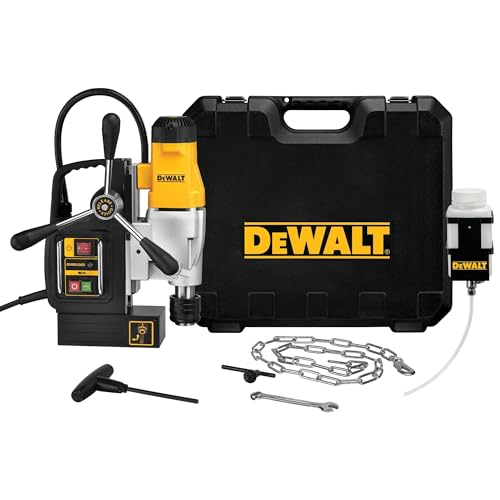


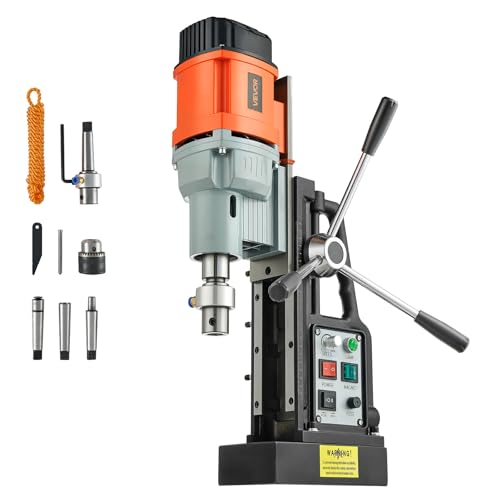
As an Amazon Associate we earn from qualifying purchases at no extra cost to you. Ratings are shown as listed on Amazon.
Choose by the job, not just the magnet rating
| Typical job | Useful capacity | Approximate machine weight | Holding-force target | What to prioritize |
|---|---|---|---|---|
| Light fabrication, small holes | Up to ¾-inch annular cutter | 20–30 lb | About 600–900 lb | Compact footprint, manageable carrying weight, safety strap |
| General structural-steel work | Up to 1¼-inch annular cutter | 30–40 lb | About 1,000–1,500 lb | Good balance of capacity, stability, and portability |
| Large holes or demanding production work | About 1½–2 inches | 40–60 lb or more | About 1,500–2,500 lb or more | Higher torque, rigid base, suitable cutting speeds |
| Overhead or frequent repositioning | Usually up to 1 inch | Preferably under 30 lb | Use the maker’s approved minimum for the setup | Low weight, strap, magnet-status warning, controlled handling |
Holding-force numbers are commonly measured under ideal conditions on clean, flat, sufficiently thick steel. Paint, rust, scale, a curved surface, an air gap, or thin plate can reduce the real-world grip substantially. A high advertised force does not make an unsuitable surface safe.
Matching the drill to steel thickness
Start with the workpiece, not the drill catalog. Check the minimum material thickness specified for the magnet, then account for the plate’s condition and shape. Thin sheet may flex under cutter pressure, and a magnet can have less secure contact than it would on a thick, flat beam. If the steel is below the manufacturer’s minimum, do not assume that a larger magnet or extra pressure will make the setup safe. Use an approved backing plate or another secure drilling method, if the manufacturer permits it.
- Thick, flat plate: A standard mag drill is usually at its best. Match cutter diameter and machine capacity, and keep the base fully seated.
- Thin plate: Verify the minimum thickness in the manual. Consider workpiece flex, breakthrough force, and whether the plate is firmly supported.
- Curved pipe or beam: A flat base may not make full contact. Use a machine and attachment specifically approved for curved surfaces, or reposition the work for a flat, secure mounting surface.
- Painted, rusty, or scaled steel: Clean the contact area where practical. Surface gaps can weaken the magnetic hold even when the steel is thick.
- Nonferrous metal: A standard magnetic base will not anchor to aluminum, copper, or stainless grades that are nonmagnetic. Use a different mounting approach.
What matters in a head-to-head comparison
Compact drill versus general-purpose drill
A compact drill is easier to carry up a ladder, maneuver between framing, and control overhead. The trade-off is usually a smaller cutter limit and less mass resisting torque. It suits repeated modest holes better than occasional holes at the machine’s maximum capacity. For a shop or structural-steel crew that needs a versatile daily tool, a midweight model with a 1¼-inch annular-cutter capacity is often the more practical balance.
General-purpose drill versus high-capacity drill
A high-capacity machine can drive larger cutters and may offer more power or speed options, but it is heavier and less convenient to position. If you rarely drill holes larger than 1 inch, the extra weight may create more hassle than value. For large-diameter work, verify that the drill’s rated capacity covers the specific cutter type and material—not just a maximum number in a headline.
Magnetic base versus vacuum or other anchoring systems
Magnetic drills require ferrous steel and reliable base contact. Other attachment systems may be available for particular applications, but they are not interchangeable by default. Follow the drill maker’s instructions for the exact surface, orientation, and accessory; never improvise a mount for overhead work.
Safety features worth paying for
- Safety strap or chain: Provides secondary restraint if the magnet loses grip. Anchor it to a suitable point, with slack controlled so it cannot snag.
- Magnet-status indicator or warning: Helps identify low or interrupted magnetic power. It is an alert, not a substitute for checking the base and using a strap.
- Motor interlock: Some designs prevent the motor from running unless the magnet is engaged. Check what the interlock actually monitors.
- Overload protection: Can help protect the motor during a bind, but correct feed pressure and cutter choice remain essential.
- Guard and chip control: A cutter guard, appropriate lubricant delivery, and manageable chip ejection reduce exposure to sharp swarf.
Secure the workpiece as well as the drill, wear eye and hearing protection, and keep hands and loose clothing away from rotating parts. Before cutting, confirm the magnet is energized, the base is fully seated, the strap is attached, and the cutter and pilot pin are installed correctly. Never rely on the magnet alone to support a drill overhead.
Buying checklist for the jobsite
- Capacity: Choose an annular-cutter rating that exceeds your usual hole size, with a suitable margin for the material and cutter.
- Weight and access: Include the drill, cutter, and accessories when planning how you will lift and position it. A 40 lb tool becomes more demanding when held away from the body or overhead.
- Stroke and clearance: Check the drill’s travel against the workpiece and cutter length. Tight structural spaces may rule out a capable machine with a bulky body.
- Power and speed: Confirm the supply available on site and whether the machine has an appropriate speed range for the cutter diameter and steel.
- Consumables and service: Check availability of compatible pilot pins, cutters, arbor parts, and replacement components.
- Typical budget: Entry-level mag drills often fall around $300–$600; professional general-purpose models commonly run about $600–$1,500, while heavy-duty or specialized machines can cost more. Prices vary by capacity and included accessories.
Bottom line
For mixed shop and field work, look first at a midweight magnetic drill rated for roughly 1¼-inch annular cutters, with a clearly specified holding force, magnet-status indication, and safety strap. Choose a lighter model when carrying and positioning are the main constraints; step up to a heavier, higher-capacity machine only when large holes are a regular requirement. Before purchase—and before every setup—verify the manufacturer’s minimum steel thickness and approved orientation for the surface you actually need to drill.