Key takeaways
- Primo and Avalon models cool slightly colder and hold more cold water per hour, which matters if you fill a 32 oz bottle multiple times after workouts or cooking.
- Brio Moderna models tend to run quietest due to improved compressor insulation, making them a better fit for studios or 10×12 ft home offices where the cooler is within 6 feet of your desk.
- Compact 34-inch units save floor space but require more bending to fill and often cannot maintain 37°F during continuous use; they are best for single-person use or as a secondary cooler.
- Empty weight of 26 to 38 lbs plus a full 5-gallon bottle (42 lbs) means the total loaded weight is 68 to 80 lbs. If you plan to move it for cleaning, choose a model with front casters.
The best bottom loading water cooler for most homes is a stainless-steel reservoir model with a 3- and 5-gallon compatible cabinet, a dispenser height around 40 to 42 inches, and a true child lock on the hot faucet, with top options coming from Primo, Brio, and Avalon in the usually $180–$380 range.
Our top picks

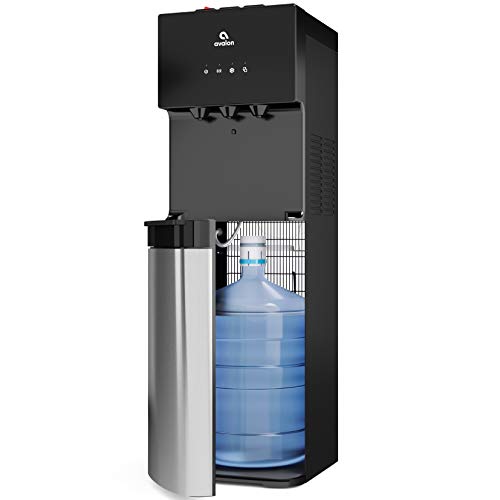

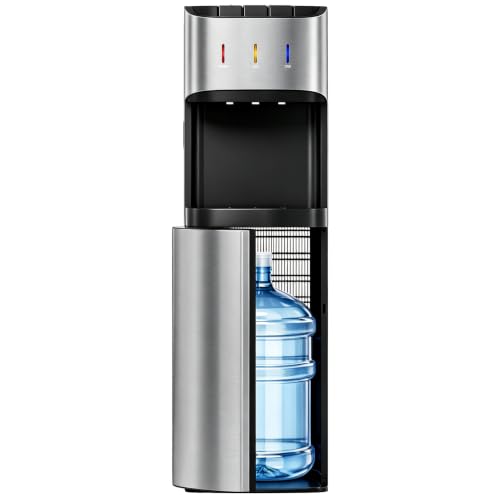
As an Amazon Associate we earn from qualifying purchases at no extra cost to you. Ratings are shown as listed on Amazon.
How to Choose a Bottom Loading Water Cooler: 6 Decision Criteria
Bottom loading coolers hide the bottle in a cabinet and pump water up, so you avoid lifting 42 lbs of water overhead. The right choice comes down to fit and daily use, not just hot/cold features.
1. Bottle Capacity and Cabinet Fit
Almost all bottom loading units accept both 3-gallon and 5-gallon bottles, but cabinet dimensions differ. A standard 5-gallon bottle is about 10.5 inches in diameter and 19.5 inches tall. Most cabinets offer 11 to 12 inches of interior width and 20 to 21 inches of interior height, but some compact cabinets only fit 3-gallon bottles without tilting. If you buy pre-filled bottles from a grocery exchange, measure your bottle before ordering and confirm the cooler lists 5-gallon compatibility, not just 3-gallon.
2. Dispenser Height and Ergonomics
Dispenser height determines whether you can fill a tall bottle without bending. Counter-height models sit at 33 to 35 inches, while full-size floor models sit at 40 to 44 inches. For comfortable one-handed filling, you want the spigot at least 38 inches from the floor and 4 to 5 inches of clearance under the spigot for a 10-inch reusable bottle. If the cooler will sit next to a kitchen counter (standard 36-inch height), a 41-inch tall unit keeps the spigots slightly above counter level and prevents spills over the edge.
3. Cooling Speed and Capacity
Look at cold tank size and compressor ratings, not just marketing claims. Most bottom loaders use a 0.8 to 1-gallon cold reservoir and a 0.3-gallon hot tank. A compressor system cools to 37–50°F and reheats to 180–190°F. Thermoelectric units are quieter but slower and often only cool to 50–59°F, which feels cool rather than cold. For a household of 3 to 4 people, a compressor model that delivers 0.8 gallons of cold water per hour will keep up with dinner and refills; a thermoelectric model will fall behind after 3 to 4 large glasses back-to-back.
4. Noise in Real Rooms
Compressors cycle on and off and produce 42 to 55 dB at 3 feet, about the level of a quiet refrigerator to a moderate conversation. In a 10×12 ft kitchen or home office, a 50+ dB unit is noticeable at night. If the cooler will sit in an open-plan living room or near a bedroom, prioritize models rated under 45 dB and with a night-mode or energy-saving switch that reduces cycling frequency.
5. Child Safety
All hot-water dispensers should have a two-step child lock: push-and-hold button or separate unlock slider plus press. Single-push locks are easy for a child to defeat. The safest designs also separate the hot and cold paddles by at least 2 inches and require distinct pressure on the hot side. If you have toddlers, avoid models with a single large push paddle that dispenses hot with one motion.
6. How Easily It Rolls Out for Replacement
Bottom loading is only easy if the cabinet opens and slides smoothly. The best designs use a full-extension tray or slide-out shelf on rollers that pulls the empty bottle forward without lifting the cooler. Check for three details: a front door that opens 90+ degrees, a tray that rolls on floor level (not a lift-over lip of 3 to 4 inches), and casters or a low-friction base so you can pull the entire unit away from the wall. Units without a tray require you to tip and drag a 30 to 45 lb cooler to swap bottles, which defeats the purpose.
Best Bottom Loading Water Coolers Compared
These types represent the most common and reliably available configurations in 2026. All are compressor-cooled, accept standard 3- and 5-gallon bottles, and include hot, cold, and room-temperature or cool options.
| Model Type | Bottle Fit | Height / Spigot Height | Cold Tank / Cold Temp | Noise at 3 ft | Child Lock | Empty Weight |
|---|---|---|---|---|---|---|
| Primo Bottom Loading (Stainless Steel Door, e.g. 601 series) | 3 and 5 gallon | 41.2 in / 40.5 in | 0.9 gal / 37°F | 44–47 dB | Two-step push-and-hold on hot | 32 lbs |
| Brio Moderna Touchless / Moderna Series (CLBL series) | 3 and 5 gallon | 41.5 in / 40.0 in | 1.0 gal / 39°F | 42–45 dB | Button lock + 2-step hot | 36 lbs |
| Avalon Bottom Loading (A5 / A6 series) | 3 and 5 gallon | 42.0 in / 41.0 in | 1.0 gal / 37°F | 43–46 dB | Separate child lock switch on hot | 38 lbs |
| Costway / Compact Bottom Loading (34–36 in class) | 3 gallon preferred, some 5 gallon | 34.5 in / 32.0 in | 0.7 gal / 42°F | 46–52 dB | Single-push hot lock | 26 lbs |
| Whirlpool Stainless Bottom Loading | 3 and 5 gallon | 40.8 in / 39.0 in | 0.8 gal / 38°F | 45–48 dB | Two-step hot lock | 34 lbs |
What the Table Means for Daily Use
- Primo and Avalon models cool slightly colder and hold more cold water per hour, which matters if you fill a 32 oz bottle multiple times after workouts or cooking.
- Brio Moderna models tend to run quietest due to improved compressor insulation, making them a better fit for studios or 10×12 ft home offices where the cooler is within 6 feet of your desk.
- Compact 34-inch units save floor space but require more bending to fill and often cannot maintain 37°F during continuous use; they are best for single-person use or as a secondary cooler.
- Empty weight of 26 to 38 lbs plus a full 5-gallon bottle (42 lbs) means the total loaded weight is 68 to 80 lbs. If you plan to move it for cleaning, choose a model with front casters.
Fit, Assembly and Moving Realities
Bottom loading coolers ship in a single box weighing 32 to 45 lbs and measuring roughly 16 x 16 x 42 inches. The box fits through any standard 30-inch interior doorway, but the assembled unit needs clearance to function.
- Leave 4 inches behind the unit and 2 inches on the sides for ventilation. Compressors vent hot air from the rear; blocking the gap raises noise and shortens compressor life.
- Allow 18 to 20 inches in front for the door to swing fully open and the tray to roll out. In a galley kitchen, avoid placing the cooler at the end of a run where the door hits a wall.
- Drip tray and bottle tray are the first parts to show wear. Drip trays warp or crack after 12 to 18 months of hot-water spills if not emptied daily; bottle trays collect water and develop mineral film. Rinse both weekly.
- Stainless steel reservoirs last longer than plastic reservoirs and do not retain taste after sanitizing. Plastic reservoirs are lighter and cheaper but can hold a faint plastic taste for the first few bottles and stain with sediment.
- Descale and sanitize every 3 months. Bottom loading pumps have a small silicone tube that can grow biofilm if you use well water or seldom change bottles.
Construction Trade-Offs
| Material / Feature | Pros | Cons | Best For |
|---|---|---|---|
| Stainless steel cold + hot tanks with stainless door | No taste transfer, resists corrosion, easier to sanitize | Heavier, usually $50–$100 more | Daily family use, well water, long-term ownership |
| Plastic-lined reservoir with metal exterior | Lighter, lower cost, adequate insulation | Can retain odors, may stain | Budget or rental use, lighter lifting needs |
| Double-wall plastic cabinet (compact models) | Compact footprint 12 x 12 in, easy to move | Less stable, louder, weaker insulation | Small kitchens, dorms, under 4 ft ceiling nooks |
| Push-paddle spigots | Fill any cup size quickly | Paddles snap with heavy use | High-volume households |
| Push-button electric dispense | Precise control, better child lock integration | Slower flow, requires power to dispense | Homes with kids and pets |
Decision Matrix: Which Cooler Fits Your Situation
| Your Situation | Priority Feature | Best Match | Why |
|---|---|---|---|
| Small apartment or 10×10 ft kitchen | Footprint under 13 x 13 in, low noise | Brio Moderna or compact 34-inch type if space is tight | Fits beside a 24-inch counter without blocking flow; under 45 dB avoids echo in small rooms |
| Kids and pets at home | True two-step child lock, separated paddles | Primo 601 series or Avalon A5/A6 | Hot water requires intentional two-step action; higher spigot keeps pet water bowls away from dispenser |
| Renters who move often | Lightweight, no plumbing, tray rolls out | Primo or Whirlpool 40–41 inch standard | 68–75 lbs loaded weight is manageable, no installation, slides out without tools |
| Back pain or limited lifting | Floor-level slide tray, full-extension door | Any full-size with pull-out bottle tray (avoid lip-style cabinets) | You slide, not lift, the 42 lb bottle at floor height |
| Home office or bedroom nearby | Quiet compressor, energy-saving mode | Brio Moderna series | Cycles less at night, stays under 45 dB at 3 feet |
| High-volume drinking (4+ people, athletes) | 1.0 gal cold tank, 37–39°F output | Avalon or Brio full-size | Maintains cold temp after 6 to 8 consecutive 12 oz servings |
Installation and Roll-Out Tips Most Listings Skip
Place the cooler on a hard, level surface. On carpet, the door may drag and the tray will not roll smoothly; use a 14 x 14 inch appliance mat or thin board underneath. When you swap bottles, turn off the hot switch 15 minutes before removal to avoid hot water sitting in the line, pull the tray fully forward, and wipe the probe and bottle cap with a sanitizer wipe. Prime the pump by pressing the cold paddle for 5 to 8 seconds after inserting a new bottle until water flows without sputtering. If you hear rapid clicking, the bottle is not pierced correctly or the pump is drawing air.
For power, all these units use a standard 110–120V outlet and draw 90 to 110 watts for cooling and 400 to 500 watts when heating. Avoid extension cords; the heater spike can trip a thin cord. Expect about $2 to $4 per month in electricity with normal household use if you use the energy-saving switch at night.
Frequently Asked Questions
Do bottom loading coolers need special bottles?
No. They use the same 3- and 5-gallon PET or polycarbonate bottles sold at grocery stores and water delivery services. The pump assembly comes with a universal cap adapter that pierces standard caps. Reusable 5-gallon bottles with a narrow 48mm neck are the most compatible.
How long does it take to get cold water after setup?
A compressor model with an empty cold tank needs 45 to 90 minutes to drop from room temperature to 37–42°F. The first bottle after installation takes longest because the tanks are warm. After that, recovery is 15 to 25 minutes after dispensing 0.5 gallons.
Can I use a bottom loading cooler without the hot function?
Yes. Turn the hot switch off on the back of the unit. Many households leave it off to save energy and as an extra child-safety step. You will still have cold and room-temperature water.
Will it fit under a kitchen cabinet or in a closet?
Floor models at 40 to 42 inches tall will not fit under a 36-inch counter or standard upper cabinets. They need open vertical space. Measuring the cooler as 12 to 14 inches wide by 12 to 14 inches deep by 41 inches tall is a safe planning size, plus the 4-inch rear gap for airflow.