
Key takeaways
- Choose the HyperX Cloud III wired if you want clear communication, low latency, broad compatibility, and low weight without paying for a battery.
- Choose the Audeze Maxwell if music-quality sound and very long battery life matter more than a light frame.
- Choose the SteelSeries Arctis Nova Pro Wireless if you switch between PC, PlayStation, Xbox, or mobile devices and value a dock, Bluetooth, and replaceable batteries.
- Choose the Astro A50 X if you own several consoles and want a central dock and switching system, provided its price and installation space fit your setup.
- Choose the Sony INZONE H9 if you want a comfortable wireless PlayStation-oriented headset with active noise cancellation for a busy room.
The best gaming headsets for clear game audio are the Audeze Maxwell for sound quality and battery life, SteelSeries Arctis Nova Pro Wireless for multi-platform convenience, and HyperX Cloud III for dependable wired performance at a lower price.
Choosing between them depends less on a single “best” model than on where and how you play. A headset for a quiet desk setup can prioritize wired audio and a lightweight frame, while a shared living room may benefit more from wireless range, a charging dock, and a microphone that rejects household noise.
Our top picks

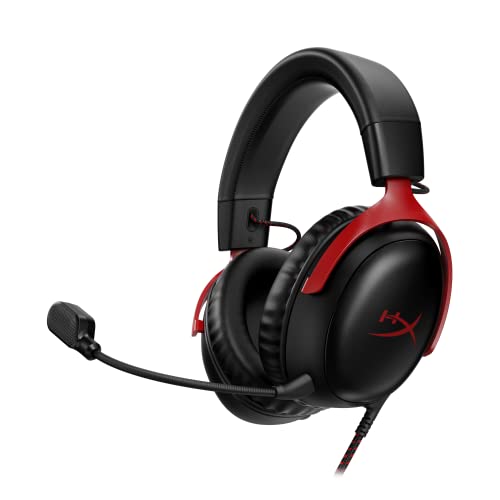


As an Amazon Associate we earn from qualifying purchases at no extra cost to you. Ratings are shown as listed on Amazon.
Best gaming headsets by situation
| Situation | Best fit | Why it works | Main compromise |
|---|---|---|---|
| Competitive PC gaming | HyperX Cloud III wired | Low-latency USB audio, clear positional effects, lightweight construction | No wireless freedom |
| Best overall wireless flexibility | SteelSeries Arctis Nova Pro Wireless | Wireless 2.4 GHz, Bluetooth, replaceable battery system, broad platform support | Expensive and heavier than basic wired models |
| Longest battery life | Audeze Maxwell | Planar-magnetic drivers and battery life measured in dozens of hours rather than a single day | Large, heavy ear cups |
| Console and TV setup | Astro A50 X | Docking station and HDMI switching simplify several-console setups | High price and more desk equipment |
| PlayStation with active noise cancellation | Sony INZONE H9 | Comfortable closed-back design, wireless USB connection, Bluetooth and noise cancellation | Less universally convenient outside Sony-focused setups |
Wired versus wireless gaming headsets
When wired is the better choice
A wired headset remains the simplest route to consistent game audio. It does not need charging, has no wireless interference, and usually costs less for comparable microphone and driver quality. USB models such as the HyperX Cloud III provide digital processing and microphone controls, while 3.5 mm models can work with a PC, PlayStation controller, Xbox controller, Nintendo Switch, phone, or another analog output.
Wired connections are particularly useful for competitive games where you want predictable latency. The practical drawbacks are cable management and the risk of pulling a console or laptop from a desk. Measure the distance from your seating position to the computer or console before buying: a 6-foot cable is comfortable at a desk, but may be restrictive from a sofa several feet away. A USB extension can help, although long, poorly made extensions may introduce connection problems.
When wireless is worth paying for
Wireless headsets make sense when you move between a desk, sofa, or TV, or when a cable would cross a walkway. Gaming models generally use a USB wireless transmitter for low-latency audio; Bluetooth is useful for a phone or laptop but can add delay and is not always available on consoles. The SteelSeries Arctis Nova Pro Wireless and Audeze Maxwell are strong examples of this two-connection approach.
Check the transmitter and console requirements carefully. Some models support PC and PlayStation but need a separate Xbox version. Others provide only Bluetooth for mobile devices. A headset advertised as “multi-platform” may still require moving a USB dongle, changing a switch, or using a controller cable between systems.
Audio, microphone, and surround-sound differences
Clear game audio starts with balanced tuning rather than maximum bass. Excessive low-end can make explosions impressive but obscure footsteps, reload sounds, and dialogue. Closed-back ear cups usually provide stronger isolation in a noisy room, while open-back designs can sound spacious but allow sound in and out; open-back headsets are less suitable for shared bedrooms or living rooms.
The Audeze Maxwell uses planar-magnetic drivers and is aimed at listeners who value detailed music and game sound, although its weight is noticeable. The HyperX Cloud III emphasizes clear positional cues and a comparatively easy fit. The SteelSeries Arctis Nova Pro Wireless adds adjustable equalization through its base station, which is useful if one preset sounds too bass-heavy for your games.
Virtual surround sound can improve spatial awareness, but it is not automatically better than stereo. Processing may make front and rear sounds easier to separate in some games and less natural in others. Start with the game’s own headphone or stereo mode, then compare the headset’s surround setting using the same short section of gameplay. Avoid running multiple spatial systems at once, such as console surround processing plus headset surround, because the result can sound hollow or inaccurately positioned.
Microphone clarity depends on more than the word “noise cancellation.” A boom mic positioned 2–3 cm from the corner of your mouth usually sounds clearer than one several centimeters away. A flexible boom that can be rotated out of the way is more useful than an excellent microphone with poor positioning. For calls in a room with a keyboard, fan, or family activity, software noise reduction can help, but aggressive processing may cut off quiet words.
Comfort: weight, clamping force, and room setup
Headset weight becomes important during long sessions. Lightweight wired models often fall around 270–310 grams, while feature-rich wireless models commonly range from about 330–450 grams. Battery, metal hinges, large drivers, and a wireless radio add weight. The Audeze Maxwell is built for substantial audio hardware and is notably heavier than the HyperX Cloud III; that trade-off may be worthwhile for sound quality but not for every neck or shoulder.
| Specification to check | Comfortable target for many users | Why it matters |
|---|---|---|
| Headset weight | Under 320 g for maximum long-session ease | Less pressure on the head and neck |
| Ear-cup opening | At least about 60 × 40 mm for medium-sized ears | Reduces contact with the outer ear |
| Wireless range | 10–12 m in a typical unobstructed home | Enough for desk-to-sofa movement, but walls reduce it |
| Battery life | 25 hours minimum; 50+ hours for frequent players | Reduces charging interruptions |
| Desk clearance | Keep at least 75 cm of clear legroom below the front edge | Prevents the cable or chair from catching on furniture |
For a small 10 × 12-foot room, a wireless range of 10 meters is normally more than sufficient, but the transmitter should not be buried behind a metal PC case or cabinet. In a shared room, choose a closed-back headset and place the wireless dock or USB transmitter in clear view of the seating area. If your chair sits beneath a compact desk, route a wired cable along the rear edge rather than across the floor.
Battery life and charging habits
Battery estimates vary with volume, microphone use, lighting, and wireless mode. A headset advertised for 80 hours may deliver less with active features enabled, while a 20-hour model can still be practical if it supports use while charging. The Audeze Maxwell is known for exceptionally long battery life, whereas many midrange wireless models provide roughly 20–40 hours.
A charging dock is convenient because it gives the headset a visible storage location and makes charging part of putting it away. A replaceable battery system, as used by the Arctis Nova Pro Wireless, is even more useful for people who play for long stretches: one battery can charge while the other is in use. Do not store a wireless headset under cushions or in a closed cabinet while charging, because heat needs to escape.
Which headset should you buy?
- Choose the HyperX Cloud III wired if you want clear communication, low latency, broad compatibility, and low weight without paying for a battery.
- Choose the Audeze Maxwell if music-quality sound and very long battery life matter more than a light frame.
- Choose the SteelSeries Arctis Nova Pro Wireless if you switch between PC, PlayStation, Xbox, or mobile devices and value a dock, Bluetooth, and replaceable batteries.
- Choose the Astro A50 X if you own several consoles and want a central dock and switching system, provided its price and installation space fit your setup.
- Choose the Sony INZONE H9 if you want a comfortable wireless PlayStation-oriented headset with active noise cancellation for a busy room.
Typical prices range from about $70–$120 for a good wired headset, $150–$250 for a capable wireless model, and $300–$400 for premium wireless systems with docks, advanced drivers, or console switching. Before buying, confirm the exact console version, measure your cable route or wireless seating distance, and check the ear-cup opening as carefully as the advertised surround-sound features.


