Key takeaways
- Useful operating range: approximately 400°F to 500°F for cooking, adjusted for dough thickness and moisture.
- Low-end range: around 100°F to 200°F is helpful for warming, but is not essential.
- Power: around 1,000 to 1,500 watts is suitable for a household 120-volt outlet.
- Recovery: the surface should return to cooking temperature after a cool piece of dough is placed on it.
- Temperature light: useful as a preheat indicator, but it does not prove that every part of the plate is equally hot.
The best lefse grill for Norwegian flatbread is usually a 16-inch electric lefse grill with a cast-aluminum cooking plate, a controllable thermostat reaching at least 500°F, and a stable heating element that covers the center rather than concentrating heat in one small spot.
Our top picks


As an Amazon Associate we earn from qualifying purchases at no extra cost to you. Ratings are shown as listed on Amazon.
Best lefse grill choices by situation
| Situation | Best choice | Why it fits | Trade-off |
|---|---|---|---|
| Frequent family lefse making | 16-inch dedicated electric lefse grill | Large enough for traditional rounds and offers useful edge clearance | Takes about 20 x 20 inches of counter space while in use |
| Small kitchen or apartment | 12-inch electric griddle | Usually easier to store and less expensive | Requires smaller lefse rounds or more trimming |
| Large holiday batches | 20-inch commercial-style griddle | More room for large rounds and repeated turning | Heavy, expensive, and difficult to store in a standard cabinet |
| Occasional use | Removable-thermostat electric griddle | Can also cook pancakes, tortillas, eggs, and grilled sandwiches | Often has less even heating at the outer edge |
Our top pick: a 16-inch dedicated lefse grill
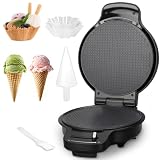
A 16-inch dedicated grill, such as the Bethany Housewares 16-inch Lefse Grill, is the best all-around format for Norwegian flatbread. It accommodates the roughly 12- to 14-inch rounds commonly rolled for home cooking while leaving enough exposed surface to turn the dough without dragging it against the rim.
Look for a model with a temperature range of approximately 100°F to 600°F and at least 1,000 watts of power. Lefse generally cooks in the mid-to-high temperature range, but the lower settings are useful for warming finished pieces, drying a lightly damp cloth, or making other flatbreads. A maximum temperature below about 450°F may still work, but it gives you less flexibility and may make browning slower.
The main advantage of a dedicated lefse grill is the shallow, unobstructed cooking surface. Unlike a frying pan, it has no sloped sides to catch a delicate round as you slide it on or off. Unlike many large griddles, it is designed around one broad flatbread rather than several small items.
Head-to-head: 12-inch, 16-inch, and 20-inch grills
| Grill size | Usable cooking area | Approximate counter footprint | Best dough-round size | Typical weight range |
|---|---|---|---|---|
| 12 inches | About 113 square inches | 15 x 15 inches | 8–10 inches | 5–9 lb |
| 16 inches | About 201 square inches | 20 x 20 inches | 12–14 inches | 8–14 lb |
| 20 inches | About 314 square inches | 24 x 24 inches | 16–18 inches | 15–25 lb |
These figures describe practical cooking space rather than only the advertised diameter. Handles, controls, and the power cord add to the footprint. Leave at least 6 inches of clearance on every side during use, and keep the grill away from the wall, curtains, and overhead cabinets. A 16-inch unit therefore needs a counter zone roughly 32 inches wide and deep for comfortable, safe operation.
Choose 12 inches if cabinet space is limited or your family makes small lefse. Choose 16 inches if you want traditional-sized rounds without moving to commercial equipment. Choose 20 inches only when you regularly make large batches and have a permanent storage location.
Temperature control and heat consistency matter more than maximum heat
Lefse needs enough heat to cook the potato-based dough quickly without turning it brittle. A usable thermostat is more important than a very high advertised temperature. Look for a dial or control that changes gradually rather than a simple low-medium-high switch.
- Useful operating range: approximately 400°F to 500°F for cooking, adjusted for dough thickness and moisture.
- Low-end range: around 100°F to 200°F is helpful for warming, but is not essential.
- Power: around 1,000 to 1,500 watts is suitable for a household 120-volt outlet.
- Recovery: the surface should return to cooking temperature after a cool piece of dough is placed on it.
- Temperature light: useful as a preheat indicator, but it does not prove that every part of the plate is equally hot.
Heat consistency is affected by the plate material and the location of the heating element. Cast aluminum heats quickly and is relatively light, but can develop cooler zones near the perimeter. A thicker plate holds heat better but increases warm-up time and weight. Thin stamped metal is inexpensive and heats quickly, yet is more likely to show hot spots or lose temperature when several rounds are cooked in succession.
Construction trade-offs
| Surface or construction | Advantages | Drawbacks |
|---|---|---|
| Cast aluminum plate | Good heat response, relatively light, common on dedicated lefse grills | Can warp if overheated or cooled abruptly; coating requires gentle tools |
| Uncoated cast iron | Excellent heat retention and durability | Very heavy, slower to preheat, needs seasoning, and may stick to moist dough |
| Nonstick-coated metal | Easy release and quick cleanup | Can scratch; metal turners and abrasive pads shorten its life |
| Stainless or painted steel housing | Protects controls and is easy to wipe clean | Housing quality does not necessarily indicate even cooking |
Storage, moving, and durability realities
Measure the storage path, not just the cabinet. A 16-inch grill with side handles may be 20 to 22 inches wide, and its cord or thermostat may prevent it from standing vertically. A standard 24-inch-deep base cabinet generally has enough depth, but the door opening may be narrower than the interior. Do not store a heavy grill above shoulder height where it could fall during removal.
Expect a dedicated 16-inch unit to weigh about 8 to 14 pounds. That is manageable for one person, but awkward when carrying it with hot equipment nearby. A 20-inch model can weigh 15 pounds or more and may need two hands. Before a holiday cooking session, clear a counter close to the storage area so you do not carry the grill across the kitchen while it is hot.
The parts most likely to wear first are the nonstick surface, thermostat contacts, power cord, and plastic feet or handles. Use a wooden or heat-safe nylon turner, never a sharp metal spatula. Avoid stacking heavy cookware on the plate. If the thermostat is detachable, remove it before washing or storing the grill, and keep the connection dry.
Cleanup: choose a simple surface over extra features
Lefse flour can burn into a thin, sticky film, especially when excess flour remains on the plate between rounds. The easiest grill to maintain has a smooth, slightly rounded surface with no deep grooves, removable drip channels, or seams around the cooking area.
- Unplug the grill and let it cool until it is warm, not hot.
- Brush away loose flour with a dry, soft brush or paper towel.
- Wipe the plate with a damp cloth and a small amount of mild dish soap if needed.
- Use a plastic scraper for stubborn residue; avoid steel wool and abrasive powders.
- Dry the surface completely before storing.
Never immerse an electric grill unless the manufacturer specifically identifies the removable plate as washable. A detachable thermostat must also stay out of water. Removable plates are convenient, but their seams can collect flour and moisture; a fixed, smooth plate is often faster to clean after lefse making.
What to buy
For most households, select a 16-inch dedicated lefse grill with a smooth cast-aluminum or thick coated-metal surface, a thermostat reaching at least 500°F, a visible preheat indicator, sturdy nonslip feet, and a detachable control if available. A 12-inch model is the practical choice for limited storage or small rounds. A 20-inch grill is worthwhile only for frequent large-batch cooking, where its additional space offsets the higher price, weight, and storage demands.
Household lefse grills usually fall in the general market range of about $70–$180, while larger or commercial-style units commonly cost about $180–$400 or more. Spend the extra money on plate stability, thermostat quality, and a surface that is easy to clean rather than on decorative controls or unused accessories.