
Key takeaways
- Keep the fire pit at least 10 feet from buildings, fences, overhanging branches, and combustible storage unless local rules or the manufacturer require more.
- Do not use a wood-burning pit on a wooden deck, artificial turf, dry grass, or a covered porch unless the unit is specifically approved for that surface and an appropriate heat shield is installed.
- Use a level, noncombustible surface such as concrete, brick, stone, or compacted gravel. Check whether heat can transfer through gaps in a paver surface.
- Allow at least 24 inches between the pit rim and the nearest chair, and keep a 30-inch route clear around the seating area.
- Keep the pit away from fabric cushions, curtains, umbrellas, and low tree limbs; floating embers can travel farther than expected in wind.
- Check local burn bans, air-quality restrictions, and homeowners-association rules before buying. A product can be well designed yet prohibited in your area.
The best wood burning fire pits are the ones whose bowl size, steel construction, airflow, smoke management, and safety clearance match your patio rather than simply producing the largest flame.
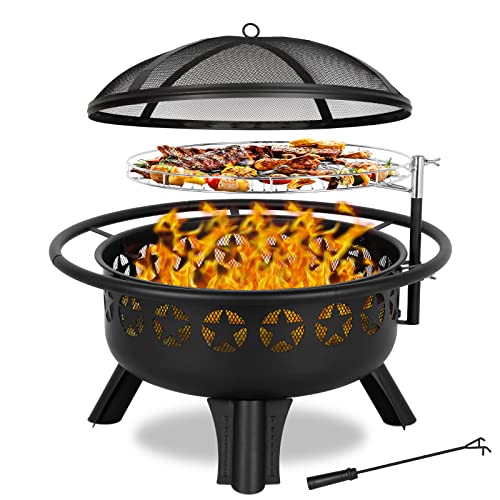
For most homes, a 24- to 30-inch steel bowl is the best all-purpose choice: it provides enough heat for four to six people, remains movable by two adults, and fits more patios than a 36-inch pit. Choose a raised, screened model for a compact patio, a deeper pit with strong airflow for a larger yard, or a portable 19- to 22-inch model if storage and moving matter more than maximum heat.
Our top picks


As an Amazon Associate we earn from qualifying purchases at no extra cost to you. Ratings are shown as listed on Amazon.
Best wood burning fire pits by outdoor situation
| Situation | Best configuration | Useful dimensions or specifications | Why it fits |
|---|---|---|---|
| Small patio or apartment terrace | Compact raised bowl with spark screen | 19–24 inch diameter; under 35 lb; 12–18 inch height | Uses less floor space and is easier to store between uses |
| Family with children or pets | Wide, stable bowl with fitted screen and safety rim | 24–30 inch diameter; broad legs; screen handle; low tipping risk | Reduces access to embers and gives the bowl a more stable footprint |
| Renter or frequent mover | Lightweight steel bowl with removable legs | 19–26 inch diameter; 20–40 lb; nesting or fold-flat parts | Can be carried through a doorway and stored without permanent installation |
| Large backyard entertaining | Deep, heavy-gauge bowl or smokeless-style pit | 30–36 inch diameter; 8–14 inch internal depth; 45–100 lb | Holds longer logs and provides more heat for six or more people |
| Back pain or limited lifting ability | Raised bowl with wheels or a permanent masonry surround | 18–24 inch rim height; total weight under 45 lb if movable | Reduces bending and avoids lifting a heavy, low pit from the ground |
Bowl or pit: which shape is better?
Fire pit bowls
A bowl has a curved basin and usually a separate base or legs. Its sloped sides direct logs toward the center, making it easier to build a controlled fire. Bowls also drain rain better than flat-bottomed boxes and can be lifted or carried when they are small enough.
A 24-inch bowl typically needs about 6 feet of usable diameter once you include a safe sitting zone. A 30-inch bowl needs closer to 7 feet. That calculation matters on a 10-by-12-foot patio: a 24-inch bowl can work with four compact chairs, while a 36-inch bowl may leave uncomfortable walking space and force furniture too close to the heat.
Fire pit tables and square pits
A square or rectangular pit often offers a wider rim for setting drinks, but its corners consume space and may be harder to cover. Many are low to the ground, which can be inconvenient for people who have difficulty standing. A pit table with an 18- to 24-inch tabletop height is more comfortable for seated use than a 10-inch ground-level model, although the higher sides can block some radiant heat.
For conversation, keep the nearest chair edge at least 24 inches from the outer rim when the manufacturer permits that arrangement. Leave a 30-inch walking route behind chairs, and avoid placing a fire pit where someone must pass between the flame and a chair.
Steel types and what they mean in practice
| Construction | Advantages | Trade-offs | Best use |
|---|---|---|---|
| Painted carbon steel | Affordable, relatively light, widely available | Finish eventually blisters or rusts; needs a dry cover | Budget buyers who can store the pit under cover |
| High-temperature coated steel | Better initial corrosion and heat resistance than ordinary paint | Coating can discolor or chip around the fire bowl | Patios needing a cleaner appearance for several seasons |
| Stainless steel | Resists rust and is easier to clean | Usually costs more; thin sheets can warp or discolor | Coastal climates or uncovered locations, if the grade is specified |
| Corten or weathering steel | Develops a protective rust-colored surface and can be very durable | Heavy; runoff can stain concrete, stone, or light paving | Permanent landscape installations on stain-resistant surfaces |
Gauge numbers are not always comparable between manufacturers, so look for actual sheet thickness where it is provided. A heavier bowl resists warping but becomes difficult to move. A 24-inch bowl weighing 25–40 pounds is manageable for many households; a 36-inch model weighing 70 pounds or more is effectively a fixed feature unless it has wheels or a dedicated cart.
Airflow and smoke control: the features that matter
Wood fires need oxygen entering below or around the fuel and a clear path for hot gases to rise. Look for drainage and ventilation holes beneath the fire grate, openings around the lower bowl, and enough space between the grate and the base for ash to fall away from the logs.
Many “smokeless” fire pits use a double-wall design. Air enters lower vents, warms inside the wall, and exits through upper holes where it helps burn some smoke. This can reduce visible smoke after the fire is hot, but it does not make the fire smoke-free. Damp wood, oversized logs, restricted airflow, or a poorly established fire can still produce substantial smoke.
For cleaner burning, use dry split hardwood with moisture content around 20 percent or less, keep logs shorter than the internal diameter, and avoid packing the chamber tightly. A taller, narrow pit often creates a stronger draft, while a wide shallow bowl is easier to tend but may smoke more when overloaded.
Spark screens, covers, and ember control
A spark screen is essential where wind, dry vegetation, children, or nearby upholstery create additional risk. Choose a screen that overlaps the rim by roughly 1–2 inches, has a heat-resistant handle, and can be lifted without placing your hand above the flame. Fine metal mesh catches more embers but can clog with soot; coarse mesh improves airflow but allows larger sparks through.
A fitted weather cover protects the bowl from rain, but never place it over a hot fire or even warm ashes. Allow the pit to cool completely, remove ash according to the manufacturer’s instructions, and then cover it. A cover does not replace a spark screen, and a screen does not make a fire pit safe beneath a roof.
Patio clearance and surface requirements
- Keep the fire pit at least 10 feet from buildings, fences, overhanging branches, and combustible storage unless local rules or the manufacturer require more.
- Do not use a wood-burning pit on a wooden deck, artificial turf, dry grass, or a covered porch unless the unit is specifically approved for that surface and an appropriate heat shield is installed.
- Use a level, noncombustible surface such as concrete, brick, stone, or compacted gravel. Check whether heat can transfer through gaps in a paver surface.
- Allow at least 24 inches between the pit rim and the nearest chair, and keep a 30-inch route clear around the seating area.
- Keep the pit away from fabric cushions, curtains, umbrellas, and low tree limbs; floating embers can travel farther than expected in wind.
- Check local burn bans, air-quality restrictions, and homeowners-association rules before buying. A product can be well designed yet prohibited in your area.
Portability, assembly, and durability realities
Measure the complete route from delivery point to patio. A box containing a 30-inch bowl may be 34–40 inches wide, which can fail through a narrow gate or doorway even when the assembled legs are removable. Confirm the packaged weight, not just the listed product weight, and plan on two adults for most bowls above 35 pounds.
Assembly is usually simple, but the first parts to wear are predictable: painted rims discolor, grate bars deform, mesh screens collect scale, and bolts on outdoor legs corrode. Stainless hardware and replaceable grates are worthwhile upgrades. For a steel bowl, empty ash only after it is cold, keep moisture from sitting inside, and touch up exposed carbon steel with high-temperature coating rather than ordinary paint.
How to choose your final size
Start with the people who will use it, not the maximum log length. Choose 19–24 inches for two to four people and easy storage, 24–30 inches for typical family use, and 30–36 inches for larger groups and longer burns. Then subtract the required seating and walking clearances from your available patio dimensions. If the remaining space feels tight on paper, it will feel tighter once chairs, firewood, and people are present.
For the majority of patios, the best wood burning fire pits balance a 24- to 30-inch diameter, sturdy but movable steel construction, a raised grate, useful lower vents, a fitted spark screen, and a weather cover. Select the lighter end of that range for renting or frequent storage, and the heavier, deeper end for a fixed backyard gathering area.


