
Key takeaways
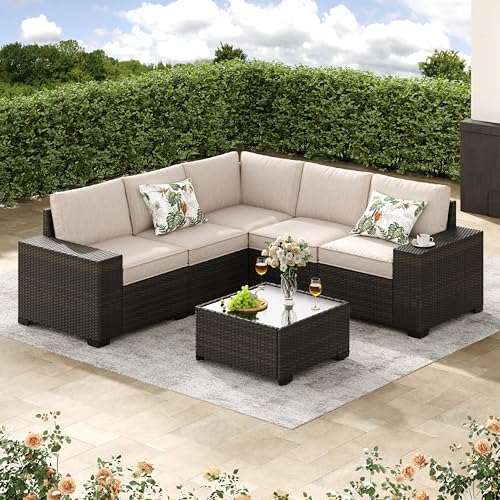
- The best outdoor sectional sofas are the ones that match your patio’s usable dimensions, climate, maintenance tolerance, and preferred seating layout—not necessarily the largest or most expensive set. Our top picksTop pickJing's Villa 6-Piece Patio Furniture SetCheck price on AmazonAlso…
The best outdoor sectional sofas are the ones that match your patio’s usable dimensions, climate, maintenance tolerance, and preferred seating layout—not necessarily the largest or most expensive set.
Our top picks


As an Amazon Associate we earn from qualifying purchases at no extra cost to you. Ratings are shown as listed on Amazon.
Best Outdoor Sectional Sofas by Patio Situation
| Patio situation | Best sectional type | Prioritize | Watch out for |
|---|---|---|---|
| Small apartment balcony or compact patio | Two-piece loveseat or armless modular sectional | 70–84-inch width, shallow 28–32-inch depth, lightweight aluminum frame | Deep cushions that consume walkway space |
| 10 × 12-foot patio | L-shaped three- or four-seat sectional | 84–110-inch long side, 60–80-inch return, 30–36 inches of circulation | Oversized corner units that block doors |
| Large entertaining area | Modular U-shaped or reversible sectional | Removable pieces, 120–180-inch total span, extra ottoman seating | Heavy modules that cannot be rearranged or stored |
| Children and pets | Powder-coated aluminum or resin-wicker sectional | Solution-dyed fabric, removable washable covers, rounded edges | Loose-weave fabric and untreated wood |
| Frequent rain or humid climate | Raised aluminum or synthetic-resin frame | Quick-dry foam, drainage gaps, breathable covers, rust-resistant hardware | Standard indoor foam and cushions left wet under a cover |
| Renter or frequent mover | Tool-light modular sectional | Individual pieces under about 55 pounds, narrow modules, reversible connectors | One-piece frames and oversized boxed deliveries |
Choose the Right Seating Layout
An L-shaped sectional is the most practical choice for many patios because it seats three to five people while leaving one side open for entry. It works particularly well against a wall or along the corner of a deck. A reversible chaise-style configuration gives more flexibility, but confirm that the chaise can be moved without removing the entire frame.
A U-shaped sectional creates the most conversational seating, usually for five to seven people, but it needs a large, relatively square patio. Leave at least 30 inches for a normal walking route and 36 inches where people pass between the sofa and a door, grill, or dining table. If the sectional faces a coffee table, allow approximately 16–18 inches between the front edge of the seat and the table.
A modular sectional is the best layout when your needs change. Separate corner, armless, ottoman, and end units can form an L, U, or two facing sofas. The trade-off is that connectors must be sturdy and easy to operate. Weak clips allow pieces to drift apart, while permanently bolted modules are difficult to rearrange.
Measure the patio before choosing a configuration
Measure the usable area after accounting for railings, posts, steps, door swings, planters, and grill clearance. A sectional advertised as 100 inches wide may require more than 106 inches once you include arm overhang and space to walk around it. Check the assembled depth as well: a 36-inch-deep sofa can leave very little room on a balcony that is only 60 inches deep.
For a 10 × 12-foot patio, a sectional about 90–105 inches on its longest side and 65–75 inches on its return is usually easier to live with than a 120-inch model. Keep at least 18 inches between the sofa and a coffee table, and avoid placing cushions where they obstruct a door’s opening arc.
Frame Materials: The Important Trade-Offs
| Frame material | Strengths | Weaknesses | Best for |
|---|---|---|---|
| Powder-coated aluminum | Lightweight, rust-resistant, easy to move, available in many shapes | Can dent; hollow frames may feel less substantial in high wind | Rainy climates, renters, balconies, modular furniture |
| Stainless or galvanized steel | Strong and stable, often less expensive than premium hardwood | Can rust if the coating or welds are damaged; heavier than aluminum | Windy patios and high-use seating |
| Teak or other naturally durable hardwood | Warm appearance, heavy and stable, can last for years with proper care | Heavy, expensive, and prone to color change, checking, and surface stains | Traditional patios where appearance and weight matter |
| HDPE lumber or recycled plastic | Does not rust, resists moisture, and needs little refinishing | Very heavy; can become hot in direct sun | Permanent outdoor seating and low-maintenance households |
| Resin wicker over a metal frame | Lightweight look, comfortable texture, broad style selection | Wicker strands can split or fade; the hidden frame determines longevity | Covered patios and moderate climates |
Engineered wood panels and indoor-grade particleboard should not be treated as equivalent to outdoor-rated hardwood or HDPE lumber. They can swell at fasteners and edges after repeated wetting. If a wood sectional uses screws, inspect whether the hardware is stainless steel or corrosion-resistant and whether the feet keep the frame off standing water.
Cushion Fabric and Foam Matter More Than the Pattern
Solution-dyed acrylic is a strong all-purpose cushion fabric because its color is integrated into the fibers rather than applied only to the surface. It generally handles ultraviolet exposure better than ordinary polyester and dries more predictably. Solution-dyed polyester can also be a good value, especially for a covered patio, but quality varies considerably by weave, coating, and fabric weight.
Olefin is often comfortable and fade-resistant for the price, though it may feel less luxurious and can be less resistant to abrasion than premium acrylic. Avoid assuming that a label saying “water-resistant” means the cushion is waterproof. It usually refers to the fabric surface, not the foam core or seams.
Standard polyurethane foam is comfortable but can retain water. Quick-dry foam uses a more open structure that allows water to drain through the cushion, reducing mildew risk after rain. It usually costs more and still needs ventilation. A waterproof cover placed over wet cushions can trap moisture rather than solve the problem.
| Feature | Useful target | Why it matters |
|---|---|---|
| Seat height | 16–19 inches without compression | Lower seats feel lounge-like; taller seats are easier to stand from |
| Seat depth | 20–24 inches for upright sitting; 25–30 inches for lounging | Deep seats may be uncomfortable for shorter adults without throw pillows |
| Seat cushion thickness | 4–6 inches | Thicker cushions generally provide better initial comfort, but support depends on foam quality |
| Coffee-table height | 16–18 inches | Keeps drinks and plates within reach without turning the table into a dining surface |
| Dining-height outdoor table | 28–30 inches | Requires a more upright sectional or separate dining chairs |
Weather Resistance and Maintenance
Look for drainage holes, slatted or mesh support under cushions, elevated feet, UV-resistant fabric, and corrosion-resistant fasteners. These details are more useful than a broad claim such as “all-weather.” In a freeze-thaw climate, bring cushions indoors and avoid leaving water pooled inside frames. In coastal areas, rinse salt deposits from metal regularly, even when the frame is advertised as rust-resistant.
Use a breathable furniture cover that fits without sealing moisture underneath. Remove cushions during extended rain, brush off leaves before they stain, and inspect frame joints at least twice a year. The first parts to wear are commonly cushion seams, hook-and-loop attachments, plastic glides, wicker corners, and powder coating around scratches—not necessarily the main frame.
Assembly, Delivery, and Moving Reality
Outdoor sectionals commonly arrive as several cartons, with each module weighing roughly 25–55 pounds; hardwood and HDPE pieces may weigh more. Check the package dimensions before ordering. A carton wider than 36 inches may not pass through a narrow hallway or apartment lift, even if the assembled sofa fits the patio.
Expect to attach legs, arms, backs, clips, or corner connectors. Assembly is easier when the parts are labeled and the fasteners are accessible from above rather than underneath the frame. Do not fully tighten every bolt until the frame is aligned; tightening too early can make later holes appear mismatched. For a large sectional, two adults are usually needed to align corner pieces without twisting the frame.
Before delivery, measure the narrowest doorway, stair landing, gate, and elevator entrance. If the patio is upstairs, confirm whether the individual modules can be carried safely. A beautiful sectional that cannot be moved through the home is a poor long-term choice for a renter.
Which Outdoor Sectional Should You Buy?
Choose an aluminum L-shaped sectional with solution-dyed fabric if you want the best balance of weight, weather resistance, and everyday usability. Choose a modular design if you host different numbers of people or may move. Choose HDPE or durable hardwood when stability and long service life matter more than portability. For back comfort, select a seat height near 18 inches, moderate 20–24-inch depth, firmer foam, and a supportive back rather than an extra-deep lounge configuration.
For most buyers, the ideal specification is a three- or four-seat L-shaped sectional with a 90–105-inch long side, a 65–75-inch return, quick-dry or well-draining cushions, removable solution-dyed covers, and at least 30 inches of circulation around the usable sides. That combination fits many medium patios without sacrificing comfort or making routine maintenance impractical.


