how often to change furnace filter: There is no universal “replace every 30 days” rule for every depth/filter. A smart thermostat filter reminder may track elapsed days or fan runtime depending on installer setup, not measure dirt. Higher MERV needs airflow compatibility.
Quick Answer: For many central forced-air systems, Carrier suggests replacing 1-inch furnace filters every 1-3 months and 4-inch media filters roughly every 6-12 months, depending on the specific filter and conditions. Check the filter monthly during heavy heating/cooling use and replace earlier if it is dirty or airflow is restricted. Your furnace/filter maker’s instructions override these illustrative ranges.
As an Amazon Associate we earn from qualifying purchases.
By DIY Ideas 4 Home Editorial Team
Furnace filter intervals by the Numbers
Each line below ties a real-world decision to a visible outcome and an explicit limit. Start with the first check that fits the symptom rather than treating the whole list as required repairs.
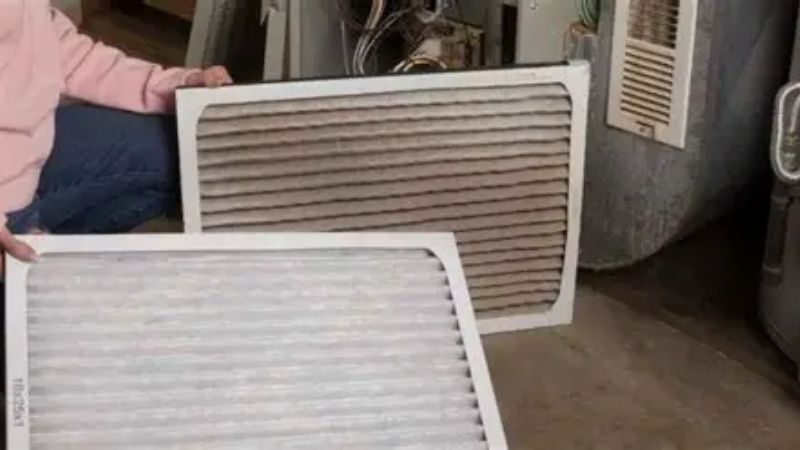
| Decision point | Owner action | Result to check | Stop or exception |
|---|---|---|---|
| Confirm filter depth and label | Read the actual filter slot, nominal dimensions and model instructions. | Distinguish a 1-inch from a 4-inch media filter. | Do not force an overly thick or high-resistance filter into an unsuitable cabinet. |
| Check condition during heavy use | Inspect the accessible return filter monthly when heating or cooling runs heavily. | Replace early if it is visibly loaded or airflow is restricted. | A calendar reminder is not an air-quality sensor. |
| Use qualified interval guidance | Carrier describes approximately 1-3 months for some 1-inch filters and 6-12 months for certain 4-inch media. | Shorten inspection intervals with heavy dust or multiple pets. | The exact manufacturer and filter instructions override illustrative ranges. |
| Protect system airflow | Choose manufacturer-compatible filter dimensions and MERV level. | Air should pass through properly seated media without bypass gaps. | Ask an HVAC professional before raising filter resistance beyond equipment capability. |
1-inch versus 4-inch furnace filters
Carrier recommends 1-inch furnace filters generally every 1-3 months; not a lifetime guarantee.
Furnace-filter intervals depend on the installed filter and the air it handles. Carrier guidance gives examples of one-inch media often needing replacement sooner than deeper four-inch media, but those illustrations are not universal service guarantees. Start with the filter slot label, dimensions, the exact product instructions, and the heating-system manual. If the furnace and air conditioner share a return and air handler, the same filter may collect particles during both seasons. A reminder on the calendar is useful for checking the filter; it does not determine the exact day the medium stops being suitable.
Why runtime, dust and pets shorten actual service life
Carrier advises checking every 30 days when there are multiple pets; a single pet does not create a fixed replacement rule.
Pets, renovation dust, heavy system runtime, and other home conditions can load a filter faster than a household with fewer particle sources. Inspect a user-accessible filter regularly during busy heating or cooling periods, looking for substantial buildup and any airflow-related warnings. Do not use color alone as a calibrated measurement: different materials and household dust can make two filters look different. If the system exhibits weak airflow or repeated temperature-limit shutdown, consult qualified HVAC help rather than assuming that a new filter is the entire repair. Filtration should protect airflow as well as capture particles.
When a visibly loaded filter needs earlier replacement
Carrier explains that loaded filters restrict airflow; heating system operation and comfort can suffer, and in some conditions limit-related shutdown occurs.
Replacement begins with a physical match. Check the printed dimensions, thickness, airflow arrow, and the filter type permitted by the furnace and filter housing. A filter that is only approximately the right size can leave gaps or fail to seat correctly. Do not stack several thin filters to imitate a thicker media cabinet, and do not insert a higher-resistance filter simply because the package promises finer capture. Follow the system’s shutdown and access instructions before removing the old medium. After installation, confirm that the access panel closes correctly and the normal air path is unobstructed.
How to Interpret the Evidence
Filters capture particles as ducted air passes through them; loading can restrict airflow.
Thickness generally correlates with filter media capacity but not a universally fixed lifespan.
MERV measures particle removal efficiency, not service interval and not standalone system compatibility.
Adjust for Your Situation
Begin with observable conditions and proceed only through permitted user controls. A safety alarm, damaged part, live connection or inaccessible component ends the do-it-yourself path.
Step 1: confirm filter depth and label
Read the actual filter slot, nominal dimensions and model instructions. Distinguish a 1-inch from a 4-inch media filter.
Do not force an overly thick or high-resistance filter into an unsuitable cabinet.
Another Carrier replacement guide describes 4-inch media filters as lasting up to 6 months; avoid claiming a universal 6-12-month standard. Use exact model/filter label as primary.
MERV describes particle-capture performance in a defined size range, not a complete assessment of how a particular furnace will move air through a filter. EPA guidance encourages efficient filtration within what the system can accommodate, but compatibility and pressure drop still matter. A high-rated cartridge that exceeds the blower or filter-cabinet capability can create a separate airflow problem. If you are unsure what rating the installed equipment supports, ask an HVAC professional before changing to a more restrictive medium. Choosing a compatible filter and changing it when needed is better than selecting a number in isolation.
Step 2: check condition during heavy use
Inspect the accessible return filter monthly when heating or cooling runs heavily. Replace early if it is visibly loaded or airflow is restricted.
A calendar reminder is not an air-quality sensor.
Carrier recommends checking filters monthly during peak heating seasons, including with thicker filters.
Keep a short maintenance record noting the installation date, filter depth, approved model, and any unusually dusty activity. When you inspect the filter later, compare its condition with airflow, room comfort, and the manufacturer’s advice. This provides a household-specific pattern that is more useful than repeating a universal ‘every 30 days’ rule. If a thermostat announces filter service, check whether its reminder is based on runtime or elapsed days rather than an actual dirt sensor. The goal is a consistently serviced HVAC system, not unnecessary filter purchases or a blocked return path.
Step 3: use qualified interval guidance
Carrier describes approximately 1-3 months for some 1-inch filters and 6-12 months for certain 4-inch media. Shorten inspection intervals with heavy dust or multiple pets.
The exact manufacturer and filter instructions override illustrative ranges.
Carrier consumer maintenance guide says 4-inch media filters generally every 6-12 months, dependent on home and system.
Step 4: protect system airflow
Choose manufacturer-compatible filter dimensions and MERV level. Air should pass through properly seated media without bypass gaps.
Ask an HVAC professional before raising filter resistance beyond equipment capability.
The U.S. EPA explains that consider at least MERV 13 or the highest rating the system fan and filter slot can accommodate, potentially after HVAC professional assessment.
Products That Help
Useful supplies for the specific checks above can include manufacturer-compatible 1-inch HVAC filter and manufacturer-compatible 4-inch media filter. Confirm the exact size, device compatibility and applicable maintenance instructions first. Equipment and tools do not remove the need to stop for a safety fault.
Frequently Asked Questions
The answers below separate normal operation, owner-accessible checks and conditions that require manufacturer support or professional service.
Is it really necessary to change a furnace filter every mon
Not universally. Carrier gives roughly 1-3 months for some 1-inch filters, while 4-inch media may have much longer intervals. Check the actual filter monthly in heavy-use periods.
How often should I change a 4-inch filter?
Carrier offers 6-12 months for some 4-inch media, but a separate guide describes up to six months. Your exact filter and operating conditions govern.
Do pets mean I need a new furnace filter more often?
Multiple pets may load filters sooner, but pet ownership alone does not set an exact expiration date. Inspect for dirt and reduced airflow.
Can a higher-MERV filter damage airflow?
Yes, a filter with too much resistance for the equipment can affect airflow. Choose a compatible MERV and ask an HVAC professional about upgrades.
Final Thoughts
Read the actual filter slot, nominal dimensions and model instructions. Ask an HVAC professional before raising filter resistance beyond equipment capability.
More from Amazon
Programs that pair well with the guide above. Offers and eligibility are set by Amazon and may change.
A free business account with business pricing and bulk-buying tools for work, shop or home office.
Create a business accountFree shipping on eligible items, Prime Video and more. Eligible new members can start with a free trial.
Start a Prime free trialAudiobooks and podcasts to listen to on the go. Eligible new members can start with a free trial.
Try Audible freeAd-free music streaming. Eligible new subscribers can start with a free trial.
Try Music Unlimited freeAs an Amazon Associate we earn from qualifying purchases.