Key takeaways
- Best overall for small to mid-size tabletop fountains: Little Giant PES-130, 130 GPH at 1 foot, 5.5 ft maximum lift.
- Best for small desktop fountains: Little Giant PES-40 (about 47 GPH at 1 foot) or Danner Fountain-Mag 35 GPH.
- Best adjustable mid-range: Danner Pondmaster Fountain-Mag 65 GPH or 80 GPH.
- Best for taller wall fountains: Danner Fountain-Mag 140 GPH, 6 ft maximum lift.
- Best budget option: Beckett M60HD, 90 GPH, 30 inch maximum lift.
- Best value for a larger bowl or cascade: Beckett M130HD or M250HD.
The best indoor pumps for tabletop fountains are the Little Giant PES-130 and PES-40 magnetic-drive pumps, the Danner Pondmaster Fountain-Mag 65 GPH and 140 GPH, and the Beckett M60HD and M130HD for a lower-cost wet-rotor option. Pick the pump by the height your water must travel, not by the highest gallons-per-hour number, because lift is what collapses flow in small fountains.
A tabletop or wall fountain lives or dies by its pump. The same bowl and stones can sound like a gentle trickle or a rattling kettle depending on the pump, the flow setting and how well the tubing fits. Buyers usually come to this search with one of four problems: the pump hums or buzzes, water barely reaches the top, the flow is too strong and splashes out, or the old pump has died and they cannot tell which replacement fits. This guide covers all four.
Our top picks
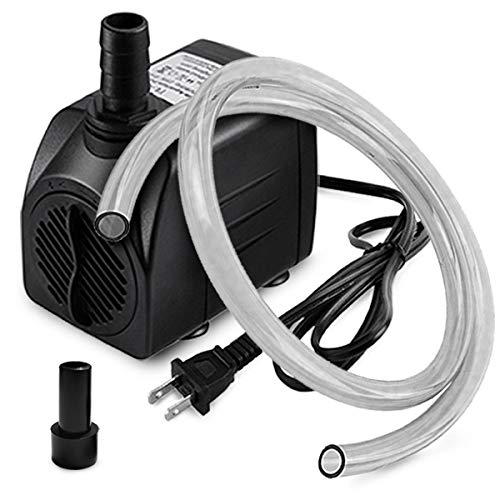

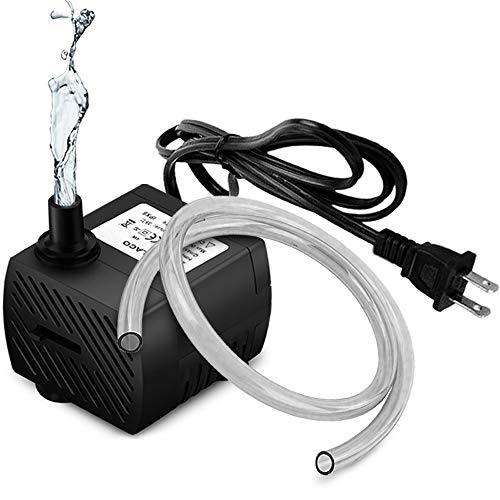

As an Amazon Associate we earn from qualifying purchases at no extra cost to you.
Quick picks
- Best overall for small to mid-size tabletop fountains: Little Giant PES-130, 130 GPH at 1 foot, 5.5 ft maximum lift.
- Best for small desktop fountains: Little Giant PES-40 (about 47 GPH at 1 foot) or Danner Fountain-Mag 35 GPH.
- Best adjustable mid-range: Danner Pondmaster Fountain-Mag 65 GPH or 80 GPH.
- Best for taller wall fountains: Danner Fountain-Mag 140 GPH, 6 ft maximum lift.
- Best budget option: Beckett M60HD, 90 GPH, 30 inch maximum lift.
- Best value for a larger bowl or cascade: Beckett M130HD or M250HD.
How we chose
This is a research-based guide that relies on manufacturer specification pages and retailer data sheets, not on listening comparisons. We kept only pumps with published flow, lift and wattage figures, and confirmed model names against current product pages. Noise is the main thing buyers care about and the least documented, so we do not claim decibel numbers. Instead we rank by the design traits that make a pump quieter in practice: magnetic-drive construction, low wattage, built-in flow control and the ability to run fully submerged. Pumps were compared on six criteria: flow range, maximum lift, adjustability, tubing and outlet sizes, power draw and ease of maintenance.
Comparison table
| Pump | Rated flow | Max lift | Power | Outlet / tubing | Flow control |
|---|---|---|---|---|---|
| Danner Fountain-Mag 35 GPH | 35 GPH | 2 ft | 5 W | 1/2 in outlet | Built-in adjustable |
| Danner Fountain-Mag 65 GPH | 65 GPH | 2 ft | 5.75 W | 5/16 in or 1/2 in | Built-in adjustable |
| Danner Fountain-Mag 80 GPH | 80 GPH | 2.5 ft | 8.5 W | 3/8 in or 1/2 in | Built-in adjustable |
| Danner Fountain-Mag 140 GPH | 140 GPH | 6 ft | 12 W | 3/8 in or 1/2 in | Built-in adjustable |
| Little Giant PES-40 | About 47 GPH at 1 ft | Low-lift model | 3 W | Fountain-size outlet | Built-in |
| Little Giant PES-130 | 130 GPH at 1 ft | 5.5 ft | 11 W | Fountain-size outlet | Built-in |
| Beckett M60HD | 90 GPH | 30 in | Not stated | Standard barbed outlet | Adjustable |
| Beckett M130HD | 160 GPH | Up to 4 ft | Not stated | Standard outlet, 6 ft cord | Adjustable |
| Beckett M250HD | 290 GPH | 77 in | Not stated | Standard outlet | Adjustable |
Flow is measured at a specific lift, usually near zero feet, so real flow at your fountain height is lower. Check the pump curve or manual for the figure at your height.
Why lift matters more than GPH
Every pump has a maximum lift, the height at which flow drops to zero, and a flow rating that applies at or near the base. As water must travel higher, flow falls steadily. A 65 GPH pump with a 2 ft maximum lift can deliver close to its rated flow at a few inches of rise, but only a trickle at 18 inches. If your water goes up through a column, over a stone and down a wall, add the vertical heights together, plus a margin for tubing friction.
Rule of thumb for choosing lift
Pick a pump whose maximum lift is at least about twice the vertical distance the water must rise. This keeps the pump working in the middle of its curve and leaves room to turn the flow down. A pump running at the very top of its lift is harsher, noisier and wears faster.
Worked example: sizing a pump for a wall fountain
- Measure the rise. Suppose the pump sits in the base reservoir and the water spout is 18 inches above the water level. That is 1.5 ft of vertical lift.
- Add friction. A 3/8 inch tube about 3 ft long adds a small loss, so budget about 0.5 ft extra. Effective lift is 2 ft.
- Apply the 2x margin. Required maximum lift is about 4 ft.
- Check the table. The Danner 35 and 65 GPH (2 ft maximum) fail. The Danner 80 GPH (2.5 ft) fails. The Danner 140 GPH (6 ft), Little Giant PES-130 (5.5 ft) and Beckett M130HD (up to 4 ft) pass.
- Check flow for the spillway. If the water falls as a sheet over a 6 inch slate lip, you want a gentle but continuous sheet. Many fountain makers suggest on the order of tens of GPH per inch of lip, but because that varies by lip shape, set the pump to its highest and turn the control down until the sheet looks continuous.
Result: for an 18 inch rise, pick a 130 to 140 GPH class pump with 4 ft or more of lift, not a 65 GPH pump, even though 65 GPH sounds like plenty of water for a small bowl.
For a tabletop bubbler with a rise of 4 inches (0.33 ft), the same method gives a required lift near 1.5 ft with friction, so a Danner 35 GPH or Little Giant PES-40 is plenty and keeps splashing low.
Magnetic-drive vs wet-rotor for indoor fountains
Magnetic-drive pumps spin an impeller on a ceramic shaft driven by a magnet, with no oil and no direct drive seal. They are efficient, run on a few watts and can run continuously, which is why Little Giant markets the PES series for continuous duty and Danner’s Fountain-Mag line is made for small fountains. Wet-rotor submersibles like the Beckett models put the rotor in the water too and are widely sold as inexpensive indoor and outdoor pumps.
- Choose magnetic-drive when quiet running and low power matter most, such as a bedroom or desk.
- Choose a Beckett when budget and easy availability matter, or you need higher flow for a cascade.
Both types should be fully submerged, as published manuals state. Dry running overheats the impeller and can crack the housing.
The picks in detail
Little Giant PES-130
Spec line: 130 GPH at 1 ft · 5.5 ft max lift · 11 W · magnetic drive · ceramic shaft · built-in flow control
Best for: mid-size tabletop fountains and wall fountains up to roughly 2 ft of rise.
Skip if: your bowl is tiny and you need a very low flow, since small bowls can run over.
- Pros: strong lift for its size, designed for continuous use, flow control built in.
- Cons: more pump than a desktop bubbler needs.
Little Giant PES-40
Spec line: about 47 GPH at 1 ft · 3 W · magnetic drive · built-in flow control
Best for: small desktop fountains and short bubblers.
Skip if: the water must climb more than a foot or two.
- Pros: lowest wattage in the group, small body fits tight reservoirs.
- Cons: limited lift.
Danner Pondmaster Fountain-Mag 65 GPH
Spec line: 65 GPH · 2 ft max lift · 5.75 W · 6 ft cord · 5/16 in or 1/2 in outlet · adjustable flow
Best for: small tabletop fountains with a rise under about 12 inches.
Skip if: you need to lift water more than a foot.
- Pros: fits both thin and standard tubing, low power draw, adjustable.
- Cons: 2 ft maximum lift limits tall designs.
Danner Pondmaster Fountain-Mag 35 GPH
Spec line: 35 GPH · 2 ft max lift · 5 W · 6 ft cord · 1/2 in outlet · adjustable flow
Best for: mini fountains and bubble bowls.
Skip if: the fountain has more than one spout.
- Pros: very gentle flow when turned down.
- Cons: not enough flow for a sheet or cascade.
Danner Pondmaster Fountain-Mag 80 GPH
Spec line: 80 GPH · 2.5 ft max lift · 8.5 W · 6 ft cord · 3/8 in or 1/2 in outlet · adjustable flow
Best for: mid-size bowls and two-tier designs.
Skip if: you need over 18 inches of rise.
- Pros: good middle ground, multiple outlet sizes.
- Cons: still limited for wall fountains.
Danner Pondmaster Fountain-Mag 140 GPH
Spec line: 140 GPH · 6 ft max lift · 12 W · 6 ft cord · 3/8 in or 1/2 in outlet · adjustable flow
Best for: taller wall fountains and cascades.
Skip if: your fountain is small and splashes easily.
- Pros: lift headroom, adjustable, magnetic drive.
- Cons: needs a larger reservoir to avoid frequent top-ups.
Beckett M60HD
Spec line: 90 GPH · 30 in max lift · wet-rotor submersible · adjustable flow
Best for: budget replacements for small fountains.
Skip if: you need the quietest possible running.
- Pros: low cost, widely available.
- Cons: shorter lift than the Danner 140 and Little Giant PES-130.
Beckett M130HD
Spec line: 160 GPH · up to 4 ft max lift · wet-rotor · continuous-use design · adjustable flow · 6 ft cord
Best for: larger tabletop cascades and small wall fountains on a budget.
Skip if: your bowl is under about 1 gallon.
- Pros: higher flow for the cost, adjustable.
- Cons: more flow than small fountains need.
Beckett M250HD
Spec line: 290 GPH · 77 in max lift · wet-rotor · adjustable flow
Best for: tall or multi-outlet indoor features that need real lift.
Skip if: you have a tabletop fountain. This is too large.
- Pros: high lift and flow.
- Cons: overkill for most tabletop uses.
Quiet operation: what actually helps
Most fountain noise has less to do with the motor than with how water and air behave around it. Use these steps before replacing a pump.
- Keep the water level above the pump intake. A low level lets air in, which causes gurgling and a rattling impeller.
- Turn the flow down until the water just covers the spout. Lower flow means smaller splashes.
- Set the pump on a thin foam or rubber pad so vibration does not travel into a hard bowl.
- Check that the tubing is not touching the bowl. A tube that rattles against ceramic buzzes.
- Reduce the drop height. Water falling a long distance onto a flat surface makes more noise than water running down a textured stone.
- Clean the impeller. A clogged or scaled impeller grinds.
Tubing size and replacement fit
Pumps fit tubing by outlet diameter. A mismatch causes leaks or kinks. Measure the inside diameter of your existing tubing, or the outside diameter of the barbed outlet on the old pump.
- Match the outlet size: 5/16, 3/8 or 1/2 inch are the common sizes listed above.
- Warm the tubing in hot water for a minute to slide it over the barb. A hose clamp or zip tie adds security.
- If the old tube is larger than the outlet, use a small adapter, not tape.
- Check the cord length. A 6 ft cord is usual, but make sure it reaches a power outlet without stretching.
- Check the pump body size against your reservoir. Measure the width and depth of the pump and leave at least an inch of clearance around it.
- Keep the original pump’s flow if it worked well, and choose the new one with an equal or slightly higher lift.
Mineral-scale care
Hard water leaves white scale on the impeller, shaft and fountain surfaces. Scale roughens the impeller and causes humming. The routine is simple.
- Use distilled or filtered water if your tap is hard.
- Unplug the pump before you touch it.
- Every month or two, remove the pump cover, pull the impeller and shaft, and soak the parts in a mix of equal parts white vinegar and water for about 30 minutes.
- Brush gently with a soft brush, rinse well and reassemble.
- Do not use bleach or harsh solvents, which can damage plastic and leave residue in the water.
- Wipe the bowl and the intake screen when you refill. A slimy screen cuts flow.
- Top up the water often, since indoor fountains lose water to evaporation, and never let the pump run dry.
Safety
- Plug the pump into a GFCI-protected outlet, especially in bathrooms and kitchens.
- Form a drip loop in the cord so water cannot run along it into the outlet.
- Place the fountain on a stable, water-resistant surface, away from electronics.
- Unplug before you clean or move the fountain.
- Keep the cord away from children and pets.
Decision matrix
| Your fountain | Rise | Pick |
|---|---|---|
| Desktop bubbler | Under 6 in | Little Giant PES-40 or Danner 35 GPH |
| Small tabletop with one spout | 6 to 12 in | Danner 65 GPH or Beckett M60HD |
| Two-tier tabletop | 12 to 18 in | Danner 80 GPH or Little Giant PES-130 |
| Wall fountain or cascade | 18 to 30 in | Danner 140 GPH, Little Giant PES-130 or Beckett M130HD |
| Tall multi-outlet feature | Over 30 in | Beckett M250HD |
Frequently asked questions
What GPH pump do I need for a tabletop fountain?
Most tabletop fountains need 35 to 130 GPH. Choose by vertical lift first, then by the water sheet you want.
Why is my fountain pump so noisy?
The usual causes are low water, air in the intake, a scaled impeller or a tube touching the bowl. Refill, clean the impeller and pad the pump base.
Can I use a pond pump in an indoor fountain?
Yes if it is rated for fully submerged use and sized for the lift, but choose a low-wattage model so the flow can be turned down and the sound stays gentle.
How often should I clean a fountain pump?
Clean it every one to two months, or sooner with hard water. Soak the impeller and shaft in a vinegar mix and rinse.
Can a pump run dry?
No. Running dry overheats the impeller and can damage the pump. Keep the water level above the intake and top up regularly.
Do I need a bigger pump than the old one?
Not usually. Match the old pump’s flow and lift, or choose slightly higher lift. A pump that is too strong splashes water out of the bowl.
What tubing size fits these pumps?
The models above list outlets of 5/16, 3/8 and 1/2 inch. Match the barb size to your tubing and use a clamp or adapter.
Are magnetic-drive pumps quieter?
They are generally considered quieter because of their design and low wattage, but installation matters more. Padding, correct water level and low flow have the biggest effect.