Key takeaways
- Diagnose before you buy: Press a straightedge across your mattress. A visible dip means you need dense foam to fill it. A flat but rock-hard surface means you need plush cushioning instead — buying the wrong category makes back pain worse, not better.
- Thickness matched to sleeping position: Side sleepers with hip and lower-back pain generally need 3 to 5 inches so shoulders and hips can settle without twisting the spine. Back and stomach sleepers usually do better around 2 to 3 inches, since too much sink flattens the lumbar curve.
- Density over softness claims: Foam density determines whether a topper still supports you in year three. High-density and CertiPUR-US certified foam resists the permanent body impressions that cheap open-cell foam develops within months.
- Anchoring system: A topper that migrates overnight is worthless. Look for deep elastic skirts sized to your mattress depth, or four-way straps. Confirm the pocket range covers your actual mattress height plus any protector you use.
- Heat management: Thick foam traps warmth, and disrupted sleep undermines recovery. Gel infusions, ventilation channels, and breathable covers like viscose bamboo all help; a removable washable cover is a practical bonus for long-term upkeep.
What's inside
Anyone who has ever pulled apart an old bed frame or shimmed a sagging box spring knows the truth: most back pain blamed on a mattress is really a support problem. A mattress that has lost its structure lets your hips sink while your lumbar curve stretches over a gap, and you wake up stiff. Replacing the whole bed is the expensive fix. A topper is the workshop fix — a targeted layer that rebuilds support where the mattress gave out, for a fraction of the cost.
I approached this the way I’d approach any retrofit: measure the problem first, then match the material. Below are six toppers that consistently help back-pain sleepers, split between dense foam that restores contour support and pillowtop builds that cushion pressure points on an already-firm bed. I’ve flagged which type suits which situation, plus the specs worth checking before you commit — depth, density, strap systems, and how each one handles heat.
As an Amazon Associate we earn from qualifying purchases.


How to Choose a Mattress Topper For Bad Back (2026)
- Diagnose before you buy: Press a straightedge across your mattress. A visible dip means you need dense foam to fill it. A flat but rock-hard surface means you need plush cushioning instead — buying the wrong category makes back pain worse, not better.
- Thickness matched to sleeping position: Side sleepers with hip and lower-back pain generally need 3 to 5 inches so shoulders and hips can settle without twisting the spine. Back and stomach sleepers usually do better around 2 to 3 inches, since too much sink flattens the lumbar curve.
- Density over softness claims: Foam density determines whether a topper still supports you in year three. High-density and CertiPUR-US certified foam resists the permanent body impressions that cheap open-cell foam develops within months.
- Anchoring system: A topper that migrates overnight is worthless. Look for deep elastic skirts sized to your mattress depth, or four-way straps. Confirm the pocket range covers your actual mattress height plus any protector you use.
- Heat management: Thick foam traps warmth, and disrupted sleep undermines recovery. Gel infusions, ventilation channels, and breathable covers like viscose bamboo all help; a removable washable cover is a practical bonus for long-term upkeep.
The Best Mattress Topper For Bad Back (2026)s Reviewed
SHOUREN 5 Inch Memory Foam Topper
At five inches of gel memory foam, this is the heavy-duty rebuild option — enough mass to compensate for a genuinely worn-out mattress rather than just soften it. The four-way strap system keeps it anchored, which matters at this thickness since tall foam layers are the most prone to shifting.
SINWEEK 3 Inch Gel Memory Foam Topper
Three inches of ventilated high-density foam hits the sweet spot for back and combination sleepers who want contouring without losing the mattress underneath. The perforated structure and CertiPUR-US certification address the two usual foam complaints, heat and off-gassing, and the cover comes off for washing.
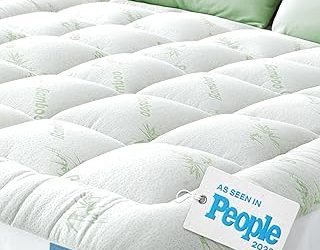
BEDLORE Viscose Bamboo Pillow Top
This one suits sleepers whose mattress is structurally sound but punishingly firm — the thick pillowtop redistributes pressure at the shoulders and hips instead of adding contour support. Stretchable pockets fit 6 to 18 inch mattresses, and the viscose bamboo surface sleeps noticeably cooler than foam.
PERLECARE 3 Inch Gel Memory Foam Topper
A well-executed mid-thickness option with a non-slip base, which spares you the strap fiddling that plagues thicker foam. Oeko-Tex certification and a removable washable cover make it the low-maintenance pick for anyone who wants pressure relief without a project.
ELEMUSE Extra Thick Mattress Pad
Overfilled down alternative gives a soft landing on hard beds, with a deep elastic pocket that grips well through the night. Best treated as cushioning rather than support — pair it with a firm mattress rather than expecting it to correct a sag.
Frequently Asked Questions
Will a topper fix a sagging mattress?
It can mask a shallow dip but not repair a broken support core. If the sag exceeds roughly an inch and a half, a thick foam topper buys you time; a failing frame or box spring needs replacing first.
Is firm or soft better for back pain?
Neither by default. You want a surface that keeps your spine neutral, which means adding firmness to a soft bed and cushioning to a hard one. Match the topper to the deficiency you actually have.
How long is the break-in period?
Memory foam typically needs one to two weeks to fully expand and for your body to adjust. Mild new stiffness during that window is normal; pain that worsens past three weeks means the thickness is wrong.
Do I need a mattress protector over it?
Yes, especially with foam. A thin breathable protector guards against moisture without smothering ventilation channels, and it saves you from washing the topper cover constantly.
Final Thoughts
For a mattress that has genuinely lost its support, the SHOUREN 5 Inch delivers the most structural correction, while the SINWEEK 3 Inch Gel is the smarter balance for most back sleepers who want contouring without excessive sink. If your bed is firm rather than worn, the BEDLORE bamboo pillowtop solves the pressure-point problem the foam options can’t.