Key takeaways
- Five laptop cooling pads compared on fan layout, published noise, USB ports and height settings, with picks for notebooks from 12 up to 19 inches.
A laptop that spends eight or more hours a day on a home office desk works harder than most people realize. Video calls, dozens of browser tabs, cloud sync tools and a second monitor all push the processor, and the heat has nowhere to go when the machine sits flat with its underside vents pressed close to the surface. The internal fans spin up, the keyboard deck gets warm, and the noise follows you into every meeting.
A cooling pad tackles the problem from below. It lifts the laptop so air can move under the chassis, and its own fans push air toward the intake vents on the base. The five pads below cover the sizes home office workers actually use, from compact notebooks to wide 17-inch and even 19-inch machines. Each was chosen for a published spec sheet, a sensible fan layout and controls that suit desk work.
Disclosure: As an Amazon Associate, we earn from qualifying purchases made through links on this page, at no extra cost to you.
How to Choose a Laptop Cooling Pad
Match the pad to your laptop size. A pad that is too small leaves the corners of a wide laptop hanging over the edge, which blocks airflow and makes the setup wobble. Pick a pad whose stated size range covers your machine with a little room to spare. A 15.6-inch laptop, the most common home office size, fits nearly every pad here.
Line the fans up with your vents. Most laptops draw air in through grilles on the underside, but the position of those grilles varies by brand. A single large fan suits machines with a central intake, while a multi-fan layout spreads air across the whole base and gives you a better chance of feeding vents near the corners.
Check the published noise figure if you take calls. A microphone sits close to the desk, so fan noise matters. Some makers publish a decibel range, quoted in the specs below. Where a maker gives no figure, expect an audible hum at full speed and plan to run the pad at a lower setting during meetings.
Count the USB ports. Almost every pad draws power from a USB port on your laptop. A pass-through port gives that connection back, so you do not lose a socket for your mouse, headset dongle or external drive.
Use the height settings. Most pads double as a simple stand. Raising the rear of the laptop brings the screen closer to eye level and opens more space beneath the chassis for air to circulate.
1. Havit HV-F2056 Laptop Cooling Pad
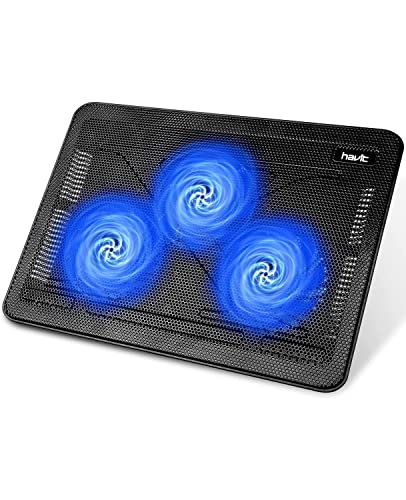
The Havit HV-F2056 Laptop Cooling Pad is the long-running default in this category, and its appeal is simplicity. Three fans of equal size sit under a metal mesh deck, there is one power switch, and the unit is slim enough to slide into a laptop bag at 28 mm thick.
Havit builds this pad for 15.6-inch to 17-inch laptops. The three 110 mm fans turn at 1,100 RPM with a tolerance of plus or minus 200, and Havit publishes an airflow figure of 65 CFM for the set. Two USB ports sit on the rear edge; one takes the power cable and the other remains free for a low-draw accessory. Two height settings lift the back of the pad when you want a typing incline.
Havit does not publish a decibel figure for this model, describing the fans only as ultra-quiet, so the specs below record that plainly rather than guessing. The fixed speed keeps the sound low, but there is no higher gear for a heavy rendering job.
Specs
- Laptop fit: 15.6 to 17 inches
- Fans: 3 fans, 110 mm each
- Fan speed: 1,100 RPM (plus or minus 200), fixed, 65 CFM published airflow
- Noise: not published by the maker
- USB ports: 2
- Height adjustment: 2 settings
- Dimensions and weight: 380 x 280 x 28 mm, 680 g
2. Cooler Master NotePal X3

The Cooler Master NotePal X3 takes the opposite approach to the Havit: one very large fan instead of several small ones. Its 200 mm fan moves air across the full width of the pad, and Cooler Master is one of the few makers here that publishes a complete set of figures, including a noise range. Fan speed adjusts with a dial from 500 to 850 RPM, delivering 65 to 76.5 CFM of airflow, and the published noise range is 16 to 23 dBA, the lowest band in this roundup. That makes the X3 a sensible pick for anyone whose desk doubles as a recording space for calls. Two height settings change the depth of the pad from 51 mm to 71 mm.
Power comes from USB, and a pass-through keeps a port free for another device. The blue LED lighting can be switched off if it does not suit your office.
Specs
- Laptop fit: up to 17 inches
- Fans: 1 fan, 200 mm
- Fan speed: 500 to 850 RPM, dial control, 65 to 76.5 CFM published airflow
- Noise: 16 to 23 dBA (maker published)
- USB ports: 1 pass-through port
- Height adjustment: 2 settings
- Dimensions and weight: 400 x 310 x 51 to 71 mm, 0.9 kg
3. TopMate C5 Laptop Cooling Pad

The TopMate C5 Laptop Cooling Pad is the control freak of this group. A small LCD panel on the front edge shows the current mode, buttons step through six fan speeds, and three modes let you run the large central fan, the four smaller fans, or all five together. If your workload swings between quiet document work and a heavy video export, that granularity is useful.
TopMate lists this pad for 12-inch to 15.6-inch laptops, which covers the ultraportable and mainstream sizes most home offices run. The fan layout pairs one 120 mm fan in the middle with four 70 mm fans around it, so air reaches the center and the corners of the base at the same time. Five height settings give a wide tilt range, and two USB ports handle power plus a spare connection.
Specs
- Laptop fit: 12 to 15.6 inches
- Fans: 5 fans, 1 x 120 mm and 4 x 70 mm
- Fan speed: 6 speeds, 3 modes, LCD controller, up to 2,500 RPM
- Noise: not published by the maker
- USB ports: 2
- Height adjustment: 5 settings
- Dimensions and weight: 370 x 300 x 38 mm, 0.95 kg
4. KLIM Wind Laptop Cooling Pad

The KLIM Wind Laptop Cooling Pad is the size generalist. KLIM rates it for laptops from 11 inches up to 19 inches, with the largest machines overhanging the edges slightly, which makes it a good household pad if two people share a desk with different computers. Four fans spin at up to 1,200 RPM, and two switches let you run the upper pair, the lower pair, or all four, aiming airflow at the end of the laptop that runs hottest.
Two USB ports sit on the side; one powers the pad and the other stays free. Fold-out legs at the rear raise the back of the pad into a typing incline, giving you a flat position and a raised position rather than a ladder of settings. The frame is light and packs flat, which suits a desk that has to be cleared at the end of the day.
KLIM does not publish a fan diameter or a decibel figure for the Wind in its listing data, and both are recorded as not published below.
Specs
- Laptop fit: 11 to 19 inches
- Fans: 4 fans, size not published by the maker
- Fan speed: up to 1,200 RPM, two fan-pair switches
- Noise: not published by the maker
- USB ports: 2
- Height adjustment: fold-out rear legs, 2 positions
- Dimensions and weight: 408 x 287 x 29 mm, about 0.9 kg
5. Kootek Chill Mat 5 Laptop Cooling Pad

The Kootek Chill Mat 5 Laptop Cooling Pad, model LCP04, spreads five fans under a wide metal mesh deck and adds the tallest stand in this roundup. Six height settings raise the rear of the laptop well off the desk, so the Kootek doubles as the stand for anyone who works on the laptop screen itself rather than an external monitor.
The layout uses one 120 mm fan in the center and four 70 mm fans around it, with two switches that run the center fan, the outer four, or all five. Kootek rates the pad for 12-inch to 17-inch laptops. The power cable is built into the pad rather than detachable, which leaves both USB 2.0 ports free for a mouse, a flash drive or a headset dongle. Two stoppers at the front edge keep the laptop from sliding when the deck is tilted.
Kootek does not publish a decibel figure for this model in its listing data, so noise is marked as not published. The blue fan lighting cannot be switched off separately from the fans, a small annoyance in a dim room.
Specs
- Laptop fit: 12 to 17 inches
- Fans: 5 fans, 1 x 120 mm and 4 x 70 mm
- Fan speed: 3 switchable fan groups, fixed speeds per group
- Noise: not published by the maker
- USB ports: 2 USB 2.0 ports, built-in power cable
- Height adjustment: 6 settings
- Dimensions and weight: 380 x 300 x 35 mm, 1.16 kg
Comparison Table
| Product | Laptop fit | Fans | Noise (maker published) | USB ports | Height settings |
|---|---|---|---|---|---|
| Havit HV-F2056 | 15.6 to 17 in | 3 x 110 mm | Not published | 2 | 2 |
| Cooler Master NotePal X3 | Up to 17 in | 1 x 200 mm | 16 to 23 dBA | 1 pass-through | 2 |
| TopMate C5 | 12 to 15.6 in | 1 x 120 mm + 4 x 70 mm | Not published | 2 | 5 |
| KLIM Wind | 11 to 19 in | 4, size not published | Not published | 2 | 2 positions |
| Kootek Chill Mat 5 | 12 to 17 in | 1 x 120 mm + 4 x 70 mm | Not published | 2 | 6 |
Frequently Asked Questions
Will a cooling pad work with my laptop?
It will help most if your laptop draws air in through vents on its underside, which is true of the great majority of Windows laptops and older Intel MacBooks. Fanless models with a sealed base gain less, because there is no intake for the moving air to feed, though lifting the chassis still helps heat leave the casing.
How much fan noise should I expect during video calls?
Only the Cooler Master NotePal X3 in this roundup publishes a decibel range, 16 to 23 dBA, which sits below typical office background sound. For pads with no published figure, run a lower speed or fewer fans during calls and save full speed for heavy work between meetings.
Does a cooling pad take up one of my USB ports for good?
Not with the pads here. Each design either includes a pass-through port or, in the case of the Kootek, a built-in power cable that leaves both hub ports free. You hand the pad one connection and get one back.
What pad size fits a 15.6-inch laptop?
Any pad whose stated range includes 15.6 inches, which is all five models above. The TopMate C5 tops out at exactly 15.6 inches, so owners of larger machines should look at the Havit, Cooler Master, KLIM or Kootek instead.
Can a cooling pad replace a separate laptop stand?
For screen height alone, partly. The tilt on pads like the Kootek and TopMate raises the display and improves the typing angle, and the lift also improves airflow. A dedicated stand usually raises a laptop higher for use with a separate keyboard, so treat the pad as the cooling layer in a setup you like.
Conclusion
For most home office desks, the choice comes down to size and noise. The Cooler Master NotePal X3 is the easiest to recommend for call-heavy work because it publishes a low noise range and backs it with a big, slow-turning fan. The Havit HV-F2056 suits 15.6-inch and 17-inch laptops that need a slim, simple pad, while the KLIM Wind covers the widest span of machines. The TopMate C5 and its LCD speed settings fit smaller laptops well, and the Kootek Chill Mat 5 earns its place when you also want the tallest stand of the group.
More from Amazon
Programs that pair well with the guide above. Offers and eligibility are set by Amazon and may change.
A free business account with business pricing and bulk-buying tools for work, shop or home office.
Create a business accountFree shipping on eligible items, Prime Video and more. Eligible new members can start with a free trial.
Start a Prime free trialAudiobooks and podcasts to listen to on the go. Eligible new members can start with a free trial.
Try Audible freeAd-free music streaming. Eligible new subscribers can start with a free trial.
Try Music Unlimited freeAs an Amazon Associate we earn from qualifying purchases.