Key takeaways
- Match CFM to your room, not the box: Standard math is one CFM per square foot for bathrooms under 100 sq ft, with a 50 CFM floor. Rooms above that get 50 CFM per fixture — tub, shower, toilet, jetted tub — added together. A 60 sq ft bath with a separate shower stall wants closer to 100 CFM than 50.
- Read the sone rating, then halve your expectations: Sones are linear, so 2.0 is genuinely twice as loud as 1.0. Anything at or below 1.0 sones reads as background hum; above 2.5 and you’ll hear it through a closed door. Manufacturers test at 0.1″ static pressure, which is friendlier than most real duct runs.
- Check duct diameter before you buy: A 110 CFM fan choked into 3-inch flex duct performs like a 50 CFM unit. Most quality fans want 4-inch minimum, and 6-inch if your run exceeds 15 feet or includes more than two elbows. Rigid or semi-rigid metal beats flex every time.
- Decide on light integration early: Combo units save a ceiling penetration and a circuit, but tie your fan lifespan to your light. Selectable CCT (3000K–5000K) lets you dial warm for evening or daylight for makeup application without swapping fixtures. Confirm the light is dimmable if you’re pairing it with an existing dimmer.
- Verify housing depth and wet rating: Measure your joist bay depth — some DC units need 7.5 inches of clearance. Anything mounted directly over a tub or inside a shower enclosure needs a wet or damp location listing and, in most jurisdictions, GFCI protection.
What's inside
Peeling paint above the shower, a mirror that stays fogged for twenty minutes, that faint mildew smell that returns no matter how often you scrub the grout — these are all symptoms of the same problem. The fan in your ceiling is either undersized, clogged with a decade of lint, or venting into your attic instead of outside. Most builder-grade units were chosen because they cost eighteen dollars in bulk, not because anyone did the math on your bathroom’s cubic footage.
Swapping one out is a genuinely approachable weekend job if you’re comfortable in an attic and can wire a switch leg. This guide breaks down what actually matters when you’re standing in the aisle or scrolling listings: airflow versus room size, sone ratings you can live with, whether a housing will drop into your existing hole, and which duct diameter your run demands. Below are the units worth your time in 2026, followed by the specs I check before anything gets screwed to a joist.
As an Amazon Associate we earn from qualifying purchases.




How to Choose a Bathroom Ceiling Fan (2026)
- Match CFM to your room, not the box: Standard math is one CFM per square foot for bathrooms under 100 sq ft, with a 50 CFM floor. Rooms above that get 50 CFM per fixture — tub, shower, toilet, jetted tub — added together. A 60 sq ft bath with a separate shower stall wants closer to 100 CFM than 50.
- Read the sone rating, then halve your expectations: Sones are linear, so 2.0 is genuinely twice as loud as 1.0. Anything at or below 1.0 sones reads as background hum; above 2.5 and you’ll hear it through a closed door. Manufacturers test at 0.1″ static pressure, which is friendlier than most real duct runs.
- Check duct diameter before you buy: A 110 CFM fan choked into 3-inch flex duct performs like a 50 CFM unit. Most quality fans want 4-inch minimum, and 6-inch if your run exceeds 15 feet or includes more than two elbows. Rigid or semi-rigid metal beats flex every time.
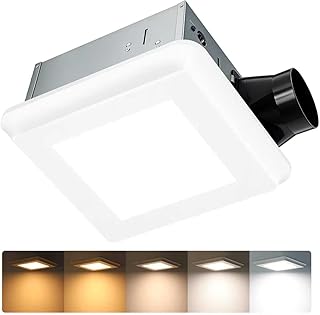
- Decide on light integration early: Combo units save a ceiling penetration and a circuit, but tie your fan lifespan to your light. Selectable CCT (3000K–5000K) lets you dial warm for evening or daylight for makeup application without swapping fixtures. Confirm the light is dimmable if you’re pairing it with an existing dimmer.
- Verify housing depth and wet rating: Measure your joist bay depth — some DC units need 7.5 inches of clearance. Anything mounted directly over a tub or inside a shower enclosure needs a wet or damp location listing and, in most jurisdictions, GFCI protection.
The Best Bathroom Ceiling Fan (2026)s Reviewed
Panasonic WhisperGreen Select FV-0511VKSL3K
This is the unit I install when the budget allows: a Pick-A-Flow selector lets you set 30, 50, 80, or 110 CFM after the housing is already in the ceiling, which is a lifesaver when you discover your duct run is longer than the plans suggested. The DC motor holds rated airflow under real static pressure, and the 5CCT LED means one SKU covers every design preference.
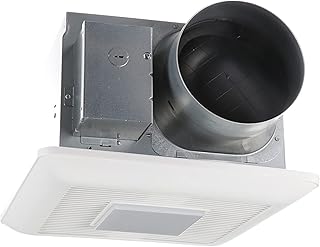
Panasonic WhisperCeiling DC FV-1115VQL1
The workhorse of the lineup — 110 CFM at a whisper, with a genuinely long-lived DC motor and a light module that doesn’t yellow after two years. It needs adequate joist depth and a proper 4-inch duct, but installed correctly it’s the fan you forget exists because it never announces itself.
Panasonic WhisperFit FV-0511VFL1
Purpose-built for shallow bays and remodels where you can’t cut into framing, the WhisperFit’s low-profile housing fits where the full-depth units won’t. Selectable 50/80/110 CFM and a dimmable LED make it the pragmatic choice for second-story baths with tight clearances.
130 CFM Humidity Sensing Exhaust Fan with Light
The built-in humidity sensor is the feature that actually changes behavior — it runs the fan when moisture spikes and shuts off on its own, which matters in households where nobody touches the switch. At 1.0 sones and 130 CFM with adjustable settings, it’s well suited to larger master baths or rooms with a soaking tub.
100 CFM Round Ventilation Fan with LED
The round housing is the selling point here: it drops into an existing recessed can opening with minimal drywall surgery, making it the fastest retrofit on this list. Wet-rated, ETL certified, dimmable, and 1.2 sones — solid value for a standard 80 to 100 sq ft bathroom.
Frequently Asked Questions
How long should I run the fan after a shower?
Twenty minutes past the last drip is the practical rule. A simple countdown timer switch costs about twenty dollars and removes the guesswork entirely — it’s the single best upgrade you can pair with a new fan.
Can I vent the fan into my attic?
No. Dumping humid air into an unconditioned attic causes sheathing rot, insulation compaction, and mold. Every run must terminate at a roof cap or sidewall vent with a functioning damper.
Do I need a permit to replace a bathroom fan?
Straight like-for-like swaps on an existing circuit typically don’t require one, but adding a new circuit, cutting a new roof penetration, or upsizing electrical usually does. Check with your local building department before starting.
Why is my new fan louder than expected?
Almost always the duct, not the fan. Kinked flex, undersized diameter, sharp elbows near the outlet, or a rattling backdraft damper account for most complaints — straighten and shorten the run before blaming the motor.
Final Thoughts
For most bathrooms, the Panasonic WhisperGreen Select FV-0511VKSL3K is the smartest money on this list thanks to its adjustable airflow and DC motor longevity. If your joist bays are shallow, the WhisperFit FV-0511VFL1 solves that problem without compromise, and the 130 CFM humidity-sensing unit is the right answer for larger baths where automatic operation matters more than brand pedigree.