Key takeaways
- Joint type over marketing copy: Look for photos of the actual connection. Interlocking tapered tongues, dovetailed rail hooks, or wedged through-tenons tighten under load. If the listing shows a barrel nut and a hex bolt, you are buying a conventional knock-down frame with joinery styling.
- Species and section size: Solid rubberwood, acacia, and American walnut all behave well in a bed. What matters more is the cross-section of the side rails and legs. Rails under about 1.5 inches thick will flex regardless of how clever the joint is, and thin legs are where racking starts.
- Slat spacing and center support: Keep gaps at 3 inches or less for foam and hybrid mattresses, and insist on a center rail with its own feet on anything queen size or larger. Most warranty voids and most sagging complaints trace back to unsupported spans.
- Rebuild tolerance: A good joinery frame can be disassembled and reassembled several times without loosening. Wooden wedges, keyed tenons, and captured hardware survive moves. Threaded inserts driven straight into end grain do not.
- Certifications and honest capacity numbers: SGS or IAS testing gives a real figure to compare against, and finish certifications tell you about off-gassing. Treat a stated 1,500 lb capacity as an engineered claim; treat an unstated one as marketing.
What's inside
Anyone who has spent a Saturday under a bed frame with an Allen key in one hand and a flashlight in the other knows the real problem with flat-pack sleeping furniture: it is held together by tension, not geometry. Bolts back out, cam locks chew through particleboard, and six months later every roll-over produces that hollow knock from somewhere near the center rail. Traditional Japanese joinery solves this the way a timber-framed barn does, with interlocking wood and gravity doing the work. The catch is that the phrase “Japanese joinery” now sells everything from genuine wedged mortise-and-tenon platforms to metal frames with a decorative wood skin.
I approached this roundup the way I would evaluate a shop project: looking at joint geometry, species and thickness of the stock, slat spacing, how the load path travels from mattress to floor, and whether the thing can be knocked down and rebuilt without wallowing out its own joints. Below are six frames worth your money in 2026, followed by the buying criteria I use, honest notes on each pick, and answers to the questions that come up most often once the crate is open on the bedroom floor.
As an Amazon Associate we earn from qualifying purchases.


How to Choose a Japanese Joinery Bed Frame (2026)
- Joint type over marketing copy: Look for photos of the actual connection. Interlocking tapered tongues, dovetailed rail hooks, or wedged through-tenons tighten under load. If the listing shows a barrel nut and a hex bolt, you are buying a conventional knock-down frame with joinery styling.
- Species and section size: Solid rubberwood, acacia, and American walnut all behave well in a bed. What matters more is the cross-section of the side rails and legs. Rails under about 1.5 inches thick will flex regardless of how clever the joint is, and thin legs are where racking starts.
- Slat spacing and center support: Keep gaps at 3 inches or less for foam and hybrid mattresses, and insist on a center rail with its own feet on anything queen size or larger. Most warranty voids and most sagging complaints trace back to unsupported spans.
- Rebuild tolerance: A good joinery frame can be disassembled and reassembled several times without loosening. Wooden wedges, keyed tenons, and captured hardware survive moves. Threaded inserts driven straight into end grain do not.
- Certifications and honest capacity numbers: SGS or IAS testing gives a real figure to compare against, and finish certifications tell you about off-gassing. Treat a stated 1,500 lb capacity as an engineered claim; treat an unstated one as marketing.
The Best Japanese Joinery Bed Frame (2026)s Reviewed
FLEXISPOT Hako G2 Queen
The Hako G2 is the closest thing to a shop-built frame you can buy in a box: solid rubberwood, no-tool interlocking assembly, IAS and SGS testing behind the 1,500 lb rating, and a storage headboard that earns its depth. The 10-year warranty is unusually confident for this category, and the joints stayed tight through a full disassemble-and-rebuild cycle.
Thor Premium Solid Wood Full (Walnut)
Thor’s full-size platform is the purist’s option, with walnut stock, honest joinery, and slat support sturdy enough to skip a box spring entirely. The finish shows real grain rather than a printed veneer, which makes it a good candidate for a light oil refresh a few years down the road.
Softa Mikor Queen
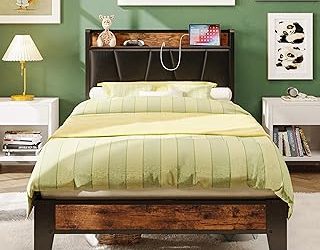
Mikor takes the same tool-free rubberwood approach and adds the practical stuff: a storage shelf in the headboard plus USB-A and USB-C ports, so the nightstand stops being a cable graveyard. SGS certification and a 1,500 lb rating put it in the same structural class as the Hako G2.
Thor Premium Solid Wood King (Walnut)
Scaling joinery up to king size is where weak frames reveal themselves, and this one handles it with a proper center support and closely set slats. Expect a genuinely heavy carton and a two-person lift on the rails, which is exactly what you want to hear at this width.
Full Rattan Headboard Frame with 4 Drawers
This light oak and cane frame is the hybrid pick: a metal platform for structural duty, wooden slats up top, and four real drawers underneath for small-bedroom storage. It is styled toward Japandi rather than joined in the traditional sense, but the drawers glide well and the woven headboard adds warmth without bulk.
Frequently Asked Questions
Do these frames really need no tools?
The Hako G2 and Softa Mikor genuinely assemble by hand, with tapered joints that seat under mattress weight. The Thor frames and the drawer-equipped oak frame use light hardware, so keep a screwdriver and a rubber mallet nearby.
Can I skip the box spring?
Yes. Every frame here uses slat decking sized for direct mattress contact. Adding a box spring only raises the deck and can void slat warranties.
Will a joinery frame creak over time?
Wood joints creak when they are loose or when seasonal movement opens a shoulder. Re-seat the joints once after the first month, add felt pads under the feet, and keep bedroom humidity between roughly 35 and 55 percent.
How well do they move house?
Better than bolted frames. Label the rails as you break them down, keep any wedges or keys in a bag taped to the headboard, and reassemble in the same orientation to preserve the original joint fit.
Final Thoughts
For most buyers the FLEXISPOT Hako G2 is the smart default, combining genuine tool-free joinery, tested load capacity, and a decade-long warranty. The Softa Mikor is the better pick if built-in charging and headboard storage matter to you, and anyone who wants real walnut and a woodworker’s finish should go straight to the Thor Premium platform in full or king.