Key takeaways
- Recline angle, measured honestly: Look for a stated 175 to 180 degrees. Anything advertised as “near-flat” without a number usually tops out around 150, which keeps a bend at your hips all night. Bring a tape measure to the showroom or check the spec sheet twice.
- Motor count: Single-motor chairs move the back and legs on one linkage, so you can’t lift your feet without dropping your head. Dual motors separate those axes. Triple motors add a powered headrest, which is what lets you flatten the neck angle instead of fighting it with a rolled towel.
- Seat width and weight rating:
- Frame construction: Kiln-dried hardwood with steel reinforcement at the linkage points is what survives nightly cycling. Particleboard bases and thin stamped brackets loosen within a year — you’ll hear it before you feel it, as a click on the way down.
- Power backup and port placement: A battery backup box gets you out of a fully reclined chair during an outage. USB-A plus USB-C on the side panel means your phone charges where you can reach it, not behind the chair.
What's inside
Sleeping in a recliner isn’t a compromise for everyone. Post-surgery recovery, acid reflux, sleep apnea, COPD, chronic back pain, or simply a partner whose snoring drove you to the living room — plenty of people end up spending full nights in a chair. The trouble is that most recliners are engineered for a two-hour movie, not an eight-hour night. Stop at a 140-degree recline and your torso stays folded, your lumbar spine loads unevenly, and you wake up stiffer than when you sat down. Add a headrest that pushes your chin toward your chest and you’ve built a neck-ache machine.
I’ve spent enough time flipping chairs over, pulling back upholstery staples, and tracing motor wiring to know which specs actually matter here. The short version: you want a true lay-flat frame, dual or triple motors so the backrest and footrest move independently, and a seat wide enough that you’re not wedged in place all night. Below are six chairs that hold up to that standard, followed by the buying criteria I’d use myself and answers to the questions that come up most often.
As an Amazon Associate we earn from qualifying purchases.


How to Choose a Recliner Chairs For Sleeping (2026)
- Recline angle, measured honestly: Look for a stated 175 to 180 degrees. Anything advertised as “near-flat” without a number usually tops out around 150, which keeps a bend at your hips all night. Bring a tape measure to the showroom or check the spec sheet twice.
- Motor count: Single-motor chairs move the back and legs on one linkage, so you can’t lift your feet without dropping your head. Dual motors separate those axes. Triple motors add a powered headrest, which is what lets you flatten the neck angle instead of fighting it with a rolled towel.
- Seat width and weight rating:
- Frame construction: Kiln-dried hardwood with steel reinforcement at the linkage points is what survives nightly cycling. Particleboard bases and thin stamped brackets loosen within a year — you’ll hear it before you feel it, as a click on the way down.
- Power backup and port placement: A battery backup box gets you out of a fully reclined chair during an outage. USB-A plus USB-C on the side panel means your phone charges where you can reach it, not behind the chair.
The Best Recliner Chairs For Sleeping (2026)s Reviewed
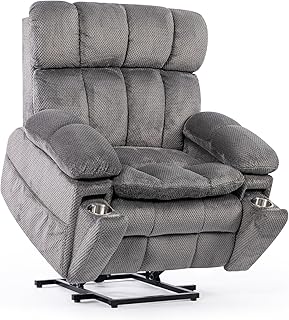
Dual Motor 26″ Extra Wide Power Lift Recliner
The 26-inch seat is the headline here, and it earns its keep: the extra span lets you shift positions through the night without your arms pinned against the wings. Zero-gravity positioning plus the flip-arm storage and dual cupholders make it genuinely livable as a nightly setup rather than a temporary fix.
MCombo 7755 Lift Chair for Tall Users
Built around a taller back and longer footrest for frames up to about 6’6″, which solves the most common complaint from tall sleepers — heels hanging off the end. The faux leather wipes down easily, a real advantage if you’re using it during recovery.
Triple Motor Large-Wide Lift Recliner
The third motor drives an independent headrest, and that single addition changes the sleeping experience more than any amount of extra padding. Infinite positioning between upright and 180 degrees means you can dial in a slight incline for reflux without giving up the flat-back support.
EONIX 2-Motor Lay Flat Power Lift Recliner
A 175-degree recline and 400-pound tested capacity put this in serious territory, and the one-touch reset is a small feature you’ll appreciate at 3 a.m. Heat and massage are integrated cleanly rather than bolted on, and the burgundy upholstery hides wear better than lighter fabrics.
Korser 360° Swivel Rocker Recliner
The manual option in this lineup, and the pick for nursery duty or smaller rooms where a lift chair’s footprint doesn’t work. It won’t go flat like the powered models, but the swivel-and-glide action plus heat and massage make it a strong choice for nights spent dozing rather than fully sleeping.
Frequently Asked Questions
Is sleeping in a recliner every night bad for you?
For most people it’s fine, and for some conditions it’s better than a bed. The risks are reduced circulation in the legs if your knees stay bent and pressure points if you don’t shift position. A true lay-flat chair addresses both. Talk to your doctor if you have a clotting history.
What’s the difference between a lift chair and a regular recliner?
A lift chair’s base tilts forward to help you stand, which matters after hip or knee surgery. Regular power recliners only move the back and footrest. Every lift chair reclines; not every recliner lifts.
Do I need a power headrest?
If you’re sleeping in the chair regularly, yes. Fixed headrests are angled for watching TV, which pushes your neck forward when the back goes flat. A powered headrest lets you neutralize that angle.
How much clearance do I need behind the chair?
Most lay-flat models need 12 to 18 inches from the wall. Wall-hugger designs cut that to around 4 inches by sliding the seat forward as it reclines, though they typically trade away some recline depth.
Final Thoughts
If you want the most complete sleeping setup, the Triple Motor Large-Wide recliner is the one to beat — that independent headrest is worth the premium for nightly use. The EONIX 2-Motor is the value play with its 175-degree recline and 400-pound rating, and tall sleepers should go straight to the MCombo 7755 rather than trying to make a standard-height chair work.