Key takeaways
- Unbox and let the mattress fully expand flat for 24 to 48 hours before running the base through its range — compressed foam is stiffer and can strain motors on the first cycle.
- Install retainer bars or corner brackets even if the mattress feels grippy; foam slides on textured decks once the head is raised past 30 degrees.
- Cycle the base through its full range empty before the mattress goes on. Listen for binding, and confirm cables have slack at full extension.
- Skip stiff quilted mattress protectors. A thin stretch-knit cover lets the mattress flex; a rigid one acts like a splint across the hinge.
What's inside
An adjustable base is a hinge-and-motor machine, and the mattress sitting on top of it is a structural component — not an afterthought. I learned this the hard way after bolting a base together in my garage, dropping on a stiff innerspring I already owned, and hitting the incline button. The mattress bridged the gap instead of bending, the head section lifted a good three inches off the deck, and the whole thing groaned like a loose deck board. The motors were fine. The mattress was simply too rigid to cooperate.
If you build, tinker, or just prefer knowing why a thing works before you buy it, this guide is for you. Below you’ll find how to judge flexibility without a showroom, which internal constructions actually hinge, why height and edge design matter more than most spec sheets admit, and how to check whether your existing frame can host a split configuration. A few solid picks are listed first if you want to skip ahead.
As an Amazon Associate we earn from qualifying purchases.
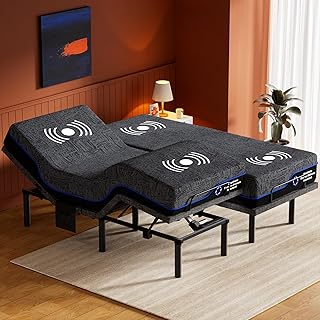


Flexibility Comes From Construction, Not Marketing Copy
Every mattress on an adjustable base has to fold at two hinge points and stay folded, night after night, for years. All-foam and pocket-coil hybrids handle this because their support layers move independently — individually wrapped coils compress in isolation rather than transmitting force across the whole panel, and foam simply flexes. Connected-coil innersprings and anything with rigid steel edge reinforcement will fight the base or eventually fatigue. The Mielmoon Made in USA 10 Inch Hybrid is a good reference build: memory foam over pocket coils, split queen sizing, thin enough that the hinge action stays smooth from the first night.
Height Is a Trade-Off You Should Make Deliberately
Thicker mattresses feel more substantial and usually sleep cooler, but every added inch increases the leverage the mattress exerts against the motors and reduces how sharply it can bend. Somewhere around 14 inches you start losing meaningful incline at the head. Sets engineered as matched pairs sidestep this — the Amada Split King Adjustable Bed Frame and 14 Inch Cooling Gel Memory Foam set and the EGOHOME Split King 14″ package both pair thick mattresses with motors sized for the load, which is different from stacking a random 14-incher on a base rated for less. If you’re combining components yourself, 10 to 12 inches is the safer window.
Split Sizes Solve a Problem Single Mattresses Cannot
Two sleepers with different preferences need two independently articulating halves. A split king is really two twin XL mattresses on two decks, each with its own motor and remote. The Marsail NS1 Massage Adjustable Base with Mattress Set runs dual motors for exactly this reason. Split queens exist too, though the halves are narrower, so measure your room before committing. Worth knowing: a split king needs split-king sheets, and standard king fitted sheets will not stay put across two moving decks.
Measure Your Frame Before You Order Anything
This step catches more people than any other. Grab a tape and check three things: interior width and length of your bed frame (adjustable bases sit inside, and side rails eat clearance), floor-to-slat clearance for the motor housing and leg assembly, and whether your headboard clears the incline arc. Bases with removable legs, like the 12-inch legs on the EGOHOME unit, give you room to adjust. Non-standard sizes need matching mattresses — the American Made 11″ Liberty Hybrid Cool Sleep comes in a 70×75 RV/short-king cut that fits platforms a standard king overhangs by inches.
Foam Density and Certification Tell You About Longevity
A mattress bending twice daily works harder than one lying flat. Higher-density foams resist permanent compression at the hinge lines; cheap low-density comfort layers develop a visible crease within a year. Look for CertiPUR-US certification, which the Marsail set carries, and check whether the manufacturer specifies foam density in pounds per cubic foot. Graphite or gel infusions, as in the Liberty Hybrid, help with the heat that builds up when your body sits in a fixed contour instead of shifting freely.
Tips
- Unbox and let the mattress fully expand flat for 24 to 48 hours before running the base through its range — compressed foam is stiffer and can strain motors on the first cycle.
- Install retainer bars or corner brackets even if the mattress feels grippy; foam slides on textured decks once the head is raised past 30 degrees.
- Cycle the base through its full range empty before the mattress goes on. Listen for binding, and confirm cables have slack at full extension.
- Skip stiff quilted mattress protectors. A thin stretch-knit cover lets the mattress flex; a rigid one acts like a splint across the hinge.
Frequently Asked Questions
Can I put my existing mattress on an adjustable base?
If it’s all-foam, latex, or a pocket-coil hybrid under about 13 inches, likely yes. Connected-coil innersprings, pillow-tops with rigid borders, and anything with a stiff perimeter will resist bending and may void the warranty.
Do I need a box spring?
No. The base replaces it entirely. Adding one blocks the articulation and defeats the whole mechanism.
How long do these mattresses last?
Roughly seven to ten years with good foam density. Repeated flexing accelerates wear at the hinge lines, so density matters more here than on a static platform.
Is a matched set better than mixing components?
Usually, yes — motor capacity, mattress thickness, and retainer placement are engineered together. Sets like the Amada, EGOHOME, Marsail, or Serta Perfect Sleeper Hybrid 12″ + Adjustable Base remove the guesswork. Mixing works fine if you verify weight ratings and dimensions first.
Conclusion
Choose a mattress that wants to bend — pocket coils or foam, moderate height, dense comfort layers, and dimensions verified against your actual frame with a tape measure. Get those four right and the base does its job quietly for years; get them wrong and you’ll hear about it every time you press the remote.