Key takeaways
- Match output to volume, not floor area: Coverage claims assume eight-foot ceilings. If you have vaulted ceilings or an open stairwell, pull out the tape measure, calculate cubic feet, and size up. A unit rated for 500 sq ft in a sealed bedroom will struggle in a 300 sq ft room that bleeds into a hallway.
- Check filter cost before you buy the machine: Wicks are consumables, replaced every one to three months in hard water. Look up the price and availability of the specific filter now. A cheap humidifier with proprietary $25 wicks is a subscription in disguise.
- Prioritize a tank you can get your hand inside: Narrow-neck tanks cannot be scrubbed, only rinsed, and biofilm builds in the corners you cannot reach. Wide openings or top-fill designs let you get a brush in and actually clean the thing.
- Insist on a real humidistat, not just fan speeds: A closed-loop sensor holds a target RH and cycles the fan accordingly. Without one you are guessing, and overshooting past 55% invites condensation on window sills and mold behind furniture pushed against exterior walls.
- Listen for bearing noise, not just decibels: Evaporative units are fans, and fans develop a low-frequency hum that rating sheets never capture. Look for models with a genuine sleep mode that drops the motor speed rather than simply dimming the display.
What's inside
Anyone who has spent a winter chasing gaps in trim with a caulk gun knows the feeling: the wood floors start ticking, drawer fronts shrink away from their frames, and a guitar left on the wall goes sharp overnight. Dry indoor air is a structural problem as much as a comfort one, and most people try to solve it with the wrong tool. Ultrasonic units fog a room fast, then leave a chalky film across every flat surface you own, including the finish you spent a weekend rubbing out. Warm-mist models sip electricity like a kettle. Neither one respects the actual physics of the room.
Evaporative humidifiers work differently. A fan pulls air through a saturated wick, and the room takes only as much moisture as it can hold, which means they self-regulate and leave minerals behind in the filter instead of on your dresser. This guide covers the models worth putting in a bedroom, nursery, or workshop-adjacent office, along with the specs that actually matter when you are matching output to square footage, and the maintenance realities nobody mentions on the box.
As an Amazon Associate we earn from qualifying purchases.


How to Choose an Evaporative Humidifier (2026)
- Match output to volume, not floor area: Coverage claims assume eight-foot ceilings. If you have vaulted ceilings or an open stairwell, pull out the tape measure, calculate cubic feet, and size up. A unit rated for 500 sq ft in a sealed bedroom will struggle in a 300 sq ft room that bleeds into a hallway.
- Check filter cost before you buy the machine: Wicks are consumables, replaced every one to three months in hard water. Look up the price and availability of the specific filter now. A cheap humidifier with proprietary $25 wicks is a subscription in disguise.
- Prioritize a tank you can get your hand inside: Narrow-neck tanks cannot be scrubbed, only rinsed, and biofilm builds in the corners you cannot reach. Wide openings or top-fill designs let you get a brush in and actually clean the thing.
- Insist on a real humidistat, not just fan speeds: A closed-loop sensor holds a target RH and cycles the fan accordingly. Without one you are guessing, and overshooting past 55% invites condensation on window sills and mold behind furniture pushed against exterior walls.
- Listen for bearing noise, not just decibels: Evaporative units are fans, and fans develop a low-frequency hum that rating sheets never capture. Look for models with a genuine sleep mode that drops the motor speed rather than simply dimming the display.
The Best Evaporative Humidifiers (2026) Reviewed
DREO Smart Evaporative Humidifier, 10L
With 800ml/h of output and a 10-liter reservoir, this is the one to buy when you want to humidify a whole open-plan level and refill twice a week instead of nightly. The 50-hour runtime and app-based RH targeting make it the closest thing to a whole-house unit without cutting into ductwork.
Levoit Evaporative Humidifier with Dual Filters
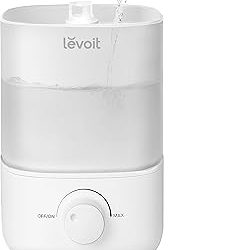
The remote sensor is the standout feature here: place it across the room from the unit and you get an honest humidity reading instead of one taken inside the machine’s own damp microclimate. Blue-light-free operation and auto-dry cycling make it the sensible pick for a nursery.
LAVIEAIR Top-Fill Evaporative Humidifier, 5L
Top-fill means you can walk over with a pitcher rather than wrestling a tank to the sink, and the 5L capacity stretches to roughly 48 hours on low. Aimed at rooms up to 300 sq ft, it disassembles quickly for a vinegar soak, which is the whole ballgame for long-term use.
AEOCKY Mist-Free Evaporative Humidifier, 4.5L
The dry-filter cycle runs the fan after shutdown to drive moisture out of the wick, which is the single best defense against that damp-basement smell. At 420mL/h it suits a bedroom or home office rather than a great room.
Vornado Evap40
Four gallons, three speeds, a mechanical humidistat, and a dual-tank layout that splits the load into two carryable halves. It is the least gadgety unit on this list and the one I would expect to still be running in a decade, with airflow that genuinely reaches across 1,000 sq ft.
Frequently Asked Questions
Do evaporative humidifiers really eliminate white dust?
Yes. Minerals stay trapped in the wick rather than being aerosolized, which is why the filter stiffens and yellows over time. That crust is the dust that would otherwise be on your furniture.
How often should I replace the wick filter?
Every 30 to 60 days with hard water, up to 90 with soft or distilled. When the wick feels rigid or output drops despite a full tank, it is saturated with scale and no longer evaporating efficiently.
Can I use tap water?
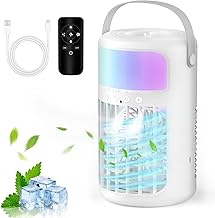
Tap water is fine and is what these units are designed for. Some compact models, including the USB-powered 3L mist-free option, specifically advertise tap-water compatibility. Distilled water only extends filter life.
What humidity level should I target?
Aim for 40 to 50% RH. Below 35% you get static and shrinking joinery; above 55% you risk condensation and mold on cold exterior walls.
Final Thoughts
For large or open spaces, the DREO 10L delivers the output and runtime to keep an entire floor stable through a dry January. The Vornado Evap40 is the durability pick, a straightforward machine with a mechanical humidistat and serviceable design that rewards basic upkeep. For bedrooms and nurseries, the Levoit with its separate sensor gives you accurate readings where you actually sleep, not just where the unit sits.