Key takeaways
- Do the amp math first: 1,500W draws roughly 12.5 amps, which eats most of a 15-amp branch circuit. Plug directly into a wall outlet, never a power strip or light-duty extension cord, and keep space heaters off circuits already loaded with a TV, gaming rig, or window AC.
- Infrared vs. fan-forced: Infrared quartz elements warm objects and bodies and feel gentler on dry sinuses; fan-forced ceramic raises air temperature faster in a closed room. Infrared usually wins in living rooms with tall ceilings, fan-forced in a bedroom you want warm in ten minutes.
- Match the form factor to your install skill: Freestanding stoves are plug-and-play. Mantel consoles need flat-pack assembly and about an hour with a Phillips driver. Recessed wall units need a stud bay, a fished cable, and a receptacle in the right place.
- Insist on a real thermostat: A built-in thermostat with a numeric setpoint cycles the element off when the room hits temperature, which is where the actual energy savings live. Units with only high/low switches run flat out until you notice and intervene.
- Check the flame independently of the heat: A flame-only mode lets you run ambiance in July at a few watts. Also look at where the heat vents — front-facing outlets warm a seating area, top-facing outlets mostly warm the wall above the unit.
What's inside
Every electric fireplace on the market pulls the same 1,500 watts at max, which means the spec sheet tells you almost nothing about which one will actually keep your feet warm in February. What separates a good unit from a disappointing one is how that heat gets moved into the room, how the thermostat behaves once the room is up to temperature, and whether the thing physically fits the space you have without a weekend of unplanned carpentry. Buyers get stuck comparing BTU numbers that are all functionally identical.
This guide comes from the install side of things: circuit loads, stud bays, mantel assembly, and where the heat outlet actually sits relative to your ankles. Below are the electric fireplace heaters worth your money in 2026, sorted by the kind of job they suit best, plus the buying criteria that matter once you stop reading marketing copy and start holding a tape measure.
As an Amazon Associate we earn from qualifying purchases.


How to Choose an Electric Fireplace Heater (2026)
- Do the amp math first: 1,500W draws roughly 12.5 amps, which eats most of a 15-amp branch circuit. Plug directly into a wall outlet, never a power strip or light-duty extension cord, and keep space heaters off circuits already loaded with a TV, gaming rig, or window AC.
- Infrared vs. fan-forced: Infrared quartz elements warm objects and bodies and feel gentler on dry sinuses; fan-forced ceramic raises air temperature faster in a closed room. Infrared usually wins in living rooms with tall ceilings, fan-forced in a bedroom you want warm in ten minutes.
- Match the form factor to your install skill: Freestanding stoves are plug-and-play. Mantel consoles need flat-pack assembly and about an hour with a Phillips driver. Recessed wall units need a stud bay, a fished cable, and a receptacle in the right place.
- Insist on a real thermostat: A built-in thermostat with a numeric setpoint cycles the element off when the room hits temperature, which is where the actual energy savings live. Units with only high/low switches run flat out until you notice and intervene.
- Check the flame independently of the heat: A flame-only mode lets you run ambiance in July at a few watts. Also look at where the heat vents — front-facing outlets warm a seating area, top-facing outlets mostly warm the wall above the unit.
The Best Electric Fireplace Heaters (2026) Reviewed
Dr. Infrared DR-991 Portable Electric Fireplace
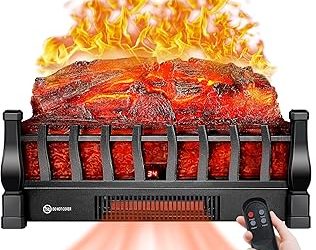
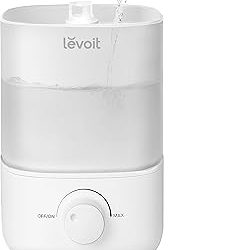
This is the most complete package here: infrared heat, an integrated humidifier that offsets the dryness most space heaters cause, an LED display, and a genuinely quiet blower. If you only buy one unit for a room you actually sit in every night, this is the one I’d wire up.
duraflame Freestanding Electric Fireplace Stove
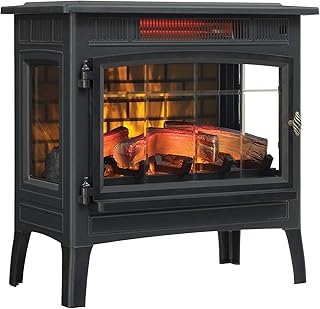
duraflame’s cast-look stove is the reliable workhorse of the category, rated for roughly 1,000 sq. ft. and built with the kind of heavy sheet-metal body that doesn’t rattle after two seasons. The 3D flame effect has real depth to it, and the freestanding footprint means zero installation beyond finding an outlet.
Tehanld 60″ Ultra-Thin Recessed Electric Fireplace
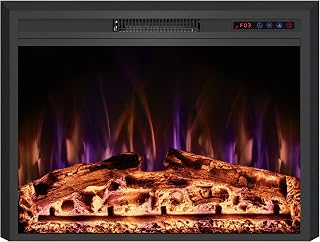
The best choice if you’re willing to open a wall — the slim depth drops between standard studs with minimal framing, and the 60-99°F thermostat plus 12-hour timer give you proper set-and-forget control. Swappable log and crystal media let you retune the look after the drywall is patched and painted.
R.W.FLAME 43″ Electric Fireplace Mantel & TV Stand
A two-in-one solve for renters and anyone who doesn’t want to cut into a wall: the wooden surround doubles as a TV console with an adjustable LED flame and 750W/1500W settings. Assembly is straightforward flat-pack work, though I’d add felt pads and check that the top shelf’s load rating clears your television.
ZAFRO 22″ Electric Fireplace Stove
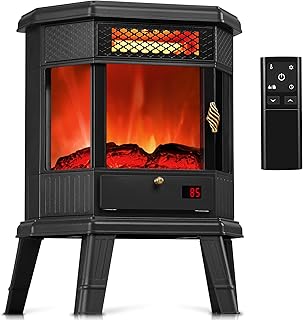
The value pick, with dual 1000W/1500W heat levels, a flame-only mode, a built-in thermostat, and ETL listing at a price that makes sense for a spare bedroom or home office. It’s a compact 5,100 BTU unit, so treat it as a supplemental heater rather than a primary heat source.
Frequently Asked Questions
Do electric fireplaces need venting or a chimney?
No. There’s no combustion, so no flue, gas line, or carbon monoxide risk. That’s why recessed models like the Tehanld only need a stud bay and a nearby receptacle rather than a mason.
Can I run one on the same circuit as my TV and console?
Not comfortably. A 1,500W heater plus an entertainment center will flirt with the limit of a 15-amp circuit. Identify a different circuit, or run the heater on its lower 750W/1000W setting.
Can I recess a wall-mount fireplace myself?
If you’re comfortable locating studs, cutting drywall, and adding blocking, yes. Electrical work beyond plugging into an existing outlet — adding a new receptacle inside the cavity — is where you should bring in a licensed electrician.
Will an electric fireplace lower my heating bill?
Only through zone heating: warming the one room you occupy while dialing the central thermostat down. A thermostatic model that cycles off, like the ZAFRO or the Dr. Infrared, is what makes that math work.
Final Thoughts
For most rooms, the Dr. Infrared DR-991 is the strongest all-around buy thanks to its infrared output, humidifier, and quiet operation. The duraflame stove is the no-install choice that simply works, and if you’re ready to open a wall for a built-in look, the Tehanld 60″ ultra-thin is the one to plan your framing around.