Key takeaways
- Carbon mass over carbon coating: Odor removal comes from activated carbon, and a thin carbon-dusted mesh saturates in weeks. Look for a granular or pelletized carbon layer with real weight to it — a heavier filter cartridge is a genuine spec signal, not a gimmick.
- Match CADR to your actual room, not the box: Measure the space the odor travels into, including connected hallways. A unit rated for 500 sq ft in a single air change beats one rated for 1,000 sq ft over four passes if you want odor gone in minutes rather than hours.
- Understand ozone before you buy it: Ozone genuinely oxidizes odor compounds, but it’s a lung irritant. If you go that route, treat it as an unoccupied-room tool with a timer, and choose ozone-free negative ion models for spaces where cats and people actually spend time.
- Filter cost is the real price: Add up three years of replacement filters and compare that against the sticker price. A cheap purifier with proprietary annual cartridges frequently costs more over its life than a mid-tier unit with a washable pre-filter.
- Sleep-mode noise, tested honestly: Litter boxes often live in bedrooms, bathrooms, or laundry nooks. Anything above roughly 25 dB on low will get switched off at night, and a purifier that’s off does nothing.
What's inside
Anyone who has scooped a litter box knows the smell doesn’t stay put. Ammonia off-gasses from urine clumps, drifts along the floor, and settles into upholstery, curtains, and the underside of whatever furniture sits nearest the box. If you’ve already tried the obvious fixes — a covered box, more frequent scooping, baking soda dumped in by the cup — and your hallway still announces the cat before guests round the corner, the problem isn’t your cleaning routine. It’s that odor molecules are gases, and gases need to be captured or broken down, not covered up.
I put this guide together the way I approach any shop project: measure first, understand the mechanism, then buy the tool that matches the job. Below you’ll find plug-in ionizers sized for the box itself, plus full HEPA-and-carbon room units for open-plan spaces. I’ll explain what each type actually does to odor, where the marketing overpromises, and how to position these things so airflow works with your room instead of against it.
As an Amazon Associate we earn from qualifying purchases.


How to Choose a/an Air Purifier For Cat Litter Odor (2026)
- Carbon mass over carbon coating: Odor removal comes from activated carbon, and a thin carbon-dusted mesh saturates in weeks. Look for a granular or pelletized carbon layer with real weight to it — a heavier filter cartridge is a genuine spec signal, not a gimmick.
- Match CADR to your actual room, not the box: Measure the space the odor travels into, including connected hallways. A unit rated for 500 sq ft in a single air change beats one rated for 1,000 sq ft over four passes if you want odor gone in minutes rather than hours.
- Understand ozone before you buy it: Ozone genuinely oxidizes odor compounds, but it’s a lung irritant. If you go that route, treat it as an unoccupied-room tool with a timer, and choose ozone-free negative ion models for spaces where cats and people actually spend time.
- Filter cost is the real price: Add up three years of replacement filters and compare that against the sticker price. A cheap purifier with proprietary annual cartridges frequently costs more over its life than a mid-tier unit with a washable pre-filter.
- Sleep-mode noise, tested honestly: Litter boxes often live in bedrooms, bathrooms, or laundry nooks. Anything above roughly 25 dB on low will get switched off at night, and a purifier that’s off does nothing.
The Best Air Purifier For Cat Litter Odor (2026)s Reviewed
LEVOIT Vital 100S-P
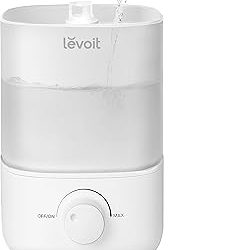
This is the one I’d install first in most homes: a true HEPA plus carbon stack, AHAM-verified coverage, and a washable pre-filter that catches litter dust and fur before it chokes the expensive layer. The side-facing intakes are a practical advantage, since you can tuck it against a wall near the box without strangling airflow.
KNKA APH4000
Rated for a very large clean-air throughput, this is the pick for open-plan spaces where the litter box shares air with a living room or kitchen. The AQI display is useful as a feedback loop — run it on Pet mode after scooping and watch the number drop, which tells you whether your placement is actually working.
Cat Litter Deodorizer 3-Pack Plug-In Ionizer
Three small plug-ins let you treat the source, the doorway, and the adjacent room instead of relying on one unit to pull odor across the house. Filterless means no ongoing cost, and they’re small enough to hide behind a console or inside a cabinet with a ventilation cutout.
Ozone & Negative Ion Deodorizer with Sensor Monitor
The onboard sensor and switchable modes make this the most controllable ozone option here, which matters because ozone should be dosed deliberately. Best used in a closed laundry room or bathroom litter setup, run while nobody is inside.
Ozone-Free Plug-In with 3 Circulation Modes
Unscented and ozone-free, this one earns its place for nurseries, small bathrooms, and anywhere a cat sleeps close to the unit. The three circulation modes let you dial output down until you find the setting that holds odor at bay without any perceptible hum.
Frequently Asked Questions
Where should I put the purifier relative to the litter box?
Roughly two to four feet away, at the same height or slightly above the box, with the intake facing it. Ammonia is heavier than room air, so floor-level placement generally outperforms a shelf. Never point the outflow directly at the litter — you’ll broadcast dust.
Do plug-in ionizers replace a HEPA purifier?
No. Ionizers address odor gases; HEPA media captures the litter dust and dander that make the room feel stale and trigger allergies. In a home with cats, the two do different jobs and complement each other.
How often should I change the carbon filter?
Assume six months in a litter room, not the twelve the manual suggests. A simple field test: pull the filter and smell it. If it smells like the litter box, it’s saturated and is no longer adsorbing anything.
Can I build an enclosure around the purifier?
Yes, and it’s a satisfying weekend build. Keep at least three inches of clearance on every intake face, cut generous grilles rather than decorative slots, and leave the top completely open if the unit exhausts upward.
Final Thoughts
For most homes, the LEVOIT Vital 100S-P is the right anchor purchase — proven filtration, sane filter costs, and quiet enough for a bedroom litter setup. Scale up to the KNKA APH4000 if the box shares air with a large open living space, and add the ozone-free plug-in ionizer at the source for targeted odor control that costs nothing to maintain.