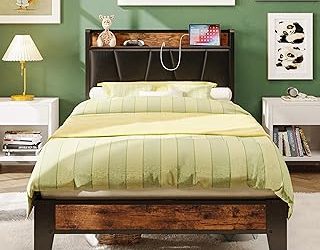
Key takeaways
- Center support geometry: A queen spans roughly 60 inches, which is wide enough that a single center rail is the bare minimum. Look for a center beam with its own legs to the floor, ideally two or three. Frames that rely only on perimeter rails will develop a sag down the middle regardless of slat count.
- Slat spacing and fastening: Keep gaps under 3 inches if you are running foam or hybrid, since wider spacing voids most mattress warranties and creates visible dips. More important is how slats attach. Slats that sit loose in a channel are the number one source of creak. Ones that bolt, screw, or clip into place stay quiet.
- Deck height versus storage reality: A 14 inch frame gives you around 12 inches of usable clearance, which fits standard under-bed bins. Measure your bins first. Also account for mattress thickness: a 14 inch frame plus a 12 inch mattress puts your sleep surface at 26 inches, which is high for shorter sleepers.
- Steel gauge and joint type over stated weight limits: Advertised capacity numbers are marketing. What matters is whether the tubing is thin-wall or substantial, and whether corners use welded or bolted plate connections rather than tab-and-slot. Bolted plates you can retighten. Tab-and-slot you cannot.
- Assembly hardware quality: Cheap frames ship with soft-alloy bolts and a stamped wrench that strips heads on the second turn. Budget for a set of proper hex keys or a driver with hex bits, and check whether the frame uses barrel nuts or bare-thread-into-steel connections, which loosen faster.
What's inside
Anyone who has spent a Saturday morning on the floor with an Allen key knows the real problem with queen bed frames: the specs sheet never tells you how the thing behaves after six months of actual use. Center support that flexes under a heavy hybrid mattress, slats that migrate out of their brackets, a headboard that develops a rattle every time you shift position. The frames that fail rarely fail dramatically. They just start creaking, and once a bed creaks, it never stops.
This guide comes from a bench-level perspective: what the joinery looks like, where the load actually travels, which frames use enough steel gauge or solid stock to matter, and which ones cut corners in places you will feel. I have grouped six queen frames covering metal storage platforms, upholstered builds, solid pine, and a tech-integrated option, then broken down the selection criteria that predict long-term quiet better than any product description will.
As an Amazon Associate we earn from qualifying purchases.



How to Choose a Queen Size Bed Frame (2026)
- Center support geometry: A queen spans roughly 60 inches, which is wide enough that a single center rail is the bare minimum. Look for a center beam with its own legs to the floor, ideally two or three. Frames that rely only on perimeter rails will develop a sag down the middle regardless of slat count.
- Slat spacing and fastening: Keep gaps under 3 inches if you are running foam or hybrid, since wider spacing voids most mattress warranties and creates visible dips. More important is how slats attach. Slats that sit loose in a channel are the number one source of creak. Ones that bolt, screw, or clip into place stay quiet.
- Deck height versus storage reality: A 14 inch frame gives you around 12 inches of usable clearance, which fits standard under-bed bins. Measure your bins first. Also account for mattress thickness: a 14 inch frame plus a 12 inch mattress puts your sleep surface at 26 inches, which is high for shorter sleepers.
- Steel gauge and joint type over stated weight limits: Advertised capacity numbers are marketing. What matters is whether the tubing is thin-wall or substantial, and whether corners use welded or bolted plate connections rather than tab-and-slot. Bolted plates you can retighten. Tab-and-slot you cannot.
- Assembly hardware quality: Cheap frames ship with soft-alloy bolts and a stamped wrench that strips heads on the second turn. Budget for a set of proper hex keys or a driver with hex bits, and check whether the frame uses barrel nuts or bare-thread-into-steel connections, which loosen faster.
The Best Queen Size Bed Frame (2026)s Reviewed
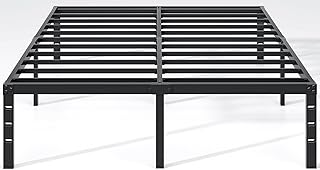
JETO Metal Bed Frame, 14 Inch
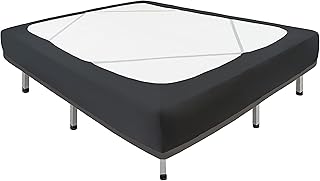
This is the frame I would point a first-time assembler toward, because it strips the problem down to steel, legs, and slats with nothing to misalign. The 14 inch deck yields genuine bin-friendly clearance, and the multiple center legs distribute load properly across the span rather than letting it hang off the perimeter.
Allewie Upholstered Platform Bed
The fully wrapped construction here does double duty: it looks finished without a bed skirt, and the fabric sleeving over the rails eliminates the metal-on-metal contact points where creaks originate. Dark grey hides scuffs well, though budget an hour with a fabric brush and vacuum crevice tool each season since upholstered rails collect dust in the seams.
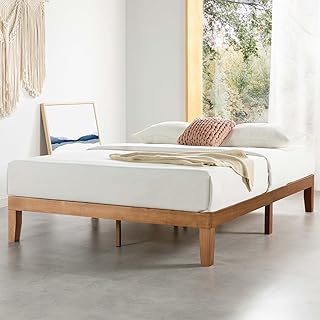
Mellow Naturalista Classic Solid Wood
For makers who plan to modify, this pine platform is the obvious pick because you can drill it, stain it, or add a headboard of your own build without fighting powder-coated steel. Solid wood also means any future looseness is fixable with glue and a clamp rather than a replacement part order.
SHA CERLIN Metal Frame with Wood Headboard
The steel-and-wood hybrid approach gets you the rigidity of a metal chassis with a headboard and footboard that read as furniture rather than utility hardware. Black oak finish is forgiving, and the 14 inch height paired with a fully enclosed under-bed area makes this the strongest storage-per-dollar option in the group.
GRUSIGN Velvet Platform Bed
The adjustable slat height is the sleeper feature here, letting you run either a mattress alone or a mattress plus box spring without ending up with an awkwardly tall sleep surface. Velvet in beige is a commitment to maintenance, so plan on a lint roller in the nightstand drawer.
Frequently Asked Questions
Do I need a box spring with a platform frame?
No. Every frame in this roundup has slat support engineered to carry the mattress directly. Adding a box spring on top of slats raises your deck height significantly and does nothing structural. The only exception is the GRUSIGN, which is built to accommodate either setup by design.
What actually causes bed frame creaking, and can I fix it?
Almost always it is two rigid parts rubbing where they meet: slat ends in their channels, bolt shanks in oversized holes, or a headboard bracket that has worked loose. Fixes are straightforward. Retighten every fastener, add felt pads or adhesive-backed foam tape at slat contact points, and apply a thread locker or nylon-insert nuts on joints that keep backing out.
How much assembly time should I plan for?
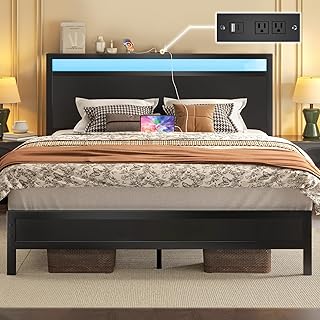
A bare metal frame like the JETO runs 20 to 40 minutes solo. Upholstered frames with headboards take 45 to 90 minutes and genuinely benefit from a second person to hold panels square while you start bolts. The Fluest, with its charging station wiring and LED strip, sits at the longer end of that range.
Is the built-in charging station on the Fluest worth it?
If you are tired of cables snaking up from the baseboard, yes. Integrated USB ports and outlets in the headboard eliminate the cord-management problem entirely, and the storage shelf handles the phone-and-book pile. Just verify the outlet placement works with your room’s plug location before committing, since it still needs a wall connection.
Final Thoughts
If your priority is bulletproof structure with real storage clearance, the JETO 14 inch metal frame does the job with the fewest failure points. The SHA CERLIN is the better call when you want that same rigidity dressed as actual bedroom furniture, and the Mellow Naturalista is the one to choose if you like knowing you can take a chisel to your own bed frame without regret.