Key takeaways
- Sleeping surface continuity: Lie down across the fold before you commit. Bifold wood frames create a hinge gap that a thin mattress can’t bridge; boneless modular designs eliminate it entirely because the cushions butt together with no hardware between them.
- Fill construction over thickness: An 8″ mattress stuffed with loose cotton will bottom out faster than a 6″ foam-and-pocket-spring build. Look for layered construction — high-density foam base, comfort layer on top, or individually wrapped coils that respond to point pressure.
- Flat length, not sofa length: A 79″ sofa often opens to roughly 79″ of sleeping length, which suits most adults. Anything advertised as a loveseat sleeper will run short unless you’re using it for kids or naps.
- Cover material and washability: Corduroy hides wear and grips bedding better than slick polyester. Twill holds up to repeated folding. Either way, check whether the cover unzips — a futon that sees overnight use needs laundering more than a sofa does.
- Assembly reality check: Wood frames mean bolts, an Allen key, and about 45 minutes on the floor. Boneless models ship compressed and need nothing but unpacking and a day to fully expand. Match that to your patience and your stairwell.
What's inside
Most futons are built to be sat on, not slept on. That’s the disconnect that trips up buyers: you test one in a showroom for thirty seconds, it feels supportive under your seat, and then a guest wakes up at 3 a.m. with a bar across their shoulder blades. I’ve disassembled enough frames and cut into enough mattresses to know where the shortcuts hide — thin cotton batting that compresses into a pancake, hinge mechanisms that leave a two-inch trench at the fold, and “convertible” designs that only convert into something shorter than an adult.
This guide sorts futons by how they actually perform overnight. I’ve grouped them into three families — boneless modular sofa beds, traditional wood-frame sets, and Japanese-style floor mattresses — because each solves a different sleeping problem. Below you’ll find what to inspect before buying, honest notes on six current options, and answers to the questions that come up once the box is already open in your living room.
As an Amazon Associate we earn from qualifying purchases.


How to Choose a Futon For Sleeping (2026)
- Sleeping surface continuity: Lie down across the fold before you commit. Bifold wood frames create a hinge gap that a thin mattress can’t bridge; boneless modular designs eliminate it entirely because the cushions butt together with no hardware between them.
- Fill construction over thickness: An 8″ mattress stuffed with loose cotton will bottom out faster than a 6″ foam-and-pocket-spring build. Look for layered construction — high-density foam base, comfort layer on top, or individually wrapped coils that respond to point pressure.
- Flat length, not sofa length: A 79″ sofa often opens to roughly 79″ of sleeping length, which suits most adults. Anything advertised as a loveseat sleeper will run short unless you’re using it for kids or naps.
- Cover material and washability: Corduroy hides wear and grips bedding better than slick polyester. Twill holds up to repeated folding. Either way, check whether the cover unzips — a futon that sees overnight use needs laundering more than a sofa does.
- Assembly reality check: Wood frames mean bolts, an Allen key, and about 45 minutes on the floor. Boneless models ship compressed and need nothing but unpacking and a day to fully expand. Match that to your patience and your stairwell.
The Best Futon For Sleeping (2026)s Reviewed
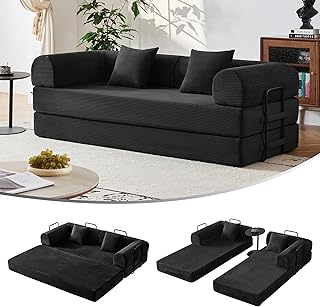
79″ Convertible Sofa Bed, Corduroy Pocket Spring (Black)
Pocket springs inside a boneless cushion is the smart combination here — you get the seamless flat surface of a modular design with coil response that keeps hips from sinking. At 79″ it sleeps an average adult comfortably, and the no-assembly delivery means you can have it usable within an hour of the box arriving.
Stanford Futon Set — Full Size, 8″ Mattress
This is the classic wood-frame approach done properly: a full-size footprint, an 8″ mattress, and a twill cover that survives the fold-and-unfold cycle. Expect a visible hinge line, so add a mattress topper if it’s serving as a nightly bed rather than an occasional one.
79″ Corduroy 5-in-1 Modular Futon (Olive Green)
The 5-in-1 configuration is genuinely useful, not marketing filler — you can split it into chaise, lounger, or two separate seats, then reassemble it flat for sleeping. Same pocket-spring support as the black version, just in a color that reads warmer in a small apartment.
6th Generation Japanese Floor Futon Mattress, Twin
Nine layers of high-density foam at extra-thick loft makes this the most comfortable option on this list for actual sleeping, full stop. The tradeoff is that it’s a mattress, not furniture — it rolls up into a closet during the day, which is either the perfect solution or a daily chore depending on your space.
Brentwood Tray Arm Futon Frame with Drawers
The integrated drawers and tray arms make this the most furniture-like pick, and the microfiber mattress is a step up from bargain futon padding. Budget real time for assembly and get a second pair of hands for the frame rails.
Frequently Asked Questions
Can you sleep on a futon every night?
Yes, if the mattress is built for it. Layered foam or pocket-spring construction holds up to nightly use; thin cotton batting compresses permanently within a few months and will start hurting your back.
Do boneless futons sag over time?
Less than you’d expect, because there’s no frame to fatigue. Rotate and flip the cushions monthly the same way you would a mattress, and fluff the corduroy cover to keep the loft even.
How long does a compressed futon take to expand?
Plan on 24 to 72 hours for full loft. Unbox it immediately on arrival and leave it in a warm room — cold slows foam recovery noticeably.
Is a floor futon better than a frame futon?
For pure sleep quality, usually yes. Floor futons avoid the hinge gap entirely and give you uninterrupted support, but you lose the daytime seating that makes a frame futon worth the compromise.
Final Thoughts
If you need one piece of furniture to do both jobs well, the 79″ Corduroy Pocket Spring Sofa Bed is the pick — the seamless surface and coil support make it genuinely sleepable, and the olive green 5-in-1 version gives you more layout flexibility for the same money. For guest rooms where sleep quality matters more than seating, the 6th Generation Japanese Floor Futon is the better buy and costs less than any frame here.