Key takeaways
- Adjustable steam settings: A single-output mop forces you to use tile-grade steam on a floor that wants the lightest touch. Two or three modes let you run low on laminate and save the heavy setting for grout and entryway tile.
- Pad quality and swap-ability: The pad is your moisture sponge. Thick microfiber with a tight weave absorbs condensate before it reaches a seam. Look for at least two washable pads included, and check that replacements are cheap and easy to find.
- Heat-up and shut-off behavior: Fast heat-up (under 30 seconds) is handy, but automatic steam cut-off when the mop sits upright matters more. A mop that keeps venting into one spot while you answer the door is how floors get ruined.
- Tank size versus weight: Bigger tanks mean fewer refills but more mass on the handle. For laminate, a smaller removable tank is often the smarter trade — you’re using less steam anyway, and a lighter mop is easier to keep moving.
- Cord length and maneuverability: Corded steam mops are the norm, so reach dictates workflow. Twenty-three feet or more covers most rooms from one outlet, and a swivel head saves you from lifting the mop around table legs.
What's inside
Laminate is a layered sandwich: a photographic decor sheet fused over a fiberboard core, with the seams held together by nothing more than a tongue-and-groove click and, if you’re lucky, a wax coating. Anyone who has pulled up a plank knows how thirsty that core is. Standing water wicks into the joints, the fiberboard swells, and you get that telltale lifted edge that no amount of buffing will flatten. That’s why a steam mop scares people off laminate — and why choosing the wrong one genuinely does cause damage.
The good news is that steam and laminate can coexist, provided the machine gives you control. What matters is low moisture output, a pad that lifts water off the surface instead of dragging it around, and the discipline to keep moving. This guide sorts through the current crop of steam mops with a builder’s eye: how much water they actually put down, how the heads are engineered, and which models are worth your money in 2026.
As an Amazon Associate we earn from qualifying purchases.


How to Choose a Steam Mop For Laminate Floors (2026)
- Adjustable steam settings: A single-output mop forces you to use tile-grade steam on a floor that wants the lightest touch. Two or three modes let you run low on laminate and save the heavy setting for grout and entryway tile.
- Pad quality and swap-ability: The pad is your moisture sponge. Thick microfiber with a tight weave absorbs condensate before it reaches a seam. Look for at least two washable pads included, and check that replacements are cheap and easy to find.
- Heat-up and shut-off behavior: Fast heat-up (under 30 seconds) is handy, but automatic steam cut-off when the mop sits upright matters more. A mop that keeps venting into one spot while you answer the door is how floors get ruined.
- Tank size versus weight: Bigger tanks mean fewer refills but more mass on the handle. For laminate, a smaller removable tank is often the smarter trade — you’re using less steam anyway, and a lighter mop is easier to keep moving.
- Cord length and maneuverability: Corded steam mops are the norm, so reach dictates workflow. Twenty-three feet or more covers most rooms from one outlet, and a swivel head saves you from lifting the mop around table legs.
The Best Steam Mop For Laminate Floors (2026)s Reviewed
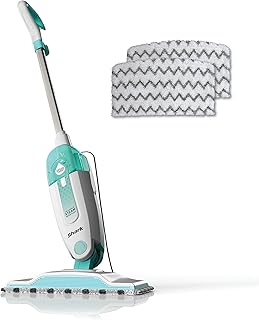
Shark Steam Mop S1000
This is the model I’d hand to someone nervous about steaming laminate for the first time — it’s simple, light, and the Dirt Grip pads are genuinely good at trapping moisture rather than spreading it. The removable tank makes refills painless, and the lack of high-output modes is arguably a feature on a floor this moisture-sensitive.
Shark Steam & Scrub S8201
The three steam modes are the real selling point here: run the lowest on laminate and reserve Steam Blaster for baked-on kitchen tile. The LED headlights are not a gimmick either, since raking light across a floor reveals streaks and grit you’d otherwise walk past.
BISSELL Spinwave SmartSteam 3897A
Swivel steering plus SmartSteam output makes this the most agile option for furniture-heavy rooms, and it holds a consistent low output instead of pulsing wet and dry. It’s heavier than the Sharks, so factor that in if you have stairs or a lot of square footage to cover in one go.
11-in-1 Steam Mop with 23FT Cord
The detachable handheld unit turns this into a small arsenal — window squeegee, garment steamer, grout brush — which is why it earns space in a utility closet. Its 15.2 oz tank is modest, but on the low setting that’s more than enough to do a couple of laminate rooms without a refill.
10-in-1 Steam Mop with Adjustable Height
Adjustable steam paired with an adjustable handle height is an underrated combination if more than one person in the house does the cleaning. Build quality sits a notch below the name brands, but the versatility-per-dollar is hard to argue with.
Frequently Asked Questions
Is steam mopping safe on laminate flooring?
On sealed, well-installed laminate with tight seams, yes — using the lowest steam setting, a dry-feeling pad, and continuous motion. On older laminate with gapped joints, chipped edges, or a floating install that’s already lifting, skip steam and use a barely damp microfiber mop instead.
How wet should the floor be after mopping?
It should flash dry in under a minute. If you can see a wet sheen trailing behind the mop, you’re either on too high a setting or your pad is saturated and needs swapping.
Do I need cleaning solution with a steam mop?
No, and most manufacturers void the warranty if you add detergent to the tank. Heat does the sanitizing; soap residue attracts dirt and can dull laminate’s wear layer over time.
Should I use distilled water?
If you have hard water, yes. Mineral scale clogs the steam nozzle and shortens the heater’s life, and descaling a sealed unit is far more hassle than buying a jug of distilled water every few months.
Final Thoughts
For most laminate floors, the Shark S1000 is the safest, simplest choice — light, low-moisture, and hard to misuse. Step up to the Shark S8201 if you want one mop that handles laminate gently and tackles tile aggressively, or pick the BISSELL Spinwave SmartSteam 3897A if maneuverability around furniture is your main frustration.