Key takeaways
- Ceiling height dictates mount type: Under 8 feet, go flush mount (hugger) or you’ll be ducking. Between 8 and 9 feet, a short downrod puts blades in the sweet spot. Above 9 feet, buy a longer downrod separately and aim for blades 8–9 feet off the floor.
- Motor type changes the whole experience: DC motors draw less power, run cooler, offer six speeds instead of three, and reverse from the remote. AC motors are cheaper and louder. If you sleep in the room, spend the extra on DC.
- Blade span versus room size: 44 inches suits bedrooms and offices up to roughly 175 sq ft. 52 inches handles living rooms and primary bedrooms up to about 400 sq ft. Oversizing a small room creates draft, not comfort.
- Check the wet/damp rating honestly: “Outdoor use” on a listing usually means damp-rated — fine under a covered porch, wrong for anywhere rain hits. Wet-rated is a separate certification, and few budget fans have it.
- Light control matters more than brightness: Look for full-range dimming plus 3CCT switching, and confirm the fan has memory so it returns to your last setting after a power blip instead of blasting 5000K at you.
What's inside
Standing on a ladder at hour two of a ceiling fan install, wire nuts in your teeth, is where most people discover the fan they bought was the wrong call. The listings all look identical: 52 inches, remote included, three color temperatures, “whisper quiet.” What separates a fan you forget about from one that ticks in the dark at 2 a.m. is stuff the bullet points bury — downrod length versus flush mount, whether the canopy has a hanging hook to hold the motor while you wire it, blade pitch, and whether that DC motor is genuinely a DC motor or an AC unit with an inverter bolted on.
I’ve hung enough of these to know which ones fight you and which ones cooperate. This guide covers the fans worth your Saturday in 2026 — indoor and damp-rated, remote and app-driven, plus one honest pull-chain workhorse for people who don’t want another device on their phone. I’ve flagged mounting quirks, real airflow behavior, and the small design details that matter once the box is open and the old fixture is already down.
As an Amazon Associate we earn from qualifying purchases.


How to Choose a Ceiling Fan Ratings (2026)
- Ceiling height dictates mount type: Under 8 feet, go flush mount (hugger) or you’ll be ducking. Between 8 and 9 feet, a short downrod puts blades in the sweet spot. Above 9 feet, buy a longer downrod separately and aim for blades 8–9 feet off the floor.
- Motor type changes the whole experience: DC motors draw less power, run cooler, offer six speeds instead of three, and reverse from the remote. AC motors are cheaper and louder. If you sleep in the room, spend the extra on DC.
- Blade span versus room size: 44 inches suits bedrooms and offices up to roughly 175 sq ft. 52 inches handles living rooms and primary bedrooms up to about 400 sq ft. Oversizing a small room creates draft, not comfort.
- Check the wet/damp rating honestly: “Outdoor use” on a listing usually means damp-rated — fine under a covered porch, wrong for anywhere rain hits. Wet-rated is a separate certification, and few budget fans have it.
- Light control matters more than brightness: Look for full-range dimming plus 3CCT switching, and confirm the fan has memory so it returns to your last setting after a power blip instead of blasting 5000K at you.
The Best Ceiling Fan Ratings (2026)s Reviewed
Passky 52″ Black Ceiling Fan with Light
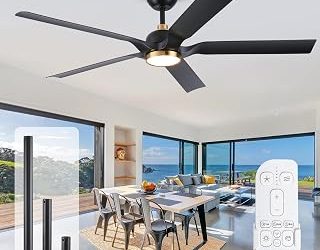
This is the one I recommend most often because the install genuinely is easier — the bracket holds the motor housing while you make connections, which saves you a helper. The reversible DC motor is quiet at every speed, the timer and app control work without a hub, and the memory function means it wakes up the way you left it.
52″ Modern Ceiling Fan with 3CCT Light
A clean-lined, no-branding-on-the-blades option that punches above its price on airflow thanks to decent blade pitch. Noiseless is a fair claim here at speeds one through four; you’ll hear air movement at the top setting, which is what you want.
Hunter Builder Deluxe 52″ (New Bronze)
The pull-chain classic, and the one to buy if you want a fan that outlives the house. Hunter’s WhisperWind motor is genuinely smooth, the New Bronze finish reads warmer in person than photos suggest, and standard-mount hardware plus included bulbs means no second trip to the hardware store.
DREO 44″ Flush Mount Smart Fan
Built for low ceilings and small rooms, and the smart integration is the most polished in this group — voice control and scheduling actually behave. At 44 inches it’s a bedroom and home-office fan, not a great room solution.
OJX 52″ DC Ceiling Fan with App Control
Strong all-arounder with both remote and app control, full dimming, and 3CCT. The DC motor is quiet enough for a kitchen where you’ll run it constantly, and the damp rating opens up covered patio installs.
Frequently Asked Questions
Which direction should the blades turn?
Counterclockwise in summer to push air down, clockwise on low in winter to pull warm air off the ceiling and circulate it. DC fans reverse from the remote; AC fans use a slider switch on the motor housing.
Can I install a ceiling fan on an existing light fixture box?
Only if that box is fan-rated. Standard light boxes aren’t built for the dynamic load of a spinning motor. Look for a metal box marked “acceptable for fan support” and secured to a joist or brace — otherwise install a fan brace first.
Why does my fan wobble?
Almost always blade balance or a loose mounting bracket. Tighten every blade screw and the canopy screws first, then check whether blades sit at equal distance from the ceiling. A balance kit fixes the rest.
Do flush mount fans move less air?
Slightly, yes — proximity to the ceiling restricts intake. Good low-profile designs compensate with blade pitch and motor speed, so the difference in a properly sized room is minimal.
Final Thoughts
For most rooms, the Passky 52″ is the pick — quiet DC motor, forgiving install, and light controls that behave. Choose the DREO 44″ flush mount if your ceiling is under 8 feet and you want real smart-home integration, or the Hunter Builder Deluxe if you’d rather have a simple pull chain and a motor that just keeps running.