Key takeaways
- Blade span vs. room size: Measure your room’s longest wall and match roughly. Under 100 sq ft works with a 20-24 inch fan, 100-200 sq ft suits 42-44 inches, and anything past 300 sq ft wants 52 inches or a second fan. Undersizing is the most common mistake I see.
- DC over AC motor: DC motors draw roughly 60-70% less power, run noticeably quieter, and give you six or more speed steps instead of three. They also reverse for winter updraft with a remote press rather than a physical switch you can’t reach.
- Mounting depth and junction box: Check the fan’s total height from ceiling to blade bottom, then confirm your electrical box is fan-rated. A standard plastic box won’t hold the dynamic load. Swapping in a metal brace box costs under twenty dollars and saves you a callback to yourself.
- Light temperature control: 3CCT or full 3000-6000K tuning lets one fixture serve as warm evening light and cool task light. If the fan is your only ceiling light, treat this as non-negotiable.
- Control method: Remote is baseline. App and voice control add convenience but depend on a 2.4GHz network and a working cloud service. Confirm the fan still responds to its physical remote if the app goes dark.
What's inside
If you’ve ever stood on a ladder with a downrod in one hand and your knuckles brushing the ceiling, you already know the problem: standard ceiling fans assume you’ve got nine-foot ceilings. In an eight-foot room, a hanging fan turns into a head-height hazard, and building code wants at least seven feet of clearance from floor to blade. That leaves a narrow window, and it’s exactly where flush mount fans earn their keep. The trade-off used to be real, though. Older hugger models sat so tight against the drywall that airflow choked out, and you’d get noise without much breeze.
That’s changed. DC motors, reworked blade pitch, and integrated LED panels have made the current crop genuinely competitive with downrod fans. I’ve mounted enough of these to know which specs matter on installation day and which ones are marketing filler. Below are six low profile fans worth considering in 2026, spanning bladeless enclosed units for tight spaces up to 52-inch models for open living areas, plus the selection criteria I’d use before clicking buy.
As an Amazon Associate we earn from qualifying purchases.


How to Choose a Low Profile Ceiling Fan (2026)
- Blade span vs. room size: Measure your room’s longest wall and match roughly. Under 100 sq ft works with a 20-24 inch fan, 100-200 sq ft suits 42-44 inches, and anything past 300 sq ft wants 52 inches or a second fan. Undersizing is the most common mistake I see.
- DC over AC motor: DC motors draw roughly 60-70% less power, run noticeably quieter, and give you six or more speed steps instead of three. They also reverse for winter updraft with a remote press rather than a physical switch you can’t reach.
- Mounting depth and junction box: Check the fan’s total height from ceiling to blade bottom, then confirm your electrical box is fan-rated. A standard plastic box won’t hold the dynamic load. Swapping in a metal brace box costs under twenty dollars and saves you a callback to yourself.
- Light temperature control: 3CCT or full 3000-6000K tuning lets one fixture serve as warm evening light and cool task light. If the fan is your only ceiling light, treat this as non-negotiable.
- Control method: Remote is baseline. App and voice control add convenience but depend on a 2.4GHz network and a working cloud service. Confirm the fan still responds to its physical remote if the app goes dark.
The Best Low Profile Ceiling Fan (2026)s Reviewed
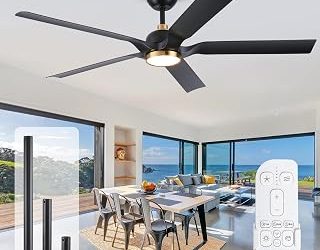
Matte Black 44″ 5-Blade Flush Mount Fan
This is the sweet spot for most bedrooms and mid-size living rooms, with enough blade span to move real air and a matte black finish that reads intentional rather than builder-grade. The DC motor is quiet enough that I’ve installed these over beds without complaints about hum at low speed.
24″ Bladeless Enclosed Fan with RGB Lights
Bladeless enclosed designs are the answer for hallways, kids’ rooms, and any ceiling under eight feet where you want zero pinch risk. The RGB lighting is a genuine feature rather than a gimmick if you’re outfitting a media room, though airflow is gentler than an open-blade fan of the same diameter.
TCL 52″ White Flush Mount Fan
At 52 inches, this is the one I’d reach for in a great room or a two-car garage where smaller fans just stir the air near the ceiling. Six speeds and a dimmable LED panel mean it handles both workshop brightness and evening ambiance without adding a separate fixture.
42″ Black Flush Mount with 3CCT and App Control
The 3CCT lighting plus app scheduling makes this a strong pick if you want the fan to run on a timer before you get home. The reversible DC motor and memory function mean it wakes up at your last setting instead of defaulting to full blast at 2 a.m.
Amico 42″ White Flush Mount Fan
Amico’s install experience is among the cleanest in this price bracket, with clear labeling and a hanging bracket that lets you free both hands during wiring. Damp-location rating makes it viable for covered porches, which most low profile fans can’t claim.
Frequently Asked Questions
How much clearance do I actually need?
Code calls for a minimum of seven feet from finished floor to the lowest blade edge. Most low profile fans sit 8-11 inches below the ceiling, so an eight-foot ceiling leaves comfortable margin.
Do flush mount fans move less air?
Older ones did. Modern designs compensate with steeper blade pitch and higher-torque DC motors, though a downrod fan will still outperform an equivalent hugger by a modest margin.
Can I install one myself?
If you’re comfortable identifying line, neutral, and ground and you can shut off the correct breaker, yes. Verify the box is fan-rated first, and have a helper or a hook to support the weight while wiring.
Are integrated LEDs replaceable?
Usually not individually, but most quality panels are rated for 25,000-50,000 hours. Some models let you swap the entire LED module, which is worth checking before purchase.
Final Thoughts
For most rooms, the 44-inch matte black fan hits the best balance of airflow, quiet operation, and finish quality. Scale up to the TCL 52-inch for open-plan spaces and garages, or drop to the 24-inch bladeless model when ceiling height is genuinely tight and safety matters more than raw CFM. All three are straightforward single-afternoon installs with a fan-rated box.