Key takeaways
- Match diameter to your footprint: A 96-inch fan covers roughly a two-car garage; 120 inches suits open shops, barns, and gyms with 14-foot-plus ceilings. Going bigger than your ceiling height allows creates turbulence, not comfort — plan on at least 10 feet of clearance under the blades.
- DC and PMSM motors earn their keep: Permanent-magnet motors draw dramatically less current than AC units at comparable airflow, run cooler, and give you usable low speeds for winter air mixing. On a shop circuit already feeding a compressor and welder, that headroom matters.
- Check your mounting structure honestly: These fans weigh 40 to 90 pounds and generate real torque. You need a fan-rated box lagged into solid framing or a purpose-built beam bracket — never a drywall ceiling box or a single sheet-metal purlin without blocking.
- Downrod length and ceiling pitch: Sloped or trussed ceilings need a longer rod and a canopy rated for the angle. Kits shipping with multiple downrods save you a return trip to the supply house when your measurement is off by a foot.
- Damp rating and reversibility: Covered patios, barns, and unconditioned garages see condensation. A damp-rated housing plus a reversible motor lets you push warm ceiling air down in winter, which pays for itself in heating season.
What's inside
Anyone who has spent a July afternoon in an uninsulated shop knows the problem: a 52-inch residential fan spinning at full tilt just stirs hot air around your head while the far corner of the bay stays dead still. Big spaces need big air movement, and that means moving a large volume of air slowly rather than a small volume fast. Swap in the wrong fan and you get noise, wobble, a flickering shadow strobe across your workbench, and a motor that runs hot by August.
I’ve hung enough of these in garages, barns, and pole buildings to know where the real decisions live — joist layout, downrod length, ceiling slope, and whether your existing wiring can handle the load. This guide covers HVLS (high-volume, low-speed) fans from 96 to 120 inches, plus a couple of compact industrial-grade options for tighter ceilings, with notes on install headaches you’ll want to plan for before you’re up on the ladder.
As an Amazon Associate we earn from qualifying purchases.


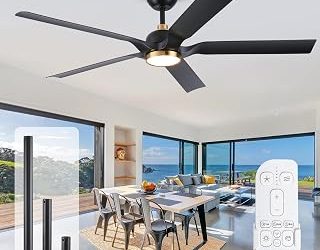
![[HVLS]96 Inch Industrial Ceiling Fan, Extra Large Commercial Big Assed Ceiling Fan, 8 Aluminum Blades, Reversible DC Motor, Remote Control with 6 Speeds, 3 Downrods, for Shop, Garage, Gym, Black](https://m.media-amazon.com/images/I/71sFsM+09vL._AC_UL320_.jpg)
How to Choose a/an Industrial Ceiling Fan (2026)
- Match diameter to your footprint: A 96-inch fan covers roughly a two-car garage; 120 inches suits open shops, barns, and gyms with 14-foot-plus ceilings. Going bigger than your ceiling height allows creates turbulence, not comfort — plan on at least 10 feet of clearance under the blades.
- DC and PMSM motors earn their keep: Permanent-magnet motors draw dramatically less current than AC units at comparable airflow, run cooler, and give you usable low speeds for winter air mixing. On a shop circuit already feeding a compressor and welder, that headroom matters.
- Check your mounting structure honestly: These fans weigh 40 to 90 pounds and generate real torque. You need a fan-rated box lagged into solid framing or a purpose-built beam bracket — never a drywall ceiling box or a single sheet-metal purlin without blocking.
- Downrod length and ceiling pitch: Sloped or trussed ceilings need a longer rod and a canopy rated for the angle. Kits shipping with multiple downrods save you a return trip to the supply house when your measurement is off by a foot.
- Damp rating and reversibility: Covered patios, barns, and unconditioned garages see condensation. A damp-rated housing plus a reversible motor lets you push warm ceiling air down in winter, which pays for itself in heating season.
The Best Industrial Ceiling Fan (2026)s Reviewed
ZMISHIBO 96-Inch Industrial Fan
Eight extruded aluminum blades on a DC motor, damp-rated, with three downrods in the box — that last detail is why this one keeps landing in my recommendations, since ceiling height guesses rarely survive contact with reality. Six speeds give you genuine low-end control, and the remote handles reversal without a second wall run.
AA-Orion 120-Inch HVLS Fan
At over 28,000 CFM, this is the fan for open-span buildings where nothing smaller makes a dent. The PMSM motor stays quiet enough that you can hold a conversation underneath it, though you’ll want a solid beam mount and a helper for the lift.
Air King 9718 18-Inch Ceiling Mount Fan
A completely different animal: an industrial-grade spot cooler for low ceilings, mezzanines, and work cells where an HVLS blade sweep is impossible. Steel construction, pull-chain simplicity, and it targets air exactly where you’re standing.
100-Inch HVLS Shop Fan
Roughly 15,000 CFM from eight aluminum blades and a reversible DC motor, which puts it in the sweet spot for a deep two-bay garage or a small barn. Less overhead demand than the 120-inch fans and noticeably easier to hang solo.
Westinghouse 7861400 56-Inch Industrial Fan
Three heavy steel blades, brushed nickel finish, and an included wall control make this the practical choice for finished shops, basements, and workrooms with eight- or nine-foot ceilings. It’s indoor-only, so keep it out of damp spaces.
Frequently Asked Questions
How much ceiling height do I need for a 96-inch fan?
Aim for 12 feet minimum, with at least 10 feet of clearance from floor to blade. Below that, blade wash becomes uncomfortable and you lose the slow, broad column of air that makes HVLS fans work.
Can I wire one of these to an existing fan box?
Usually not. Standard fan-rated boxes are tested to around 70 pounds of static load, and HVLS fans exceed that while adding dynamic torque. Mount to framing with lag bolts or a manufacturer beam bracket, and have an electrician verify the circuit if you’re unsure.
Do reversible motors actually help in winter?
Yes, meaningfully. Running slowly in reverse destratifies the warm air trapped at your ceiling and pushes it back into the occupied zone, which cuts heater runtime in tall buildings.
Will a big fan strobe under my LED shop lights?
It can if your lights have high flicker. Choose fixtures with low flicker percentage and mount them so blades don’t pass directly beneath, or offset the fan from your primary light rows.
Final Thoughts
For most home shops and garages, the ZMISHIBO 96-inch is the balanced pick — damp-rated, DC-efficient, and shipped with the downrods you’ll actually need. Step up to the AA-Orion 120-inch if you’re cooling an open barn or gym, and keep the Westinghouse 7861400 in mind when your ceiling simply won’t accommodate an eight-foot blade sweep.