Key takeaways
- Joint hardware over stated capacity: A 3,000 lb rating means little if the corners rely on friction-fit tabs. Look for bolted or screwed connections at the head and foot rails — those are the joints that loosen first and cause the creak everyone blames on the mattress.
- Slat spacing and material: Steel slats spaced 3 inches or less support foam and hybrid mattresses without sag. Wider gaps let memory foam bulge through, which voids most mattress warranties and creates dead spots you’ll feel within a season.
- Center support legs: Count them. A queen needs at least two center legs, ideally three, with adjustable feet. Frames with a single center post transmit every movement across the entire span.
- Real clearance, not headline height: An 18-inch frame doesn’t give you 18 inches of storage — subtract the rail depth. Measure your bins first, then check the usable figure in the spec sheet rather than the product title.
- Noise-proofing details: Rubber or felt washers at slat contact points, plus vinyl-capped feet, do more for silence than any amount of steel gauge. If the listing doesn’t mention them, plan on adding your own.
What's inside
Every metal bed frame looks the same in a listing photo. The differences show up at 2 a.m. when you roll over and the whole thing announces it, or six months in when a center leg has quietly wandered off the floor and one side of the mattress sits lower than the other. Most of that comes down to a handful of unglamorous details: how the slats attach, whether the joints are bolted or just slotted together, and how many legs actually carry load rather than decorating the perimeter.
I’ve put together frames on hardwood, on carpet over plywood, and on one memorably uneven 1940s floor, and the pattern holds. Below I’ve broken down what to inspect before you buy, then walked through five queen frames worth considering in 2026 — with notes on assembly quirks, storage clearance, and which ones hold up to a rough shove.
As an Amazon Associate we earn from qualifying purchases.


How to Choose a Metal Bed Frame (2026)
- Joint hardware over stated capacity: A 3,000 lb rating means little if the corners rely on friction-fit tabs. Look for bolted or screwed connections at the head and foot rails — those are the joints that loosen first and cause the creak everyone blames on the mattress.
- Slat spacing and material: Steel slats spaced 3 inches or less support foam and hybrid mattresses without sag. Wider gaps let memory foam bulge through, which voids most mattress warranties and creates dead spots you’ll feel within a season.
- Center support legs: Count them. A queen needs at least two center legs, ideally three, with adjustable feet. Frames with a single center post transmit every movement across the entire span.
- Real clearance, not headline height: An 18-inch frame doesn’t give you 18 inches of storage — subtract the rail depth. Measure your bins first, then check the usable figure in the spec sheet rather than the product title.
- Noise-proofing details: Rubber or felt washers at slat contact points, plus vinyl-capped feet, do more for silence than any amount of steel gauge. If the listing doesn’t mention them, plan on adding your own.
The Best Metal Bed Frame (2026)s Reviewed
NEW JETO 18-Inch Queen Frame with Storage
The tallest option here, and the one to pick if you’re treating under-bed space as real storage rather than an afterthought — full-depth totes slide in without tipping. Assembly is genuinely quick since most of the structure bolts together with a single Allen key, though I’d recommend snugging every fastener a second time after the first week of use.
Allewie Queen with Victorian Iron-Art Headboard
The scrollwork headboard and footboard give this a wrought-iron look that reads far more expensive than it is, and the decorative panels are welded rather than clipped, so nothing rattles. Worth noting the footboard adds real length to the footprint — measure your walkway before committing to a smaller room.
MAF 14-Inch Platform with Round Corner Legs
My pick for pure structural confidence: heavy-gauge steel slats, a mattress baffle that stops midnight creep, and rounded corner legs that spare your shins and baseboards. The 12.4 inches of clearance is honest, and the noise-free claim held up under deliberate abuse.
Allewie 14″ Queen with 50″ Vintage Headboard
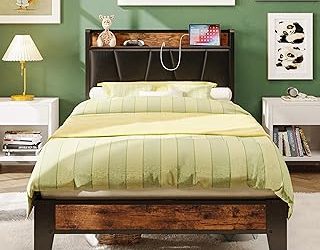
That 50-inch headboard is the draw here — tall enough to anchor a wall without a separate upholstered panel, and it stays put once the side rails are torqued down. Combined with the low 14-inch profile, it suits anyone who wants presence at the head of the bed and a mattress height that doesn’t feel like climbing.
Hafenpo 14-Inch Queen Platform
The straightforward workhorse of the group: no headboard, no styling, just a well-braced platform with solid bearing capacity and usable storage beneath. It’s the frame I’d put in a guest room or under a bed that already has a wall-mounted headboard doing the visual work.
Frequently Asked Questions
Do metal frames really work without a box spring?
Yes, provided the slats are steel and closely spaced. The platform surface performs the same job a box spring does, which is why every frame here is rated for direct mattress contact. Adding a box spring on top just raises the sleep surface unnecessarily.
Why does my new frame squeak?
Almost always under-tightened hardware or metal-on-metal contact at the slat ends. Go around with the supplied wrench and finish every bolt properly, then slip felt pads or thin rubber washers between the slats and rails. That fixes the vast majority of cases.
How do I stop the legs from denting carpet or hardwood?
Set 3-inch furniture coasters or plywood squares under each leg, including the center supports. This spreads the load, keeps adjustable feet from punching through carpet padding, and makes the frame easier to nudge into position.
Can one person assemble these?
Mostly yes, though the taller storage frames are easier with a second set of hands to hold rails square while you start the bolts. Leave all fasteners finger-tight until the full frame is standing, then tighten in a crisscross pattern.
Final Thoughts
For most buyers the MAF 14-inch platform is the smartest all-round choice — dense slat support, honest clearance, and the quietest performance of the group. Go with the NEW JETO 18-inch if under-bed storage is the priority, or the Allewie Victorian iron-art frame when you want the bed itself to carry the room’s style.