Key takeaways
- Blade span vs. room size: Measure the room’s longest wall before you shop. Under 100 sq ft, a 20–30″ fan is plenty; 150–300 sq ft wants 44–52″. Oversizing a hugger in a small room just makes noise and papers fly.
- DC vs. AC motor: DC motors run quieter, draw roughly 60–70% less power, and give you six or more speeds instead of three. If the fan will run in a bedroom, spend the extra money here. It’s the single upgrade you’ll notice nightly.
- Check your junction box rating: This is non-negotiable. The box must be stamped “fan rated” or “acceptable for fan support.” A drywall-only light box will pull loose. Swapping in a proper brace box takes 20 minutes and costs less than a pizza.
- Control method: Remote-only fans are easiest to wire (single hot line, no traveler needed), but you’ll lose the remote eventually. Pull chain models like the Hunter Builder never need batteries. App-controlled fans need solid 2.4GHz coverage at ceiling height, which isn’t guaranteed in a basement.
- Light output and color temp: Look for 3CCT or stepless tuning so you can shift from 3000K warm in a bedroom to 5000K in a kitchen. Integrated LEDs aren’t user-replaceable, so check that the fixture is rated for 30,000+ hours.
What's inside
If you’ve ever stood on a ladder with a downrod-mounted fan wobbling six inches from your forehead, you already know the problem: standard ceiling fans assume you’ve got nine-foot ceilings. Most of us don’t. In a room with an 8-foot ceiling, a fan hanging on even the shortest downrod eats the clearance you need to walk under it comfortably, and building code wants 7 feet of headroom below the blades. Flush mount fans (also called hugger or low profile fans) bolt straight to the junction box, which buys you back those critical inches.
The tradeoff used to be real. Hugger fans moved less air because the blades sat too close to the ceiling to pull a clean column of it. That’s changed. DC motors, better blade pitch, and integrated LED panels have made 2026’s crop genuinely competitive with downrod fans. I’ve installed a fair number of these in basements, kids’ rooms, and one very cramped attic conversion, so below you’ll find what actually matters at the electrical box, plus honest notes on six models worth your time.
As an Amazon Associate we earn from qualifying purchases.


How to Choose a Flush Mount Ceiling Fan (2026)
- Blade span vs. room size: Measure the room’s longest wall before you shop. Under 100 sq ft, a 20–30″ fan is plenty; 150–300 sq ft wants 44–52″. Oversizing a hugger in a small room just makes noise and papers fly.
- DC vs. AC motor: DC motors run quieter, draw roughly 60–70% less power, and give you six or more speeds instead of three. If the fan will run in a bedroom, spend the extra money here. It’s the single upgrade you’ll notice nightly.
- Check your junction box rating: This is non-negotiable. The box must be stamped “fan rated” or “acceptable for fan support.” A drywall-only light box will pull loose. Swapping in a proper brace box takes 20 minutes and costs less than a pizza.
- Control method: Remote-only fans are easiest to wire (single hot line, no traveler needed), but you’ll lose the remote eventually. Pull chain models like the Hunter Builder never need batteries. App-controlled fans need solid 2.4GHz coverage at ceiling height, which isn’t guaranteed in a basement.
- Light output and color temp: Look for 3CCT or stepless tuning so you can shift from 3000K warm in a bedroom to 5000K in a kitchen. Integrated LEDs aren’t user-replaceable, so check that the fixture is rated for 30,000+ hours.
The Best Flush Mount Ceiling Fans (2026) Reviewed
LEDIARY 20″ Modern Fandelier
This is the one I reach for in hallways, laundry rooms, and walk-in closets where a 52″ fan would be absurd. The stepless color temperature adjustment is genuinely useful, and at 20″ it clears tight corners, though don’t expect it to cool a full living room.
Sofucor 52″ Wood Low Profile
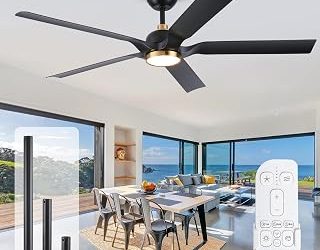
The best all-rounder here: a quiet reversible DC motor, six speeds, 3CCT dimming, and wood-finish blades that read as farmhouse without feeling like a costume. It’s damp-rated for covered patios too, which is rare at this size and price.
Hunter Builder 52″ New Bronze
Hunter’s Builder series is the workhorse of the category, and the pull chain design means no pairing, no batteries, no firmware. The five-blade AC motor is louder than a DC unit at high speed, but the WhisperWind bearing assembly holds up for years and the installation hardware is a cut above.
DREO 44″ Flush Mount Smart Fan
DREO’s engineering shows in how little this fan hums at low speeds, and the app scheduling is actually well built rather than bolted on. At 44″ it splits the difference nicely for bedrooms in the 150–200 sq ft range.
ZMISHIBO 52″ Low Profile
Strong airflow for a hugger, with both remote and app control and a dimmable 20W LED panel. The wiring harness is clearly labeled and the canopy hooks let you hang the motor housing while you connect leads, which is a small mercy when you’re working overhead alone.
Frequently Asked Questions
How much ceiling height do I need?
Code requires 7 feet from floor to blade. A flush mount fan typically drops 8–12 inches total, so an 8-foot ceiling works comfortably. Below 7’10”, measure your specific model’s height before buying.
Do flush mount fans move less air?
Slightly, yes. Blades closer to the ceiling get less clean intake. Modern DC models close most of that gap by using steeper blade pitch and higher RPM ranges, so the practical difference is small in rooms under 300 sq ft.
Can I install one myself?
If you’re comfortable killing a breaker, testing the line with a non-contact tester, and identifying hot/neutral/ground, yes. Budget 90 minutes for your first one. If your box isn’t fan rated or you find aluminum wiring or no ground conductor, call an electrician.
Why does my fan wobble?
Nearly always blade balance or a loose mounting bracket, not the motor. Tighten every bracket screw, confirm all blades sit at identical distance from the ceiling, and use a stick-on balancing weight on the light blade if needed.
Final Thoughts
For most rooms, the Sofucor 52″ is the pick I’d make with my own money: quiet DC motor, tunable light, and finish options that suit real rooms. Choose the Hunter Builder if you want a fan that will outlive three remotes and never need an app update, and grab the DREO 44″ if smart scheduling and a mid-size footprint fit your bedroom better than a full 52″ span.