Key takeaways
- Insist on a DC motor: Brushless DC motors run cooler, draw a fraction of the power, and eliminate the 60Hz hum that AC motors push through the mounting plate. Look for published noise figures around 20–25dB rather than vague “whisper” claims.
- Count the speeds: Six speeds is workable; twelve or stepless control is better. More increments mean you can find the airflow level that cools the room without pushing the motor into its noisy upper range.
- Check ceiling height before blade span: Flush-mount and low-profile designs suit anything under eight feet, but a fan mounted too close to the ceiling recirculates air and sounds louder as blades chop through turbulence. Aim for 8–10 inches of clearance where you can.
- Match blade material to location: Solid or engineered wood blades damp vibration and look right in living spaces. For covered patios, confirm the blades are moisture-rated, or they will warp and throw the fan out of balance within a season.
- Plan the wiring first: Fans without integrated lights need a single switched hot, while light-and-fan combos want either a two-switch setup or full remote control. Verify your box is fan-rated for the load before you commit.
What's inside
Anyone who has ever stood on a ladder at 11 p.m., wire nuts in one hand and a downrod in the other, knows the real test of a ceiling fan comes after the breaker goes back on. The blades spin, the room cools, and then you hear it: a faint tick on every rotation, a hum through the junction box, a rattle in the canopy that no amount of tightening seems to fix. Noise is rarely a defect. It is usually the sum of a cheap AC motor, blades that were never balanced against each other, and a mounting bracket transmitting vibration straight into your joists.
This guide approaches silent fans the way a maker would: from the motor out. We look at what actually makes a fan quiet, which specs are worth paying for in 2026, and how installation choices can undo an otherwise excellent machine. Below are the models worth your bracket screws, spanning flush-mount low-profile units for tight ceilings, bladed propeller fans for covered patios, and smart DC fans with app control.
As an Amazon Associate we earn from qualifying purchases.


How to Choose a Silent Ceiling Fan (2026)
- Insist on a DC motor: Brushless DC motors run cooler, draw a fraction of the power, and eliminate the 60Hz hum that AC motors push through the mounting plate. Look for published noise figures around 20–25dB rather than vague “whisper” claims.
- Count the speeds: Six speeds is workable; twelve or stepless control is better. More increments mean you can find the airflow level that cools the room without pushing the motor into its noisy upper range.
- Check ceiling height before blade span: Flush-mount and low-profile designs suit anything under eight feet, but a fan mounted too close to the ceiling recirculates air and sounds louder as blades chop through turbulence. Aim for 8–10 inches of clearance where you can.
- Match blade material to location: Solid or engineered wood blades damp vibration and look right in living spaces. For covered patios, confirm the blades are moisture-rated, or they will warp and throw the fan out of balance within a season.
- Plan the wiring first: Fans without integrated lights need a single switched hot, while light-and-fan combos want either a two-switch setup or full remote control. Verify your box is fan-rated for the load before you commit.
The Best Silent Ceiling Fans of 2026, Reviewed
DREO Smart Ceiling Fan, 52 Inch
The 22dB DC motor and twelve stepless speeds make this the most controllable fan on the list, and the app and Alexa integration means you can dial airflow down overnight without reaching for a remote. It is the pick if you want quiet plus genuine smart-home wiring.
TCL 52″ Black Flush Mount Fan
A well-executed low-profile unit with a six-speed reversible DC motor and dimmable LED, designed for ceilings where a downrod simply will not fit. The flush canopy sits tight and, in our experience, stays quiet as long as the mounting bracket is torqued evenly to a fan-rated box.
ZMISHIBO 52 Inch Flush Mount Fan
Strong airflow for a flush-mount design, with remote and app control and a 20W dimmable LED that handles a bedroom on its own. Assembly is refreshingly straightforward, with blades that seat positively rather than relying on guesswork and washers.
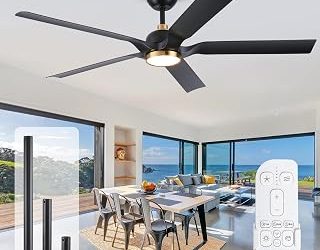
52 Inch Wood Fan, No Light (Walnut)
Three propeller-style walnut blades and no light kit means fewer components to buzz, which is exactly why bladed, lightless fans often run quietest. It suits covered patios and bedrooms already lit by lamps, and the wood finish hides the fasteners well.
Amico 42 Inch Low Profile Fan
At 42 inches, this is the right proportion for small bedrooms, hallways, and covered outdoor nooks where a 52-inch span would overwhelm the space. The three-color dimmable light, timer, and memory function cover the practical bases, and the reversible DC motor keeps winter circulation quiet.
Frequently Asked Questions
Why does my new fan still wobble?
Almost always the blades or the bracket, not the motor. Measure blade tip to ceiling on each blade; a variance over 1/8 inch calls for a balancing kit or reseating the blade arms.
Are fans without lights quieter?
Often marginally, since there is no LED driver and no light housing to resonate. The bigger factor is still motor type and mounting.
Do flush-mount fans move less air?
They can, because reduced ceiling clearance disrupts intake. A DC motor with high-speed headroom largely compensates.
Can I install one alone?
Yes, if the box is fan-rated and the bracket has a hanging hook. Cut the power at the breaker and verify with a tester.
Final Thoughts
For most rooms, the DREO 52-inch smart fan offers the best combination of low noise and fine-grained control, while the TCL flush mount is the stronger choice for low ceilings. If you want the simplest quiet build, the 52-inch walnut fan without a light kit has the fewest parts to ever buzz.