Key takeaways
- Runtime versus power mode: That “60 minutes” figure is measured on the lowest setting with no motorized brush. Expect roughly a third of it on max. If you clean 1,200 square feet in one pass, look for 45 minutes or more on the label and check whether the battery detaches for a spare.
- Brush roll access: Long hair wraps around the roller — every roller, on every vacuum. What matters is whether you can pop it out with a thumb latch or need to hunt for a Phillips screwdriver. Anti-tangle combs help, but tool-free removal is the feature that saves you actual time.
- Filter type and cost: Washable HEPA-style filters are standard here. Confirm replacements are sold separately and inexpensively, then check whether the pack ships with a second filter so you can rotate while one air-dries overnight.
- Mounting hardware: Wall docks are great, but most kits include only drywall anchors. Into studs, masonry, or a plywood shop wall you’ll want your own screws. Free-standing models skip this hassle entirely if you don’t want holes in the wall.
- Dustbin volume and dump mechanism: Anything under 1 liter fills fast in a pet household. A bottom-release trapdoor over the trash beats pulling a canister off and shaking it, which sends fine dust right back into the room.
What's inside
Anything with a plug on it becomes a negotiation with the nearest outlet, and if you’ve ever dragged a canister vacuum across a workshop floor to sweep up sawdust, you know the routine: unplug, re-plug, snag the cord on a sawhorse, repeat. Cordless stick vacuums solve that, but the sub-$100 shelf is crowded with listings shouting suction numbers that mean very little on their own. Two models can both claim 40,000Pa and behave nothing alike once there’s a rug and a golden retriever involved.
I approach these the way I’d size up any tool: what’s serviceable, what’s replaceable, and what’s going to annoy me in month six. This guide covers the spec numbers worth trusting, the maintenance details manufacturers bury in the manual, and honest notes on six budget cordless vacuums that hold up to real use — including which one I’d actually mount in a garage versus which belongs in a hall closet.
As an Amazon Associate we earn from qualifying purchases.



How to Choose a Cordless Vacuum Under $100 (2026)
- Runtime versus power mode: That “60 minutes” figure is measured on the lowest setting with no motorized brush. Expect roughly a third of it on max. If you clean 1,200 square feet in one pass, look for 45 minutes or more on the label and check whether the battery detaches for a spare.
- Brush roll access: Long hair wraps around the roller — every roller, on every vacuum. What matters is whether you can pop it out with a thumb latch or need to hunt for a Phillips screwdriver. Anti-tangle combs help, but tool-free removal is the feature that saves you actual time.
- Filter type and cost: Washable HEPA-style filters are standard here. Confirm replacements are sold separately and inexpensively, then check whether the pack ships with a second filter so you can rotate while one air-dries overnight.
- Mounting hardware: Wall docks are great, but most kits include only drywall anchors. Into studs, masonry, or a plywood shop wall you’ll want your own screws. Free-standing models skip this hassle entirely if you don’t want holes in the wall.
- Dustbin volume and dump mechanism: Anything under 1 liter fills fast in a pet household. A bottom-release trapdoor over the trash beats pulling a canister off and shaking it, which sends fine dust right back into the room.
The Best Cordless Vacuums Under $100 (2026) Reviewed
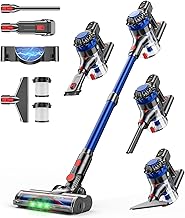
KARDV 8-in-1 Cordless Stick Vacuum (500W / 40Kpa)
The strongest all-rounder of the group: an LED display that shows actual remaining battery instead of three vague dots, plus a genuinely useful attachment set covering crevices, upholstery, and ceiling corners. The wall dock charges while it stores, which is the only storage arrangement I’ve found people stick with long-term.
Tikom V500 Cordless Stick Vacuum
Tikom’s touch-screen control panel makes mode switching intuitive, and the anti-tangle roller earns its name on pet hair and long human hair alike. It’s the pick if hard floors dominate your square footage — the sealed head glides rather than skips over transitions.
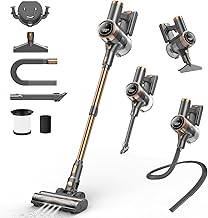
650W / 55Kpa Self-Standing Cordless Vacuum (70 Min)
The self-standing hinge is the sleeper feature: park it mid-job without leaning it against a wall, which matters when you’re working around furniture. It’s also the most capable on medium-pile carpet, and the included car nozzle means you’re not buying a second vacuum for the driveway.
500W / 45Kpa Lightweight Cordless Vacuum (Blue)
Light enough for overhead work — stair edges, baseboards, the top of a bookcase — without your forearm giving out. Runtime is a realistic 45 minutes on eco mode, so it suits apartments and single-floor homes better than sprawling layouts.
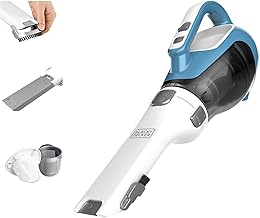
Black+Decker Dustbuster AdvancedClean Handheld
Not a stick vacuum and not pretending to be. This is the tool you keep in the shop for bench dust and in the car for floor mats, with a rotating nozzle that reaches into seat rails and a charging base that keeps it topped off. Buy it as a companion, not a replacement.
Frequently Asked Questions
Can I vacuum sawdust or drywall dust with these?
Coarse sawdust, yes, in small amounts. Drywall dust and fine plaster, no — the particles clog HEPA filters fast and can pass through to the motor. Use a shop vac with a dedicated dust bag for renovation work.
How long do the batteries actually last?
Expect 300 to 500 charge cycles, which is two to three years of twice-weekly cleaning. Storing the vacuum on its charger at full charge indefinitely shortens that, so unplug the dock if you’re away for weeks.
Are these strong enough for thick carpet?
For area rugs and low-to-medium pile, yes. Deep plush carpet is where budget cordless units struggle, since suction alone can’t replace the mechanical agitation of a heavier upright’s beater bar.
Do I need to replace filters or can I just wash them?
Wash monthly under cool water, air-dry a full 24 hours, and replace every six to twelve months. A filter that never fully dries breeds odor and loses airflow permanently.
Final Thoughts
For most homes, the KARDV 8-in-1 offers the best balance of runtime, attachments, and a display you can trust, while the 650W self-standing model is worth the look if carpet and vehicle interiors are in the mix. Pair either with the Black+Decker Dustbuster for spot cleaning, and you’ve covered nearly every mess a house or workshop can produce for well under the price of one mid-range corded upright.