Key takeaways
- Measure the stud bay first: Most 60-inch linear units are built to slip into a 2×6 wall, roughly 5.5 inches of depth. If your wall is 2×4 framing, you either build a shallow bump-out or mount the unit on the surface. Confirm the manufacturer’s rough opening before you touch a drywall saw.
- Check the power situation: At 1500W these pull about 12.5 amps, which means a dedicated 15-amp circuit is the safe play. Some units ship hardwire-ready, others come with a plug you’ll need to hide behind the unit or feed to a recessed outlet inside the cavity.
- Heat output vs. room size: 1500W realistically warms 400 to 500 square feet as supplemental heat. It is not a furnace replacement. If you mainly want the look, make sure the flame runs independently with the heater off.
- Trim and reveal: A unit with a wider front flange forgives an imperfect cut. Flush-mount styles look sharper but demand a clean opening and shimming to sit true. Decide which you’re comfortable with before ordering.
- Controls you’ll actually use: Remote and touch panel are standard. Voice control matters if the firebox ends up above a mantel or behind furniture where the panel is awkward to reach.
What's inside
Cutting a 60-inch hole in a finished wall is the kind of job that looks simple on a Saturday morning and gets complicated by lunch. The listings all promise the same thing — recessed or wall-mounted, 750/1500W, color-changing flames — but they say almost nothing about the stuff that actually decides whether your install goes smoothly: how deep the box is, where the power lead exits, whether the trim covers a slightly ragged drywall cut, and how loud the fan gets once the heater kicks on. Buy the wrong one and you’re either furring out a wall or staring at a gap you have to caulk and repaint.
This guide is written from the tool-belt side of the problem. I’ve focused on the 60-inch models people are actually installing in 2026, with attention to stud-bay depth, mounting hardware, cord routing, and how the flame reads in a real room rather than in a dark showroom. You’ll get a short checklist to run before you buy, honest notes on five units, and answers to the questions that come up mid-install.
As an Amazon Associate we earn from qualifying purchases.




How to Choose a 60-Inch Electric Fireplace (2026)
- Measure the stud bay first: Most 60-inch linear units are built to slip into a 2×6 wall, roughly 5.5 inches of depth. If your wall is 2×4 framing, you either build a shallow bump-out or mount the unit on the surface. Confirm the manufacturer’s rough opening before you touch a drywall saw.
- Check the power situation: At 1500W these pull about 12.5 amps, which means a dedicated 15-amp circuit is the safe play. Some units ship hardwire-ready, others come with a plug you’ll need to hide behind the unit or feed to a recessed outlet inside the cavity.
- Heat output vs. room size: 1500W realistically warms 400 to 500 square feet as supplemental heat. It is not a furnace replacement. If you mainly want the look, make sure the flame runs independently with the heater off.
- Trim and reveal: A unit with a wider front flange forgives an imperfect cut. Flush-mount styles look sharper but demand a clean opening and shimming to sit true. Decide which you’re comfortable with before ordering.
- Controls you’ll actually use: Remote and touch panel are standard. Voice control matters if the firebox ends up above a mantel or behind furniture where the panel is awkward to reach.
The Best 60-Inch Electric Fireplaces Reviewed (2026)
R.W.FLAME 60″ Recessed and Wall Mounted Electric Fireplace
Purpose-built for 2×6 studs, this one has the most forgiving install of the group — the bracket layout lines up with standard framing and the blower stays genuinely quiet, which matters in an open living room. The flame color and speed adjust independently, so you can dial in something subtle rather than the default carnival mode.
Westinghouse 60 Inch Electric Fireplace Heater
The pick if your house already runs on Alexa or Google Home, since scheduling the 24-hour timer by voice beats hunting for the remote. Build quality feels a step up in the glass and frame, and the recessed-or-surface flexibility means you can start with a wall mount and cut it in later.
EUHOMY 60 Inch Recessed Electric Fireplace
The 2026 revision ships with both log and crystal media, which is a nice touch — swap the crystals in for a modern look, logs for something traditional, no extra purchase. Flame realism at the low setting is better than the price suggests.
Antarctic Star 60 Inch Electric Fireplace
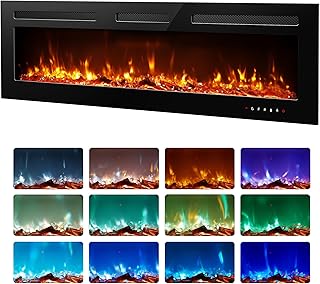
A clean linear look with a multicolor flame bed and both touch-panel and remote control. It’s the straightforward value option here: fewer bells, solid heat, and a slim profile that suits a bump-out wall or a media niche.
AMERLIFE 80″ Fireplace TV Stand with 40″ Fireplace
Include this if you’d rather skip drywall work entirely. The 80-inch high-gloss console carries a 40-inch insert, handles TVs up to 90 inches, and gives you closed storage — an appealing weekend project that involves a screwdriver instead of a reciprocating saw.
Frequently Asked Questions
Can I install a 60-inch fireplace in a 2×4 wall?
Not directly. You’ll need to fur the wall out with 2x2s or build a shallow false wall to gain the extra depth. Many people frame a bump-out the full width of the room so it reads as intentional.
Do I need an electrician?
If you’re adding a dedicated circuit or hardwiring, yes — and check local code. If you’re plugging into an existing outlet behind the unit, verify nothing else heavy shares that circuit.
Can I mount a TV directly above one?
Usually yes, since heat vents forward or upward from the front face rather than out the top. Leave 8 to 12 inches of clearance and check the manual for the specific figure.
How much does it cost to run?
At 1500W and average US rates, expect roughly 20 cents per hour. Running flame-only draws very little, often under 50W.
Final Thoughts
For a clean recessed install in 2×6 framing, the R.W.FLAME is the one I’d cut into a wall, with the Westinghouse close behind if smart-home control is on your list. If you’d rather avoid framing altogether, the AMERLIFE console delivers the same warm glow with a fraction of the mess.