Key takeaways
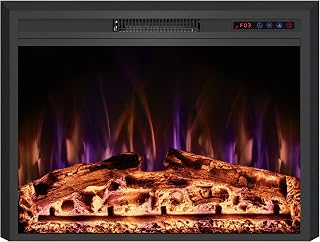
- Flame projection method: Look for units that bounce light off a textured rear panel or rotating rod rather than shining LEDs straight at you. Depth in the firebox is what sells the illusion, which is why recessed models generally beat slim wall-mounts.
- Hearth media options: Swappable logs and crystals matter more than flame color count. Logs with molded ember detail catch the light unevenly, and that irregularity is exactly what reads as real fire.
- Install path and framing: Recessed units need a stud bay opened up. Check the required rough opening depth against your wall build — a 2×4 wall gives you 3.5″, and some fireboxes want a 2×6 bay or a bump-out. Measure before you buy, not after.
- Power draw and circuits: A 1,500W heater pulls roughly 12.5 amps, which will monopolize a 15A circuit. Plan for a dedicated 120V line, and put the receptacle inside the framed cavity so no cord shows.
- Serviceability: Mantel packages with a replaceable insert let you swap the guts in five years without ripping out the woodwork. That single feature quietly doubles the life of the piece.
What's inside
Nothing kills a cozy living room faster than an electric fireplace with flames that look like a screensaver from 2009. The problem is that almost every listing photo is shot in a dark room at the flattering angle, so a flat orange LED strip and a genuinely convincing ember bed look nearly identical on screen. Then the box arrives, you get it wired in, and the “realistic” flame turns out to be a repeating loop with a hard seam down the middle.
I’ve installed enough of these to know that realism comes down to three things: how the light is projected, what it reflects off of, and how the trim meets your wall. This guide breaks down the models that actually hold up in a bright room, what to check before you cut drywall, and which ones are worth the framing work versus which ones you can unbox and plug in on a Saturday afternoon.
As an Amazon Associate we earn from qualifying purchases.


How to Choose a Realistic Electric Fireplace (2026)
- Flame projection method: Look for units that bounce light off a textured rear panel or rotating rod rather than shining LEDs straight at you. Depth in the firebox is what sells the illusion, which is why recessed models generally beat slim wall-mounts.
- Hearth media options: Swappable logs and crystals matter more than flame color count. Logs with molded ember detail catch the light unevenly, and that irregularity is exactly what reads as real fire.
- Install path and framing: Recessed units need a stud bay opened up. Check the required rough opening depth against your wall build — a 2×4 wall gives you 3.5″, and some fireboxes want a 2×6 bay or a bump-out. Measure before you buy, not after.
- Power draw and circuits: A 1,500W heater pulls roughly 12.5 amps, which will monopolize a 15A circuit. Plan for a dedicated 120V line, and put the receptacle inside the framed cavity so no cord shows.
- Serviceability: Mantel packages with a replaceable insert let you swap the guts in five years without ripping out the woodwork. That single feature quietly doubles the life of the piece.
The Best Realistic Electric Fireplaces (2026), Reviewed
Touchstone Sideline 50″ Smart Recessed Fireplace
This is the one I’d build a wall around. Thirty ember and flame combinations sounds like marketing filler until you see the log set lit at low intensity in daylight, where the multi-layer flame keeps its depth instead of flattening out. WiFi and Alexa control are genuinely useful for scheduling the 1,500W thermostat heater, and the trim tolerances are tight enough that a clean drywall return looks factory-finished.
Real Flame Malie 68″ Landscape Mantel
The widest pick here, and the landscape firebox is the reason: a long, low flame line reads far more like a real firebox than a tall narrow one. Assembly is straightforward cam-lock cabinetry, and the insert pulls out from the front if it ever needs replacing.
Real Flame Silverton 48″ White Mantel
A well-proportioned option for a room that needs a focal point without a wall project. The white finish takes paint touch-ups nicely if you want to color-match trim, and the log and flame effect is the same convincing insert Real Flame uses across its line.
Real Flame Cravenhall Landscape Mantel
Cravenhall pairs the landscape firebox with a heavier mantel profile, which makes it the better choice under a mounted TV where you want visual mass below the screen. Remote and timer control are standard, and the top shelf is deep enough to be genuinely usable.
R.W.FLAME 60″ Recessed Wall-Mount
The value pick for anyone doing their own framing, and notably it fits a 2×6 stud bay without a bump-out. Flame color and speed are both adjustable via touch screen or remote, and the blower is quiet enough that you won’t hear it over a conversation.
Frequently Asked Questions
Do I need an electrician?
For a plug-in mantel unit, no. For a recessed install, you’ll want a dedicated 120V circuit run to the cavity, and that’s electrician territory in most jurisdictions unless you’re permitted to do your own work.
Can I mount a TV above one?
Yes, provided the unit vents from the front or top-front and you leave the manufacturer’s clearance. Check the spec sheet rather than assuming — front-venting is common but not universal.
How much heat do these actually put out?
A 1,500W unit handles roughly 400 square feet as supplemental heat. It’s a shoulder-season and single-room solution, not a furnace replacement.
Are the cheaper mantel units worth it?
Often yes. Something like the Naice 44″ mantel with its stacked stone surround delivers a lot of presence for the money, and doubles as a TV stand.
Final Thoughts
If you’re willing to open a wall, the Touchstone Sideline 50″ is the most convincing flame in this group and the smart controls earn their keep. For a no-cut install with real visual weight, the Real Flame Malie 68″ landscape mantel is the pick, and the R.W.FLAME 60″ is the budget-conscious recessed option that still fits standard framing.