Key takeaways
- Measure the opening, not the window: Record the clear inside width and height of the sash channel, then subtract nothing — that’s your hard ceiling. A true casement unit runs roughly 15 inches wide by 23 to 24 inches tall, so if your opening is narrower than 15.25 inches, you’re building a panel or going portable.
- Match BTU to square footage honestly: Around 10,000 BTU covers 450 square feet; 8,000 handles 350. Oversizing feels clever and isn’t — the unit short-cycles, never runs long enough to pull humidity, and leaves the room clammy.
- Check the crank clearance: Outward-opening casements need the operator arm either removed or fully retracted. Confirm you can reach the mechanism after the unit is seated, or you’ll be pulling it back out.
- Plan your filler panel and seal: Above or beside the unit you’ll have empty sash space. Half-inch exterior plywood or rigid foam board, cut to fit and sealed with closed-cell weatherstripping plus exterior caulk, beats the flimsy accordion vents every time.
- Decide how much you want to drill: Casement installs almost always mean screwing into the frame and adding support. If your window is historic, aluminum-clad, or a rental, a portable unit vented through a slim panel keeps the frame untouched.
What's inside
Casement windows are lovely to look at and a genuine headache to cool. That tall, narrow opening — whether it cranks outward on a hinge or slides sideways in a track — refuses the wide, squat box that every standard window AC is built around. Anyone who has tried to wedge a conventional unit into a 15-inch-wide sash knows how that ends: a gap stuffed with foam, a crank arm jammed against the housing, and a rain-catching sill you now regret. The fix is either a vertically oriented unit built for the job, or a smart workaround with a filler panel you cut yourself.
This guide walks through both routes. I measured openings, cut a few scrap-plywood panels, and paid close attention to the details makers actually care about: real cabinet dimensions, where the mounting screws land, whether the crank mechanism clears, how the condensate drains, and how much sealing work you’re signing up for. Below are the units worth your time in 2026, plus the sizing math and installation notes that decide whether this becomes a Saturday project or a two-weekend saga.
As an Amazon Associate we earn from qualifying purchases.



How to Choose a Casement Window Air Conditioner (2026)
- Measure the opening, not the window: Record the clear inside width and height of the sash channel, then subtract nothing — that’s your hard ceiling. A true casement unit runs roughly 15 inches wide by 23 to 24 inches tall, so if your opening is narrower than 15.25 inches, you’re building a panel or going portable.
- Match BTU to square footage honestly: Around 10,000 BTU covers 450 square feet; 8,000 handles 350. Oversizing feels clever and isn’t — the unit short-cycles, never runs long enough to pull humidity, and leaves the room clammy.
- Check the crank clearance: Outward-opening casements need the operator arm either removed or fully retracted. Confirm you can reach the mechanism after the unit is seated, or you’ll be pulling it back out.
- Plan your filler panel and seal: Above or beside the unit you’ll have empty sash space. Half-inch exterior plywood or rigid foam board, cut to fit and sealed with closed-cell weatherstripping plus exterior caulk, beats the flimsy accordion vents every time.
- Decide how much you want to drill: Casement installs almost always mean screwing into the frame and adding support. If your window is historic, aluminum-clad, or a rental, a portable unit vented through a slim panel keeps the frame untouched.
The Best Casement Window Air Conditioners (2026) Reviewed
Perfect Aire 10,000 BTU Casement Air Conditioner
This is the purpose-built answer: 14.75 inches wide by 23.5 tall, dimensioned specifically for sliding and crank-out sashes, with a digital LED display and Follow Me remote that reads temperature where you’re sitting rather than at the chassis. If your opening clears 15 inches, start and probably finish here.
Element ESC10BE 10,000 BTU Window Casement Unit
A straightforward vertical-format 10,000 BTU unit with a no-nonsense control set, and typically the value play against the Perfect Aire. Build quality is functional rather than refined, so budget an hour for proper gasketing and a bead of exterior caulk along the sill.
Air Choice 10,000 BTU Portable Air Conditioner
The zero-drilling escape hatch — it cools the same 450 square feet, and you vent it through a plywood or foam panel you cut once and store each fall. Dehumidifier and fan modes plus a 24-hour timer make it genuinely useful year-round, though it occupies floor space and runs louder than a window install.
Midea 10,000 BTU U-Shaped Smart Inverter
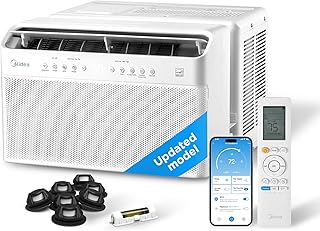
Not a casement unit, but worth knowing about if you have a double-hung window elsewhere in the same room: the U-shaped saddle design lets the sash close through the middle, cutting noise dramatically and saving roughly 35% on energy. Alexa and Google support and inverter compressor control make it the quietest option on this list by a wide margin.
BLACK+DECKER 12,000 BTU Window Unit
The pick for larger rooms up to 550 square feet where a wide double-hung window is available, with three cooling speeds, a fan-only mode, and remote control. Its horizontal cabinet will not fit a casement opening — treat it as the alternate-window solution, not a casement candidate.
Frequently Asked Questions
Can I put a regular window AC in a casement window?
Not safely. Standard units are wider than they are tall and depend on the sash pressing down on the top flange for support. A casement opening gives you neither the width nor the clamping force, so the unit would rely entirely on improvised bracing.
Do I have to remove the crank mechanism?
On most outward-opening casements, yes — at minimum the operator arm has to disconnect from the sash. Keep the hardware and screws bagged and labeled so reinstallation in the fall takes ten minutes.
What should I make the filler panel from?
Half-inch exterior-grade plywood painted on both faces, or foil-faced rigid foam if you want more R-value and less weight. Cut it about 1/8 inch undersized, then close the gap with closed-cell foam tape so it compresses into a real seal.
How do I keep rain out of the opening?
Pitch the unit very slightly toward the exterior so condensate drains outward, then seal the top and sides with exterior-grade caulk and add a small drip edge or flashing above the unit. Leave the bottom edge of your panel unsealed so any water that does get in can escape.
Final Thoughts
For a genuine casement opening, the Perfect Aire 10,000 BTU is the one to buy — the dimensions are right, the Follow Me remote is a real comfort upgrade, and the install is predictable. The Element ESC10BE covers the same ground for less if you’re willing to do more sealing work, and the Air Choice portable is the right call for rentals or windows you’d rather not put a drill to.