Key takeaways
- Panel material and thickness: Steel-frame units with fabric or thin metal panels win on price and assembly speed; engineered wood at 15mm or thicker holds screws better and won’t drum when you close a door. Check whether the back is a solid panel or a thin sheet held by tacks, because that back panel is what stops the whole box from twisting.
- Rod support spacing: A hanging rod spanning more than 36 inches without a center support will bow under a loaded coat section. Look for a rod that seats into cupped brackets rather than resting in open notches, and count how many hanging zones the layout actually gives you.
- Hinge and closure hardware: Soft-close hinges are worth the upcharge if the wardrobe sits in a bedroom you enter at 6 a.m. Magnetic catches are the practical alternative on metal units — they hold doors flush without the alignment fussiness of a latch.
- Real footprint versus door swing: Measure the cabinet depth, then add 20 to 24 inches of clearance for the doors to open fully. A 95-inch-wide six-door unit needs a genuinely unobstructed wall, not a wall with a radiator on one end.
- Anti-tip anchoring: Any wardrobe over 65 inches tall should ship with a wall strap, and you should use it. Locate a stud, not drywall anchors, especially on units with pull-out drawers that shift the center of gravity forward.
What's inside
Old houses and rentals share a common insult: a single shallow closet with one sagging rod, or no closet at all. If you’ve ever measured a doorway with a tape measure clenched in your teeth, wondering whether a freestanding wardrobe will clear the baseboard trim, you already know the real problem isn’t storage capacity — it’s fitting real storage into a room that was never designed for it. An armoire wardrobe solves that, but only if you pick one whose build quality matches how you actually load it.
I’ve assembled enough flat-pack furniture to have opinions about cam locks, and enough steel-frame units to know which ones rack under a full rod of winter coats. This guide covers what to look for in a 2026 armoire — panel material, rod support, hinge type, and how the thing behaves once it’s actually holding weight — followed by reviews of six standouts spanning steel budget builds to nine-drawer wooden systems.
As an Amazon Associate we earn from qualifying purchases.




How to Choose a/an Armoire Wardrobe (2026)
- Panel material and thickness: Steel-frame units with fabric or thin metal panels win on price and assembly speed; engineered wood at 15mm or thicker holds screws better and won’t drum when you close a door. Check whether the back is a solid panel or a thin sheet held by tacks, because that back panel is what stops the whole box from twisting.
- Rod support spacing: A hanging rod spanning more than 36 inches without a center support will bow under a loaded coat section. Look for a rod that seats into cupped brackets rather than resting in open notches, and count how many hanging zones the layout actually gives you.
- Hinge and closure hardware: Soft-close hinges are worth the upcharge if the wardrobe sits in a bedroom you enter at 6 a.m. Magnetic catches are the practical alternative on metal units — they hold doors flush without the alignment fussiness of a latch.
- Real footprint versus door swing: Measure the cabinet depth, then add 20 to 24 inches of clearance for the doors to open fully. A 95-inch-wide six-door unit needs a genuinely unobstructed wall, not a wall with a radiator on one end.
- Anti-tip anchoring: Any wardrobe over 65 inches tall should ship with a wall strap, and you should use it. Locate a stud, not drywall anchors, especially on units with pull-out drawers that shift the center of gravity forward.
The Best Armoire Wardrobe (2026)s Reviewed
GAIOUS 71″ Metal Wardrobe Cabinet with 2 Drawers
The two integrated drawers are the differentiator here — most steel wardrobes at this height give you a rod and a shelf and call it done. Assembly is bolt-together rather than cam-lock, which means you can snug everything after squaring the frame, and the adjustable shelf lets you split the interior for folded knits instead of wasting vertical space.
White Armoire Wardrobe Closet, 9 Drawers, 75″ x 95″
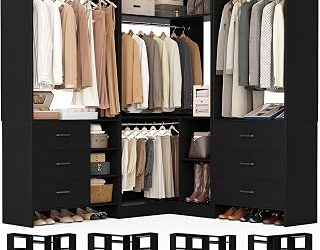
At 95 inches wide with six doors and nine drawers, this is less a wardrobe than a closet system that happens to be freestanding — genuinely enough for two people’s clothing. Plan on a helper and a couple of hours for assembly, and confirm your wall run before ordering, because there’s no forgiving a shortfall on a unit this size.
VOWNER 71″ Armoire with Drawers and Mirror
The integrated mirror earns its place in a small bedroom by eliminating a separate floor-standing piece, and six doors let you compartmentalize by season rather than digging through one deep cavity. It’s a wood-composite build, so treat the wall strap as mandatory rather than optional.
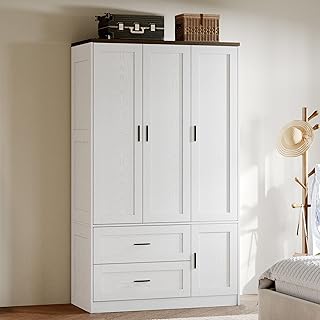
ANCTOR 3-Door Armoire with 2 Drawers and Shelves
This is the one I’d point a woodworker toward: soft-close hinges, adjustable shelves, and concealed drawer storage in a farmhouse profile that reads as furniture instead of storage equipment. The three-door layout keeps the door swing manageable in tighter rooms where a six-door unit would be unusable.
Polup 71″ Metal Armoire with Adjustable Shelves
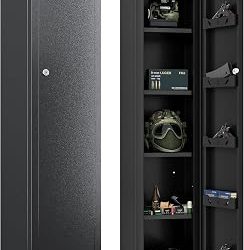
Heavy-duty steel construction with magnetic door closures makes this the pick for a garage, workshop, or basement where humidity would swell a particleboard carcass. The adjustable shelving means it converts easily from a clothing rod setup to gear and bin storage if your needs change.
Frequently Asked Questions
How long does assembly actually take?
Budget 60 to 90 minutes for a single-rod steel unit and two to three hours for a multi-door wooden armoire. Working on carpet or a moving blanket protects the panels and lets you assemble the box face-down before standing it upright.
Do I really need to anchor it to the wall?
Yes. Tall wardrobes with drawers are genuinely tip-prone, and a drywall anchor won’t hold under load. Find a stud with a magnet or finder, and drive the strap screw into framing.
Will a metal wardrobe hold as much as a wooden one?
Steel frames typically handle rod weight fine, but shelf capacity is where they lag — thin metal shelves deflect faster than 15mm engineered wood. Distribute heavy items low and near the side panels.
Can I modify the interior layout?
Adjustable-shelf models are the ones worth buying if you plan to customize. Adding a second rod at the halfway point for shirts is a straightforward upgrade with a cut-to-length closet rod and two flange brackets.
Final Thoughts
For most bedrooms, the ANCTOR 3-Door Armoire is the smartest buy — soft-close hardware and adjustable shelves in a footprint that fits real rooms. If you need serious capacity, the 95-inch nine-drawer white armoire replaces an entire closet, while the Polup 71″ metal wardrobe is the durable, humidity-proof answer for garages and utility spaces.