Key takeaways
- Do the downrod math first: Target blade height is 8 to 9 feet off the floor. Subtract that from your ceiling height, then subtract roughly 12 inches for the motor housing. A 14-foot ceiling lands you around a 36- to 48-inch rod, so buy the fan knowing you’ll likely order a longer rod separately.
- Size by sweep, not by speed: Cranking a small fan higher adds noise, not coverage. Rooms over 400 square feet want 65 inches minimum; open great rooms and shops do better at 72 to 96 inches, and 20-foot industrial spans call for HVLS gear.
- Insist on a DC or PMSM motor: These pull a fraction of the wattage, give you six real speed steps instead of three vague ones, and stay quiet at the low settings you’ll actually run all winter. On a long downrod, motor hum carries — this matters more than it does on an 8-foot ceiling.
- Check the box before you check the blades: A fan-rated metal box screwed into solid blocking is non-negotiable, especially with a heavy 96-inch fan swinging on a three-foot rod. Sloped ceilings add another constraint: verify the canopy’s maximum pitch, since many top out around 20 degrees without an adapter.
- Plan for maintenance you can’t reach: Anything at 15 feet should be replaceable from the remote, not the ladder. Look for standard E26 sockets over sealed LED modules, damp ratings for porches and gazebos, and a remote that stores its settings after a power blip.
What's inside
Standing on a ladder at the top of a 16-foot vaulted room, you learn something the spec sheets never tell you: heat has already won. All the warm air your furnace pushed out is parked up there against the drywall, while you’re down at floor level with cold feet and a thermostat that insists the room is 72°F. A stock 52-inch fan hanging off a 6-inch downrod, tucked up near the peak, just stirs that trapped layer and calls it a day. The airflow never reaches you, and the room never feels any different.
Fixing this is a mounting problem as much as a fan problem. You need enough blade sweep to move real volume, a downrod long enough to drop the blades into the occupied zone, and an electrical box actually rated to carry the load. This guide walks through the sizing math I use before I ever open a box, the hardware that trips people up mid-install, and six fans — from a 65-inch farmhouse build to a 120-inch HVLS beast — that genuinely work in tall rooms.
As an Amazon Associate we earn from qualifying purchases.


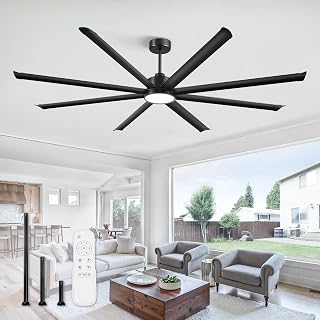
How to Choose a Ceiling Fan For High Ceilings (2026)
- Do the downrod math first: Target blade height is 8 to 9 feet off the floor. Subtract that from your ceiling height, then subtract roughly 12 inches for the motor housing. A 14-foot ceiling lands you around a 36- to 48-inch rod, so buy the fan knowing you’ll likely order a longer rod separately.
- Size by sweep, not by speed: Cranking a small fan higher adds noise, not coverage. Rooms over 400 square feet want 65 inches minimum; open great rooms and shops do better at 72 to 96 inches, and 20-foot industrial spans call for HVLS gear.
- Insist on a DC or PMSM motor: These pull a fraction of the wattage, give you six real speed steps instead of three vague ones, and stay quiet at the low settings you’ll actually run all winter. On a long downrod, motor hum carries — this matters more than it does on an 8-foot ceiling.
- Check the box before you check the blades: A fan-rated metal box screwed into solid blocking is non-negotiable, especially with a heavy 96-inch fan swinging on a three-foot rod. Sloped ceilings add another constraint: verify the canopy’s maximum pitch, since many top out around 20 degrees without an adapter.
- Plan for maintenance you can’t reach: Anything at 15 feet should be replaceable from the remote, not the ladder. Look for standard E26 sockets over sealed LED modules, damp ratings for porches and gazebos, and a remote that stores its settings after a power blip.
The Best Ceiling Fan For High Ceilings (2026)s Reviewed
65″ Farmhouse Ceiling Fan with Light and Remote
This is the sweet spot for most vaulted living rooms — enough sweep to matter, dual-finish blades that read as intentional design, and an E26 base so you swap a bulb instead of a whole light kit years from now. Both 6-inch and 12-inch downrods ship in the box, though tall ceilings will want a longer one.
AA-Orion 120″ HVLS Industrial Fan
At 28,000+ CFM, this moves air in a way residential fans simply can’t, making it the right call for barns, gyms, and shops with 18-foot-plus clearance. The PMSM motor runs slow and quiet by design, and reverse mode makes it a genuine winter destratification tool.
96″ Industrial Ceiling Fan (No Lights)
Eight reversible aluminum blades and no light kit to fuss with — this is a pure airflow appliance for garages, covered porches, and workshops. Budget for solid blocking and a helper on install day, because the blade arms are long and awkward to hang solo.
TCL 72″ Large Ceiling Fan with Light
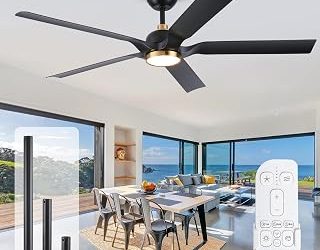
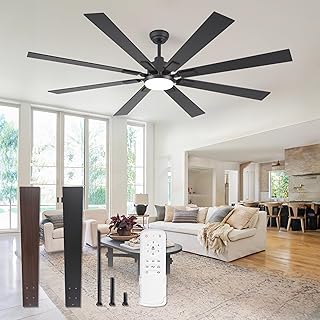
A clean modern profile with 3 CCT dimmable LEDs that remember your last setting, which is exactly what you want on a fixture you can’t reach. The dual-side blades let you flip the finish to suit the room without buying a second fan.
ZMISHIBO 72″ Damp-Rated Ceiling Fan
Strong airflow from a quiet DC motor, damp rated for covered patios, and finished in black that hides dust between cleanings. The 24W 3 CCT light is bright enough for outdoor dining without overpowering the space.
Frequently Asked Questions
What downrod length do I need for a 14-foot ceiling?
Roughly 36 to 48 inches, aiming for blades 8 to 9 feet off the floor. Measure your specific fan’s housing height and subtract it, since bodies vary by several inches.
Can one fan handle a two-story great room?
Usually not well. One 72-inch fan plus a smaller unit over the seating area beats a single fan fighting a 20-foot column of stratified air.
Is reverse mode worth using on high ceilings?
Absolutely — it’s the single biggest win. Running low-speed reverse pushes trapped warm air down the walls, often letting you drop the thermostat two or three degrees.
Do I need a special electrical box?
Yes. Use a listed fan-rated box anchored to framing or a brace bar. Standard plastic lighting boxes aren’t built for rotational load on a long downrod.
Final Thoughts
For most vaulted living spaces, the 65″ farmhouse fan hits the best balance of sweep, style, and serviceable lighting, while the TCL 72″ is the pick if you want a cleaner modern look with dimmable CCT control. If you’re conditioning a shop, barn, or gym, skip residential sizing entirely and go straight to the AA-Orion 120″ HVLS — or the ZMISHIBO 96″ if you want industrial airflow with a light kit included.