Key takeaways
- Absorbency beats abrasion. On laminate you want a pad that pulls moisture off the surface, not a stiff scrub pad that pushes it around. Shark’s Dirt Grip pads, included with both the S1000 and the Steam & Scrub S8001, are built to trap grit inside the fibers instead of dragging it across your wear layer.
- Keep three or four in rotation. A saturated pad stops absorbing and starts depositing. Swap it the moment it feels heavy.
- Wash without fabric softener. Softener coats microfiber and kills its wicking ability permanently. Vinegar in the rinse cycle instead.
What's inside
Laminate is the one floor type where steam cleaning gets genuinely contentious, and for good reason. Underneath that photorealistic wood-look wear layer sits a high-density fiberboard core, and fiberboard is essentially compressed wood pulp. Get moisture into the seams and that core swells, lifting plank edges into little ridges you can feel under your socks. It doesn’t shrink back. So the question isn’t really “which steam mop cleans best” — it’s “which steam mop puts the least water on my floor while still sanitizing it.”
I’ve pulled apart, refilled, and worn out enough of these machines to notice what actually separates a laminate-safe mop from a floor-ruiner: how fast it heats, how precisely you can dial steam down, whether the pad wicks moisture away or smears it around, and how quickly the head keeps moving. Below you’ll find our current picks, then a breakdown of the specs worth caring about, plus the technique that matters more than the machine itself.
As an Amazon Associate we earn from qualifying purchases.




Check Your Laminate Is Actually Sealed First
Before anything else, do the two-minute test. Drip a few drops of water onto an inconspicuous seam and leave it five minutes. Wipe it up. If the water beads and lifts clean with no darkening at the joint, your laminate has tight seams and a healthy wear layer. If it soaks in or the edge darkens, stop — steam is off the table and you want a barely-damp microfiber flat mop instead. Also dig out your manufacturer’s warranty language. Some laminate brands void coverage the moment a steam appliance touches the surface, regardless of how carefully you use it. That paperwork decision comes before the shopping decision.
Variable Steam Control Is the Single Most Important Feature
A mop with one setting is designed for tile, full stop. On laminate you want the lowest output the machine offers, which means you need a machine that offers more than one. The BISSELL PowerFresh 1940A earns its long-standing reputation here because its variable steam dial genuinely steps down rather than just toggling, and the 12-inch head covers ground fast enough that you’re not dwelling in one spot. The 10-in-1 detachable steam mop takes a different route with two-level control and a 10-second heat-up, which sounds like a convenience spec but is actually a safety one — a fast-heating machine spends less time idling and dripping while you wait.
Pad Design: The Part Everyone Ignores
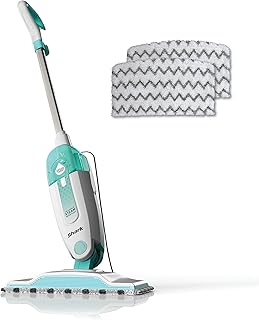
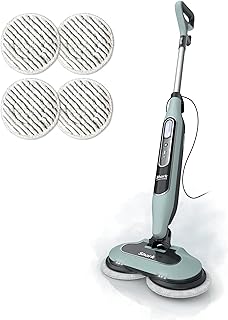
- Absorbency beats abrasion. On laminate you want a pad that pulls moisture off the surface, not a stiff scrub pad that pushes it around. Shark’s Dirt Grip pads, included with both the S1000 and the Steam & Scrub S8001, are built to trap grit inside the fibers instead of dragging it across your wear layer.
- Keep three or four in rotation. A saturated pad stops absorbing and starts depositing. Swap it the moment it feels heavy.
- Wash without fabric softener. Softener coats microfiber and kills its wicking ability permanently. Vinegar in the rinse cycle instead.
Tank Size, Weight, and Cord Length
These three specs decide whether you’ll actually use the thing. A small tank like the 11-in-1 handheld-plus-mop combo‘s 15.2 oz reservoir isn’t a weakness on laminate — you’re using minimum steam anyway, so it lasts longer than the number suggests, and it keeps the mop light in the hand. That same unit’s 23-foot cord is the real win, because reaching for an extension lead is how people end up rushing a room. Conversely, the S8001’s XL tank suits bigger open-plan spaces where refill trips break your rhythm. For mixed households, the multi-purpose steam cleaner with a detachable handheld gives you a grout and upholstery tool in the same box, which justifies the storage footprint.
Technique: Keep Moving, Never Dwell
The mop matters less than your hands. Vacuum thoroughly first — steaming over grit turns your pad into sandpaper. Then work in a slow, continuous S-pattern, one pass forward and one back, and never let the head rest in place while steam is running. For a stubborn spot, trigger a burst, lift the mop away, and let the moisture sit two or three seconds before wiping with a dry section of pad. The floor should be touch-dry within 30 to 45 seconds of the head passing over it. If you see any lingering sheen, you’ve used too much steam.
Tips
- Use distilled water even when the manual says tap is fine. Mineral scale is the number one reason these mops die early, and descaling a sealed boiler is a miserable job.
- Park the mop on a folded towel between rooms — residual heat causes drips, and a drip on one spot for two minutes is worse than a whole steamed floor.
- Crack a window or run a ceiling fan. Airflow cuts dry time roughly in half and pulls humidity away from seams.
- Steam laminate monthly at most, with dry microfiber the rest of the time. Frequency does more cumulative damage than any single pass.
Frequently Asked Questions
Will a steam mop void my laminate warranty?
Sometimes, yes. Several major laminate manufacturers explicitly exclude steam cleaning. Check your installation paperwork or the brand’s care sheet before buying — it’s a five-minute check that can save you a flooring replacement claim.
Is a cheaper multi-purpose mop good enough for laminate?
Often, genuinely yes. Because you want low steam output, you don’t need a premium high-pressure boiler. What you do need is adjustable output and decent pads, and several budget 10-in-1 and 11-in-1 units deliver both.
How do I know if I’ve already caused damage?
Run your palm across the seams. Slight raised ridges at plank edges, a cupped feel, or a faint haze in the finish all point to moisture intrusion. Stop steaming immediately; mild edge swelling sometimes settles partially over weeks in dry conditions.
Can I add cleaning solution to the tank?
No. Detergents foam inside the boiler, clog the steam jets, and leave a film that attracts dirt. If you need a spot treatment, apply it to the pad, never the reservoir.
Conclusion
For most laminate floors, the BISSELL PowerFresh 1940A remains the safest all-rounder thanks to real variable control and a wide, quick-moving head, while the Shark S1000 is the pick if you want the lightest possible tool for frequent quick passes. Whichever you choose, remember that on laminate the machine is only half the equation — low steam, constant motion, and a genuinely dry pad will protect your floor far better than any feature list.