Key takeaways
- Match CFM to room volume, not floor area: Multiply length by width by ceiling height, then aim for enough airflow to turn that volume over roughly every two minutes. A 7,000+ CFM fan handles most living rooms; vaulted spaces and open shops need five figures.
- DC motors over AC, almost always: A DC motor pulls a fraction of the wattage for the same airflow, runs noticeably quieter, and gives you six speeds instead of three. PMSM motors on large HVLS fans take that further with high torque at very low RPM.
- Check your downrod math before you buy: Blades should sit 8 to 10 feet off the floor with at least 18 inches of clearance to the nearest wall. Fans shipping with multiple downrods save you a separate hardware order.
- Confirm the electrical box is fan-rated: A standard lighting box will not carry a moving load. You want a metal box rated for fan support, screwed into a brace or blocking — this is non-negotiable on any large-span fan.
- Read the moisture rating literally: Damp rated works under a covered porch or in a garage. Wet rated is what you need for anything exposed to blowing rain. Indoor-only fans corrode fast in humid shops.
What's inside
Airflow is the one ceiling fan spec that gets buried under everything else. Showrooms and product pages lead with finishes, blade counts, and LED color temperature, while CFM — the cubic feet per minute a fan actually moves — hides in a footnote or gets skipped entirely. The result is predictable: you mount a good-looking fan over a 400 square foot great room, flip it on, and feel almost nothing. Anyone who has ever stood on a ladder twice in one month, once to install and once to uninstall, knows the frustration.
This guide approaches the problem the way a maker would: start with the volume of air you need to move, then work backward to blade span, motor type, and mounting hardware. Below are six fans that publish honest airflow figures and back them with hardware that can handle it — from a 52-inch bedroom fan to 120-inch HVLS units built for shop bays. Each one has been evaluated on real installation considerations: joist reach, downrod options, wiring access, and whether the remote is something you will still tolerate in year three.
As an Amazon Associate we earn from qualifying purchases.




How to Choose a Cfm Ceiling Fan (2026)
- Match CFM to room volume, not floor area: Multiply length by width by ceiling height, then aim for enough airflow to turn that volume over roughly every two minutes. A 7,000+ CFM fan handles most living rooms; vaulted spaces and open shops need five figures.
- DC motors over AC, almost always: A DC motor pulls a fraction of the wattage for the same airflow, runs noticeably quieter, and gives you six speeds instead of three. PMSM motors on large HVLS fans take that further with high torque at very low RPM.
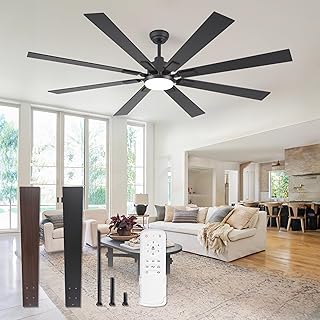
- Check your downrod math before you buy: Blades should sit 8 to 10 feet off the floor with at least 18 inches of clearance to the nearest wall. Fans shipping with multiple downrods save you a separate hardware order.
- Confirm the electrical box is fan-rated: A standard lighting box will not carry a moving load. You want a metal box rated for fan support, screwed into a brace or blocking — this is non-negotiable on any large-span fan.
- Read the moisture rating literally: Damp rated works under a covered porch or in a garage. Wet rated is what you need for anything exposed to blowing rain. Indoor-only fans corrode fast in humid shops.
The Best Cfm Ceiling Fan (2026)s Reviewed
120-Inch HVLS Industrial Fan, AA-Orion
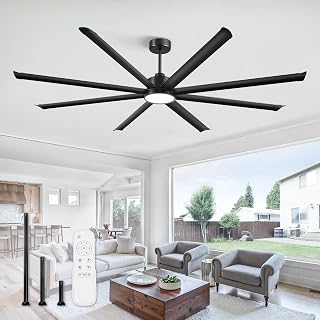
At over 28,000 CFM from a PMSM motor, this is the fan for a two-car shop or a barn aisle where you need to move the whole air mass, not just create a breeze under one spot. Install it as a two-person job with a proper structural mount — the low RPM keeps noise and vibration remarkably contained for the span.
120 Inch Industrial Fan with 6 Aluminum Blades
Six heavy-duty aluminum blades and three included downrods make this the more flexible of the 120-inch options, especially in garages with varying ceiling heights or exposed truss work. The reversible DC motor is genuinely quiet at mid speeds, which matters if you actually work under it.
ZMISHIBO 96 Inch Fan with Lights
Eight aluminum blades and integrated 3CCT lighting make this a strong single-fixture solution for a large covered patio or gazebo where you would otherwise be running a fan and a separate light. Damp rated construction and six speeds give it real range between summer cooling and winter downdraft mode.
ZMISHIBO 72″ Fan with Lights, Dual-Finish
The sweet spot for most great rooms and deep porches: enough span to move serious air without the industrial look, plus a dual-finish body that reads as intentional design rather than equipment. The 24W 3 CCT LED is bright enough to serve as primary lighting in a seating area.
60 in Fan, 7400+ CFM with Light
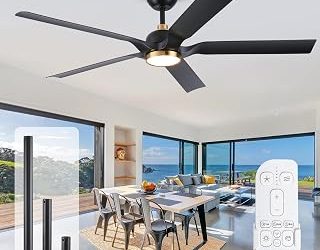
Three blades, a mute DC motor, and 7,400 CFM in a 60-inch footprint make this the efficiency pick for standard-ceiling living rooms and bedrooms. The timer function is more useful than it sounds — set it for two hours and you are not running the fan all night.
Frequently Asked Questions
How much CFM do I actually need?
For a typical 12×15 room with 8-foot ceilings, 5,000 to 7,000 CFM is comfortable. Open-plan spaces, vaulted ceilings, and garages scale up quickly — a two-bay shop realistically wants 15,000 CFM or more to feel any different.
Can I install a 120-inch fan myself?
Only if you can verify the structural mounting point and get a second set of hands for the lift. These fans weigh substantially more than residential units, and the blade assembly is awkward on a ladder. Hire an electrician if the ceiling framing is unclear.
Does higher CFM mean a louder fan?
Not with a DC or PMSM motor. Large-diameter fans generate airflow through span rather than speed, so a 96-inch fan at low RPM often runs quieter than a 52-inch fan pushed to its top setting.
Should I reverse the fan in winter?
Yes, on any ceiling above 9 feet. Run it in reverse at low speed to pull warm air off the ceiling and circulate it down the walls without creating a draft. All the fans here are reversible by remote.
Final Thoughts
For workshops, garages, and any space where air volume is the whole point, the AA-Orion 120-inch HVLS fan is the most capable option here and the one that changes how a room feels rather than just stirring it. Living rooms and covered patios are better served by the ZMISHIBO 72-inch, which balances real airflow with a fixture you will not mind looking at, while the 60-inch 7400+ CFM fan is the efficient, straightforward choice for standard-height bedrooms and dens.