Key takeaways
- Measure before you buy: Stand where you’ll actually be working and measure floor-to-ceiling, then add roughly two feet for your own reach. A 13–50 inch wand is plenty for standard 8-foot ceilings; anything over 12 feet needs a true multi-section pole. Advertised “reach” usually assumes an average adult holding the pole overhead, so treat it as a ceiling, not a guarantee.
- Pole stiffness over raw length: Aluminum and fiberglass sections resist the noodle-like sag that makes long poles useless. Past about 16 feet, any pole flexes — the question is whether it flexes predictably or whips around. Twist-lock or spring-button joints both work, but check that the locks bite firmly when fully extended.
- Head design matters more than fiber count: A U-shaped or pincer head that wraps both faces of a blade in one pass beats a flat pad every time. Look for a pivoting joint so you can angle into fan blades, then flip it flat for walls and door tops without swapping tools.
- Washable, replaceable sleeves: Microfiber covers that slip off and go through the washer will outlast disposable pads by years. Buy a set that ships with spares, and skip anything where the fabric is glued to the frame — once it’s loaded with dust it just smears.
- Bundled attachments, honestly assessed: Squeegees and cobweb brushes on the same pole genuinely earn their keep on second-story windows and porch eaves. But an extra attachment is only useful if it locks tight; a wobbly squeegee head on a 20-foot pole is more frustrating than no squeegee at all.
What's inside
Anyone who has balanced on a kitchen chair with a pillowcase in one hand and a ceiling fan blade in the other knows how this goes. The dust comes off in gray sheets, half of it lands on the bed, and the blade you can’t quite reach stays furry until next spring. Vaulted ceilings and stairwell landings make it worse, because the honest answer up there is that no ladder you own is the right ladder. Meanwhile that buildup isn’t just cosmetic: caked dust throws blades out of balance, which is where a lot of mystery wobble and bearing noise comes from.
The fix is a telescoping duster that lets you work from the floor, flat-footed, with both hands on the pole. This guide breaks down what actually matters when you’re shopping — pole material and flex, how the head grips a blade, whether the sleeves wash clean, and how honest those advertised reach numbers really are. Below are six picks that hold up to repeat use, from short indoor wands to 30-foot kits that double as window gear.
As an Amazon Associate we earn from qualifying purchases.



How to Choose a/an Ceiling Fan Duster With Extension Pole (2026)
- Measure before you buy: Stand where you’ll actually be working and measure floor-to-ceiling, then add roughly two feet for your own reach. A 13–50 inch wand is plenty for standard 8-foot ceilings; anything over 12 feet needs a true multi-section pole. Advertised “reach” usually assumes an average adult holding the pole overhead, so treat it as a ceiling, not a guarantee.
- Pole stiffness over raw length: Aluminum and fiberglass sections resist the noodle-like sag that makes long poles useless. Past about 16 feet, any pole flexes — the question is whether it flexes predictably or whips around. Twist-lock or spring-button joints both work, but check that the locks bite firmly when fully extended.
- Head design matters more than fiber count: A U-shaped or pincer head that wraps both faces of a blade in one pass beats a flat pad every time. Look for a pivoting joint so you can angle into fan blades, then flip it flat for walls and door tops without swapping tools.
- Washable, replaceable sleeves: Microfiber covers that slip off and go through the washer will outlast disposable pads by years. Buy a set that ships with spares, and skip anything where the fabric is glued to the frame — once it’s loaded with dust it just smears.
- Bundled attachments, honestly assessed: Squeegees and cobweb brushes on the same pole genuinely earn their keep on second-story windows and porch eaves. But an extra attachment is only useful if it locks tight; a wobbly squeegee head on a 20-foot pole is more frustrating than no squeegee at all.
The Best Ceiling Fan Duster With Extension Pole (2026)s Reviewed
Eunice 13–50 Inch Ceiling Fan Duster
This is the one to grab if your ceilings are standard height and you just want the job done in five minutes without hauling out a ladder. The bendable head and short telescoping shaft give you real control, which makes it surprisingly good for blinds, baseboard trim, and the top edge of door frames too.
20 Foot Cobweb Duster with 5–12ft Pole
A sensible middle ground: enough length for stairwell fans and garage rafters, short enough that the pole still feels manageable when collapsed. The reusable feather head is the star for cobwebs and loose dust, and the included squeegee makes it a decent one-tool solution for exterior windows.
LAANPOLE 26FT High Reach Duster Cleaning Kit
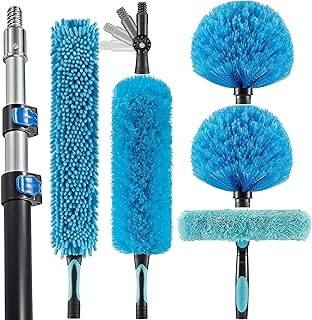
Built for the tall-foyer crowd, with a pole that stays noticeably more rigid at full extension than most in its class. The kit approach pays off here — feather duster for webs and beams, microfiber head for blade faces, squeegee for glass — all sharing one pole and one storage spot.
LAANPOLE 26FT Ceiling Fan Cleaner Duster
The fan-focused sibling: same 5–20ft pole, but with a head shaped specifically to sandwich a blade and pull dust off both sides in a single stroke. The replaceable cleaning cloth washes clean repeatedly, which is the detail that separates a tool you keep from one you toss.
SISUPASSIE 30FT High Ceiling Duster Kit
Longest reach of the group and the pick for open-concept great rooms, atriums, and second-story windows you’ve been avoiding. The rotatable squeegee is the standout feature — being able to change blade angle from the ground turns awkward glass into a manageable job.
Frequently Asked Questions
How often should I dust ceiling fan blades?
Every four to six weeks in normal use, more often if you run the fan year-round or have pets. Light, frequent passes take under a minute and prevent the greasy buildup that eventually needs a wet wipe-down.
Will a long pole scratch my ceiling or fan finish?
Microfiber and feather heads are safe on painted ceilings and standard fan finishes. The risk is the pole tip, not the head, so keep the shaft angled away from walls and don’t lean on it for leverage.
Can I use these dusters wet?
Most microfiber sleeves can be lightly dampened for sticky kitchen-adjacent grime, but wring them out thoroughly. Soaking a head makes it heavy, drips down the pole, and pushes dust into streaks instead of lifting it.
Do I need to turn the fan off first?
Yes, and cut power at the wall switch rather than just the pull chain. A blade that starts moving while your duster is wrapped around it can bend the head or torque the pole out of your hands.
Final Thoughts
For most homes with 8- to 9-foot ceilings, the Eunice 13–50 inch duster is the practical everyday choice — cheap, quick, and stored in a drawer. If you’re dealing with a two-story entry or vaulted living room, the LAANPOLE 26FT Ceiling Fan Cleaner earns its keep with a blade-hugging head and a pole that holds steady, while the SISUPASSIE 30FT kit is the one to reach for when high windows are part of the same chore list.