Key takeaways
- Measure before you buy: Stand where you’ll be working and measure floor-to-blade. An 8-foot ceiling needs roughly 4 to 5 feet of pole in average hands; vaulted ceilings and open stairwells want 10 feet or more. Buying too long is more annoying than buying too short, since excess pole flexes and steers badly.
- Sleeve vs. flat head: A U-shaped sleeve that slides over the blade cleans top and bottom in one pass and catches nearly everything. A flat or bendable head is slower on blades but far more versatile for walls, vents, and baseboards.
- Weight at full extension: Leverage multiplies weight fast. A head that feels like nothing in your hand feels like a bowling ball at arm’s length overhead. Sub-one-pound tools make a real difference by the third bedroom.
- Washable and swappable covers: Look for removable microfiber you can toss in the machine, ideally with a spare in the box. Skip glued-on heads; when the fibers pack with grease, the whole tool is done.
- Pole build and locking: Twist-lock joints in thicker-wall aluminum resist the sag and slippage that plague cheap flip-cam poles. If you plan to hang a squeegee or cobweb brush off the end, a threaded universal tip is worth prioritizing.
What's inside
Anyone who has climbed a wobbly step stool with a rag in one hand knows the ceiling fan problem: the dust doesn’t come off, it comes down. One swipe and you’ve got a gray snowfall over the bed, the dresser, and your own face. Fan blades collect a stubborn film of dust bound up with airborne kitchen grease, which is exactly why dry paper towels smear it around instead of lifting it. Add in blades mounted eight to twelve feet up, and a two-minute chore turns into a fifteen-minute production with a ladder, a drop cloth, and a bad mood.
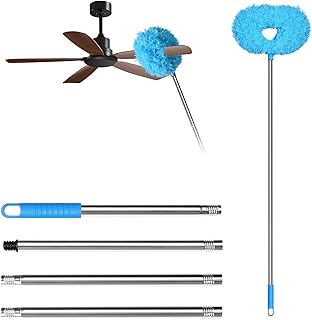
A purpose-built fan duster fixes the whole workflow. The good ones sleeve over both sides of a blade at once, trap the dust in microfiber instead of scattering it, and ride on a telescoping pole so your feet stay on the floor. This guide covers the pole-and-sleeve designs, the ultralight 360° heads, and the tall-ceiling kits built for stairwells and vaulted rooms, plus what actually matters when you’re comparing them.
As an Amazon Associate we earn from qualifying purchases.




How to Choose a Ceiling Fan Duster (2026)
- Measure before you buy: Stand where you’ll be working and measure floor-to-blade. An 8-foot ceiling needs roughly 4 to 5 feet of pole in average hands; vaulted ceilings and open stairwells want 10 feet or more. Buying too long is more annoying than buying too short, since excess pole flexes and steers badly.
- Sleeve vs. flat head: A U-shaped sleeve that slides over the blade cleans top and bottom in one pass and catches nearly everything. A flat or bendable head is slower on blades but far more versatile for walls, vents, and baseboards.
- Weight at full extension: Leverage multiplies weight fast. A head that feels like nothing in your hand feels like a bowling ball at arm’s length overhead. Sub-one-pound tools make a real difference by the third bedroom.
- Washable and swappable covers: Look for removable microfiber you can toss in the machine, ideally with a spare in the box. Skip glued-on heads; when the fibers pack with grease, the whole tool is done.
- Pole build and locking: Twist-lock joints in thicker-wall aluminum resist the sag and slippage that plague cheap flip-cam poles. If you plan to hang a squeegee or cobweb brush off the end, a threaded universal tip is worth prioritizing.
The Best Ceiling Fan Duster (2026)s Reviewed
DRQ Ceiling Fan Cleaner Duster (13–48″)
This is the straightforward pick for standard 8-foot ceilings: a snug microfiber sleeve on a pole that collapses down to 13 inches for closet storage. The sleeve pops off for washing, which matters more than any other feature since a loaded microfiber head stops picking up dust entirely.
Ceiling Fan Blade Cleaner with Extension Pole (13–49.7″)
Nearly identical in concept with a touch more reach, and the removable duster head makes it a genuine multi-tool for bookshelf tops, door frames, and the dead space above kitchen cabinets. A solid choice if you want one tool handling the whole “up high and out of sight” list.
Eyliden 68″ Adjustable Ceiling Fan Duster
At three-quarters of a pound with a dual-sided 360° head, this is the one I’d hand someone with shoulder or wrist issues, since it stays controllable fully extended. The pivoting head also gets flat against walls and blind slats without you rolling your wrist over.
Storystore 4.2FT Ceiling Fan Cleaner
A well-balanced 13-to-50-inch pole with a head shaped to hook cobwebs out of ceiling corners as easily as it sleeves a fan blade. Good pick for older homes where the corners and crown molding need as much attention as the fans.
SetSail Extra-Long Duster, 100″
The bendable microfiber head is the standout here: bend it to about 45 degrees and it wraps a fan blade, run it straight and it sweeps ceilings and wall tops. At just over 8 feet extended, it reaches high fixtures most fan-specific tools can’t touch.
Frequently Asked Questions
How often should I dust ceiling fan blades?
Every two to four weeks during heavy run months. Waiting until you can see the buildup means the dust has bonded with grease and needs a damp pass, not a dry one.
Can I use these damp?
Yes, lightly. Mist the microfiber sleeve with water or a drop of dish soap, wring it out well, and never let liquid run down toward the motor housing or a light kit.
Will an extension pole reach a 20-foot ceiling?
Only a dedicated kit will. The 20-foot-class systems with 5-to-12-foot heavy-duty poles are built for stairwells and vaulted great rooms, and they typically accept squeegee and cobweb attachments too.
How do I wash the microfiber head?
Machine wash warm with detergent, no fabric softener or dryer sheets, and air dry. Softener coats the fibers and kills the static cling that makes microfiber work.
Final Thoughts
For most homes, the DRQ Ceiling Fan Cleaner Duster covers the job at a sensible price and stores anywhere. Step up to the Eyliden 68″ if overhead fatigue is your limiting factor, or the SetSail 100-inch bendable duster if you’ve got tall fixtures and want one tool that handles fans, ceilings, and everything in between.