Key takeaways
- Basements and crawlspaces: 50%, sometimes 45% in humid summer months. These spaces have cool surfaces where moisture condenses first. The 5500 Sq.Ft or 4500 Sq.Ft compressor units are built for this — big coils, real drain ports.
- Bedrooms: 45–50% with sleep mode engaged. The 95OZ Dehumidifier and ToLife both run quiet enough to sit on a nightstand shelf; dim or kill the 7-color LED before bed.
- Bathrooms: 50%, run after showers rather than continuously. Peltier units handle the load fine here.
- Garages and workshops: 50–55%. You’re protecting tools from rust, not people from allergens.
What's inside
I spent a winter chasing a musty smell through the crawlspace under my workshop before I figured out the problem wasn’t the machine I’d bought — it was the number I’d dialed into it. A dehumidifier running at 30% in a Minnesota basement in February is a small, expensive space heater with a bucket. Set it to 65% and you’ve basically got an ornament. The dial matters more than the badge on the front panel, and almost nobody talks about it.
Below I’ll walk through the target range that actually protects wood furniture, drywall, and your lungs, plus how to adjust it by room, by season, and by what your hygrometer is telling you instead of what the manual assumes. You’ll also see where continuous mode beats a set point, why the drain hose changes your strategy, and how to spot a unit that’s fighting a losing battle against the space it’s in.
As an Amazon Associate we earn from qualifying purchases.


The Number: 45–50% Is Your Home Base
Set it to 50% and walk away. That’s the honest answer for the majority of homes. Dust mites struggle to reproduce below roughly 50% relative humidity, mold spores need around 60% or higher to colonize surfaces, and solid wood furniture stays dimensionally happy in the 40–55% band. Push down to 45% if you’re storing instruments, veneered antiques, or paper. Below 40% you start seeing shrinkage gaps in table leaves, cracked drawer bottoms, and static that shocks you off the doorknob. Every unit here — the Waykar 34 Pint with its 30%–80% control range, the KNKA Energy Star, the ToLife — can hit that window. The trick is not overshooting it.
Match The Set Point To The Room, Not The House
A finished basement, a bathroom, and a bedroom are three different climates, and one setting doesn’t serve them all.
- Basements and crawlspaces: 50%, sometimes 45% in humid summer months. These spaces have cool surfaces where moisture condenses first. The 5500 Sq.Ft or 4500 Sq.Ft compressor units are built for this — big coils, real drain ports.
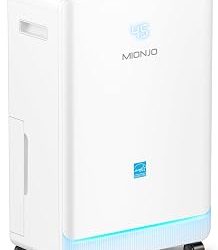
- Bedrooms: 45–50% with sleep mode engaged. The 95OZ Dehumidifier and ToLife both run quiet enough to sit on a nightstand shelf; dim or kill the 7-color LED before bed.
- Bathrooms: 50%, run after showers rather than continuously. Peltier units handle the load fine here.
- Garages and workshops: 50–55%. You’re protecting tools from rust, not people from allergens.
Season Shifts The Math
Here’s what my crawlspace taught me: in cold weather, indoor air held at 50% will condense on any window or wall cavity below its dew point, and you get water where you can’t see it. In winter, ease your set point down to 40–45% in heated spaces. Come summer, when outdoor dew points climb into the 70s, you can hold 50% comfortably and the unit will cycle less. Compressor models also lose efficiency below about 41°F unless they have automatic defrost — the Waykar and both large Energy Star units include it, which is what makes them viable in an unheated basement in shoulder season.
When Continuous Mode Beats A Set Point
If you’ve plumbed a drain hose to a floor drain or condensate pump, continuous mode is worth considering for a genuinely wet space — a post-flood dry-out, a new concrete pour, a basement that never quite catches up. The unit ignores the humidistat and runs until you stop it. Use it for days, not seasons. Once you’re stable, switch back to an intelligent humidistat setting so the compressor isn’t grinding away 24/7 for no gain. The KNKA and the 4500 Sq.Ft Quilt compressor model both ship with hoses, which makes this a five-minute setup rather than a plumbing project.
Size Determines Whether Your Setting Even Works
A dial can’t fix undersizing. If a 1,000 sq ft rated unit is asked to dry 2,500 sq ft, it will run permanently and never reach 50%. Rule of thumb: match the square footage rating to your space and then go up one tier if the area is damp rather than just humid, has a dirt floor, or connects to outside air. That’s the case for a 4500 or 5500 sq ft class machine over two small ones — one compressor, one drain, one power draw.
Tips
- Buy a $12 standalone hygrometer and put it across the room from the dehumidifier. Onboard sensors read the air they just dried and lie to you by 5–8%.
- Give the unit 12 inches of clearance on the intake and exhaust sides. Shoved against a wall, it recirculates its own output.
- Rinse the filter monthly under warm water and dry it fully. A clogged filter drops capacity fast and makes a correctly-set machine look broken.
- If the tank fills more than twice a day at 50%, you have a moisture source — grading, a gutter, an unsealed slab. Fix the cause, then let the dial coast.
Frequently Asked Questions
Is 30% ever the right setting?
Rarely for living spaces. It’s useful for short-term drying of building materials or a storage vault for paper and film. Held long-term, it dries out wood joinery and irritates sinuses.
Should I leave it running all night?
Yes, if it’s on a humidistat setting with sleep mode. It’ll cycle rather than run flat out, and overnight is when cool surfaces are most prone to condensation.
Does a lower setting cost more to run?
Meaningfully so. Each 5% you drop increases runtime. Energy Star models cut the penalty, but 50% will always cost less than 40% in the same room.
Why won’t mine reach the setting I chose?
Usually undersizing, an air leak from outside, a dirty filter, or ambient temperature below the unit’s operating range. Check those four before assuming a fault.
Conclusion
Set 50% as your default, drop to 45% for winter or for rooms holding wood furniture and paper, and only reach for continuous mode when you’re actively drying something out. Pair that with a properly sized unit — a compressor model with a drain hose for basements, a quiet tank-based one for bedrooms — and an independent hygrometer to keep you honest, and the dial stops being guesswork.