Key takeaways
- Measure the swing gap first: Close the door and slide a ruler between the panel and your front shelf edge. Anything under two inches rules out most basket-style organizers. Write the number down before you shop, because “slim profile” is a marketing word, not a dimension.
- Adhesive versus mechanical: Peel-and-stick mounts are brilliant on smooth melamine, painted MDF, and glass, and they’re the only sane choice on a rental. Raw wood, textured laminate, and anything with a satin grain will shed them within a month. If the load is heavy or the surface is porous, use screws.
- Respect the hinge: Adding weight to a door multiplies leverage on the hardware. Cheap face-frame hinges start sagging around three to five pounds of door-mounted load. If you’re loading up, upgrade to a soft-close or six-way adjustable hinge while you’re in there.
- Match depth to contents: Shallow trays are for lids, foil boxes, sponges, and sachets. Deep wire baskets swallow bottles and cleaning supplies but will collide with shelves. Pick the item you’re storing first, then the container.
- Check the finish and the fasteners: Powder-coated steel handles humidity and grease far better than plated wire, which pits in a bathroom within a season. Look for included anchors rated for drywall if the unit is going on a wall instead of a door.
What's inside
Every cabinet door in your house is dead weight. Two, sometimes three inches of unused air sits between the back of that door and whatever’s on the shelf behind it, and most of us fill it with nothing at all while the shelf itself turns into a landfill of lids, spice jars, and cleaning sprays. I noticed it properly when I pulled a sink base apart to re-route a supply line and realized the door panel had more usable real estate than the shelf I’d been fighting with for years. That’s the whole premise behind hinge-mounted and behind-door storage: you’re not adding square footage, you’re annexing the gap you already paid for.
The catch is that this category is a mess. Some products bolt to the door and swing with it, some hang off the hinge pin itself, some clamp over the top of a full-size door, and a few are slim cabinets designed to live in the arc a door sweeps when it opens. They solve different problems and they fail in different ways. Below I’ve sorted through the options worth your money in 2026, with notes on load limits, mounting reality, and where each one actually earns its keep. I’ve hung, drilled, and occasionally ripped off enough of these to have opinions.
As an Amazon Associate we earn from qualifying purchases.


How to Choose a Behind Door Storage Cabinet Hinge Mounted (2026)
- Measure the swing gap first: Close the door and slide a ruler between the panel and your front shelf edge. Anything under two inches rules out most basket-style organizers. Write the number down before you shop, because “slim profile” is a marketing word, not a dimension.
- Adhesive versus mechanical: Peel-and-stick mounts are brilliant on smooth melamine, painted MDF, and glass, and they’re the only sane choice on a rental. Raw wood, textured laminate, and anything with a satin grain will shed them within a month. If the load is heavy or the surface is porous, use screws.
- Respect the hinge: Adding weight to a door multiplies leverage on the hardware. Cheap face-frame hinges start sagging around three to five pounds of door-mounted load. If you’re loading up, upgrade to a soft-close or six-way adjustable hinge while you’re in there.
- Match depth to contents: Shallow trays are for lids, foil boxes, sponges, and sachets. Deep wire baskets swallow bottles and cleaning supplies but will collide with shelves. Pick the item you’re storing first, then the container.
- Check the finish and the fasteners: Powder-coated steel handles humidity and grease far better than plated wire, which pits in a bathroom within a season. Look for included anchors rated for drywall if the unit is going on a wall instead of a door.
The Best Behind Door Storage Cabinet Hinge Mounted (2026)s Reviewed
3 Piece Cabinet Door Storage Box Set (Black)
The most straightforward way to test whether door-mounted storage suits your habits: three shallow adhesive boxes, no tools, no holes. Clean the panel with isopropyl before sticking and let the tape cure a full day under no load, and they’ll hold small items reliably for years in a wardrobe or bathroom.
Kelueo 31.5″ Metal Wall Cabinet with Up-Flip Door
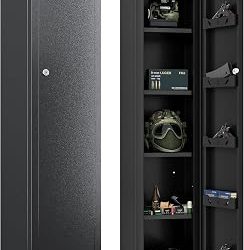
This is the heavyweight of the group, a 120 lb powder-coated steel box with a gas-assisted flip-up lid that swings clear of your head instead of into it. Find studs, use the appropriate lag hardware rather than the generic anchors, and it becomes the tool cabinet you stop thinking about.
Garage Wall Cabinet, 13.8″ H Up-Flip Door
The compact sibling, and honestly the smarter buy for a tight workshop or above a laundry pair where a full-height cabinet would crowd the room. Assembly is bolts and captive nuts, roughly forty minutes with a driver, and the up-flip door means no swing clearance to plan around.
Behind The Door Bookshelf Wooden 6-Tier
At 3.9 inches deep and nearly six feet tall, this one exploits the vertical strip of wall a door hides when it’s open. It’s genuinely useful for paperbacks, craft supplies, and kids’ clutter, but treat the included anchors as a starting point and hit a stud on at least one bracket.
Hongtamoya Over The Door Organizer, 5 Metal Baskets
No drilling, no adhesive, just hooks over the top edge of a standard door, which makes it the obvious pick for renters and pantry doors. Add the included screws to the lower bracket if you can, since that’s what stops the whole rack from swaying every time the door slams.
Frequently Asked Questions
Will door-mounted storage damage my cabinets?
Adhesive mounts can lift paint or veneer on removal, so warm the tape with a hairdryer and peel slowly at a low angle. Screw-mounted units leave holes, but on an interior door panel nobody will ever see them.
How much weight can I safely add to a cabinet door?
Stay under about five pounds on standard residential hinges and keep the load low on the panel to reduce leverage. Anything heavier belongs on a wall-mounted steel cabinet, not a door.
Why does my adhesive organizer keep falling off?
Almost always surface prep or cure time. Degrease with alcohol, avoid silicone-based cleaners entirely, and leave it empty for 24 hours before loading. Textured or raw-wood surfaces need mechanical fasteners instead.
Do I need to adjust my hinges afterward?
Check the door gap after a week of use. European cup hinges have depth and height adjustment screws that take fifteen seconds with a Phillips driver, and a small tweak restores alignment before sagging becomes permanent.
Final Thoughts
For most kitchens, the 3 Piece Cabinet Door Storage Box set is where I’d start: cheap, reversible, and it tells you within a week whether you’ll actually use the space. If you’re kitting out a garage or workshop, the Kelueo 31.5″ Metal Wall Cabinet is the one built for real tool weight, with the 13.8″ Up-Flip Cabinet covering tighter walls. Renters and anyone allergic to drilling should go straight to the Hongtamoya Over The Door Organizer.