Key takeaways
- Measure the opening, not the window: Grab the clear width and clear height of the sash channel with the window fully open. Casement-style units like the Perfect Aire run tall and slim (roughly 23.5″ H x 14.75″ W), so a few missing inches kills the fit before the box even arrives.
- Decide chassis or portable early: A U-shaped unit sits in the frame and stays there for the season. A portable sits on the floor and needs a vent panel. Chassis units cool more efficiently; portables move room to room and store flat in winter.
- Check panel travel on any vent kit: Vertical sliders demand a plate that extends along the height of the opening. Look for real numbers — the LOVIGA kit spans 40 to 64 inches, while the 5.9″ panel kit covers 16.9″ to 62.1″. Buy for your longest dimension, not the average.
- Match hose diameter exactly: Most portables use a 5.9-inch exhaust. A coupler mismatch means duct tape and warm air leaking back into the room, which is exactly the problem you’re trying to solve.
- Weigh support and weight: Vertical frames often have narrower sills. Confirm the sash can carry the chassis, add a support bracket if there’s any flex, and remember inverter compressors reduce the on/off cycling that loosens a marginal install over time.
What's inside
Tall, narrow windows that slide up and down instead of side to side are the bane of anyone shopping for cooling gear. Most window air conditioners are built wide and short, sized for the standard double-hung opening — but casement, awning, and vertical slider frames flip that geometry on its head. Drop a conventional unit into one and you get a gap you can’t seal, a sash that won’t latch, and a chassis with nothing solid to rest on. I’ve measured enough oddball frames in old rentals and converted attics to know the frustration is real, not imagined.
The good news: there are two workable paths. Either you pick a chassis shaped for the frame you actually have, or you go portable and solve the venting problem with a purpose-built seal kit. This guide covers both, including the U-shaped inverter units that straddle the sash and the adjustable vent panels that turn a vertical slider into a clean exhaust port. Everything here has been chosen with install reality in mind — bracket support, panel travel, hose diameter, and how much fussing you’ll do on a hot Saturday afternoon.
As an Amazon Associate we earn from qualifying purchases.




How to Choose a/an Air Conditioner For Vertical Sliding Window (2026)
- Measure the opening, not the window: Grab the clear width and clear height of the sash channel with the window fully open. Casement-style units like the Perfect Aire run tall and slim (roughly 23.5″ H x 14.75″ W), so a few missing inches kills the fit before the box even arrives.
- Decide chassis or portable early: A U-shaped unit sits in the frame and stays there for the season. A portable sits on the floor and needs a vent panel. Chassis units cool more efficiently; portables move room to room and store flat in winter.
- Check panel travel on any vent kit: Vertical sliders demand a plate that extends along the height of the opening. Look for real numbers — the LOVIGA kit spans 40 to 64 inches, while the 5.9″ panel kit covers 16.9″ to 62.1″. Buy for your longest dimension, not the average.
- Match hose diameter exactly: Most portables use a 5.9-inch exhaust. A coupler mismatch means duct tape and warm air leaking back into the room, which is exactly the problem you’re trying to solve.
- Weigh support and weight: Vertical frames often have narrower sills. Confirm the sash can carry the chassis, add a support bracket if there’s any flex, and remember inverter compressors reduce the on/off cycling that loosens a marginal install over time.
The Best Air Conditioner For Vertical Sliding Window (2026)s Reviewed
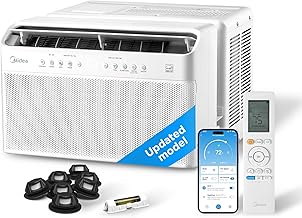
Midea 12,000 BTU U Shaped Window Air Conditioner
The U-shaped chassis wraps around the lower sash so the window closes through the middle of the unit, which is what makes it work in frames a conventional box would rattle around in. At 12,000 BTU it handles up to 550 square feet, and the inverter compressor plus the sash-in-the-gap design is the quietest install I’ve done — the glass itself blocks compressor noise from the room.
Perfect Aire 10,000 BTU Casement Window Air Conditioner
This is the purpose-built answer for tall, narrow openings: a vertical chassis measuring 23.5 inches high by 14.75 inches wide, designed for sliding and crank-out windows. The Follow Me remote sensor is genuinely useful here, since a unit mounted high in a tall frame reads air temperature well above where you’re sitting.
Midea 8,000 BTU U Shaped Smart Inverter Window AC
Same clever U-shaped geometry in a smaller, lighter package that covers 350 square feet — the better pick if your sash feels flexy or you’re working in a bedroom. Smart control and Alexa/Google support come standard, and the inverter drive delivers the same energy savings claim as its bigger sibling.
LOVIGA Portable AC Window Kit, 40–64 Inch Adjustable
If you’ve already got a portable unit, this is the piece that makes it usable in a vertical slider. The panel extends from 40 to 64 inches to fill the height of the opening, and the waterproof sealing is meaningfully better than the flimsy plate that shipped in your AC box.
Portable AC Window Vent Kit, 5.9″ Panel, 16.9″–62.1″
A no-coupler design that accepts a 5.9-inch hose directly, with a panel that works in both vertical and horizontal sliders — handy if you move the unit between rooms with different window styles. The shorter minimum length also suits half-height basement and transom openings the longer kits can’t compress into.
Frequently Asked Questions
Can a regular window air conditioner work in a vertical sliding window?
Not safely. Standard units are wider than they are tall and rely on the sash pressing down across the top of the chassis. In a vertical slider there’s nothing to secure the sides, which leaves the unit unsupported and the opening unsealed.
How does the U-shaped design fit a tall window?
The window sash slides down into the U-shaped channel between the indoor and outdoor halves of the unit, so the glass becomes part of the seal. It gives you a smaller footprint in the opening and lets the window sit closer to closed than a conventional box allows.
Do I still need a vent kit if I buy a portable AC?
Yes, and the one in the box usually won’t span a vertical opening. Aftermarket kits with 40 to 64 inches of travel are built for that geometry and seal far better, which directly affects how well the unit cools.
What size unit do I need?
Roughly 20 BTU per square foot is a reasonable starting point — 8,000 BTU for a 350-square-foot bedroom, 10,000 to 12,000 for a 450 to 550 square foot living space. Add capacity for sun-facing rooms, top floors, and poor insulation.
Final Thoughts
For most tall-window installs, the Midea 12,000 BTU U-Shaped unit is the strongest all-around choice — quiet, efficient, and shaped to work with the sash instead of against it, with the 8,000 BTU version covering smaller rooms just as capably. If your frame is genuinely narrow or crank-out, the Perfect Aire 10,000 BTU casement unit is the one built for that shape. And if a portable is already sitting in your garage, the LOVIGA adjustable window kit is the cheapest way to finally make it seal properly.