Key takeaways
- Chase CFM, not blade count: Aim for 5,500+ CFM in a bedroom and 7,000+ CFM in a great room, patio, or garage. Blade count is mostly acoustic tuning — three well-pitched blades routinely outperform five flat ones.
- Insist on a DC motor: DC fans draw roughly 60–70% less power than AC equivalents, run cooler and quieter, and give you six speeds plus true reverse. They’re also lighter, which is kind to older boxes.
- Size the span to the room: Up to 12 x 12 ft, a 52-inch fan is plenty. Past 18 ft in either direction, step up to 60 or 72 inches or plan on two fans — one undersized fan just stirs the middle of the room.
- Get the drop right: Blades should sit 8–9 ft off the floor and at least 10 inches below the ceiling to avoid choking airflow. Sloped or vaulted ceilings need a longer downrod and a compatible canopy — check the max slope rating first.
- Match the rating to the location: Damp-rated works for covered porches and garages; wet-rated is required for anywhere blowing rain reaches. Indoor-only fans on a patio will rust at the blade irons within a season.
What's inside
Stand under most ceiling fans on a 90-degree afternoon and you feel a polite flutter, not a breeze. That gap between what a fan looks like it should do and what it actually does comes down to numbers most listings bury: airflow in cubic feet per minute, blade pitch, motor torque, and how far the blades sit from the ceiling. A gorgeous five-blade fixture with a 12-degree pitch and 3,200 CFM will decorate a room beautifully and cool almost none of it. Meanwhile a plain three-blade DC fan pushing 7,000+ CFM can drop the perceived temperature by several degrees and let you nudge the thermostat up.
I’ve hung enough fans to know that the install matters as much as the spec sheet — a fan-rated brace box, the right downrod, and balanced blades are what separate a quiet breeze machine from a ticking, wobbling regret. This guide focuses on fans built to actually move air: high-CFM DC motors, aggressive blade pitch, and spans from 52 to 72 inches. Below you’ll find current picks, the specs worth checking before you buy, and answers to the questions that come up mid-install.
As an Amazon Associate we earn from qualifying purchases.


How to Choose a Ceiling Fan To Move Air (2026)
- Chase CFM, not blade count: Aim for 5,500+ CFM in a bedroom and 7,000+ CFM in a great room, patio, or garage. Blade count is mostly acoustic tuning — three well-pitched blades routinely outperform five flat ones.
- Insist on a DC motor: DC fans draw roughly 60–70% less power than AC equivalents, run cooler and quieter, and give you six speeds plus true reverse. They’re also lighter, which is kind to older boxes.
- Size the span to the room: Up to 12 x 12 ft, a 52-inch fan is plenty. Past 18 ft in either direction, step up to 60 or 72 inches or plan on two fans — one undersized fan just stirs the middle of the room.
- Get the drop right: Blades should sit 8–9 ft off the floor and at least 10 inches below the ceiling to avoid choking airflow. Sloped or vaulted ceilings need a longer downrod and a compatible canopy — check the max slope rating first.
- Match the rating to the location: Damp-rated works for covered porches and garages; wet-rated is required for anywhere blowing rain reaches. Indoor-only fans on a patio will rust at the blade irons within a season.
The Best Ceiling Fan To Move Air (2026)s Reviewed
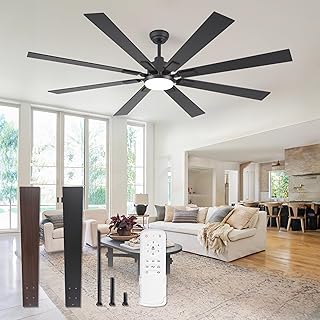
60″ 7400+ CFM DC Ceiling Fan with Light
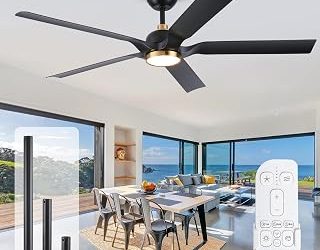
This is the airflow benchmark in the roundup: three deeply pitched blades on a reversible DC motor that clears 7,400 CFM without the hum you get from cheap AC fans. The 3-CCT dimmable light and timer make it a genuine one-fixture solution for a living room or covered patio, and six speeds mean the lowest setting is actually usable overnight.
Minislak 72″ 8-Blade Industrial DC Fan
Eight aluminum blades on a 72-inch span move a wall of air at low RPM, which is exactly what you want in a garage, shop, or double-height living room — high volume, minimal noise, no strobing light overhead. There’s no light kit, so pair it with existing fixtures and appreciate the lighter assembly at hanging time.
52″ 3-Blade Fan with Light, Matte Black and Gold
A rare case of styling and performance not fighting each other: the black-and-gold finish reads intentional in a modern bedroom, while the three-blade layout keeps airflow respectable for rooms up to about 225 sq ft. Remote control and outdoor suitability make it flexible for covered entries too.
OPONL 52″ Ceiling Fan with 6CCT Light
Six color temperatures plus full dimming is unusual at this size, and the reversible DC motor handles winter downdraft duty without the low-speed groan common to budget fans. A solid pick for a bedroom where you want the light to shift from task-bright to warm evening tone.
52″ Modern DC Ceiling Fan with 3CCT Light
Clean lines, a genuinely quiet DC motor, and three color temperatures at a price that undercuts most name-brand equivalents. It won’t out-blow the 60- and 72-inch options, but for apartments and standard bedrooms it hits the sweet spot between airflow and unobtrusiveness.
Frequently Asked Questions
How much CFM do I actually need?
Roughly 40–50 CFM per square foot of room area for noticeable cooling. A 200 sq ft bedroom is comfortable around 5,000 CFM; a 400 sq ft open living space wants 7,000 or more, or two fans working together.
Do I need a special electrical box?
Yes. Ceiling fans must hang from a UL-listed fan-rated box or brace bar that supports at least 35 lbs of moving load. A standard plastic lighting box will eventually pull free — replace it before you hang anything.
Which way should the blades spin?
Counterclockwise in summer to push air down and create a wind-chill effect, clockwise on low in winter to pull warm air off the ceiling and circulate it without a draft. Every fan here reverses from the remote.
Why does my new fan wobble?
Almost always mounting or blade alignment, not a bad motor. Confirm the downrod ball is fully seated in the canopy hanger, tighten every blade screw, then measure blade tip-to-ceiling distance and shim the outlier with the included balancing kit.
Final Thoughts
If your goal is raw air movement, the 60″ 7400+ CFM DC fan is the most complete package — big airflow, quiet operation, and a tunable light in one fixture. For garages, shops, and cathedral ceilings where span is everything, the Minislak 72″ eight-blade moves serious volume at low speed, with the ZMISHIBO 72″ as the alternative if you want that scale plus integrated lighting. For standard bedrooms, the OPONL 52″ delivers the quiet DC performance and lighting flexibility most rooms actually need.