Key takeaways
- New work vs. old work: If the ceiling is open or you can pull the drywall, a nail-on or brace-bar box installs fast. If the ceiling stays intact, you need an old-work box with an expanding brace that feeds through the existing hole and grips the joists from above.
- Weight rating: Match the rating to the fan, not to the average. Most boxes list separate numbers for fans and static fixtures, commonly 35 to 70 lb for fans and up to 75 lb for lights. Weigh in the downrod, glass shade, and light kit before deciding.
- Joist spacing: Brace bars usually cover 16 to 24 inches. Measure your actual spacing first, because retrofits in older homes and trusses often land outside that window.
- Box depth and cubic inches: A 1/2-inch pancake leaves almost no room once you have three cables and wire nuts in there. A 1.5-inch box gives you space to fold conductors without straining the canopy screws. Adjustable-depth designs let you sit flush with thick drywall or a decorative medallion.
- Location and material: Indoor dry locations take steel. Covered outdoor spots need weatherproof PVC with a gasket surface and reducer bushings sized to your conduit.
What's inside
The plastic pancake box holding up your existing light fixture was never meant to carry a ceiling fan. It’s rated for static weight only, and a fan adds a rotating load that works screws loose over months of use. That’s why every fan manual points to a fan-rated box, and why so many DIY installs stall out once the old fixture comes down and the wiring bay looks nothing like the diagram. The good news is that the fix is a $10 to $25 part, and picking the right one comes down to a few things you can check in five minutes with a flashlight.
This guide covers fan-rated boxes for the three situations you’ll actually run into: an open ceiling during framing or a remodel, a finished ceiling where you’re working through a single round hole, and a covered porch or patio where moisture is in play. I’ve noted joist spacing ranges, weight ratings, depth, and knockout counts for each, plus the details that catch people out mid-install, like reducer bushings and sloped-ceiling compatibility.
As an Amazon Associate we earn from qualifying purchases.


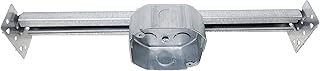
How to Choose a/an Electrical Box For Ceiling Fan (2026)
- New work vs. old work: If the ceiling is open or you can pull the drywall, a nail-on or brace-bar box installs fast. If the ceiling stays intact, you need an old-work box with an expanding brace that feeds through the existing hole and grips the joists from above.
- Weight rating: Match the rating to the fan, not to the average. Most boxes list separate numbers for fans and static fixtures, commonly 35 to 70 lb for fans and up to 75 lb for lights. Weigh in the downrod, glass shade, and light kit before deciding.
- Joist spacing: Brace bars usually cover 16 to 24 inches. Measure your actual spacing first, because retrofits in older homes and trusses often land outside that window.
- Box depth and cubic inches: A 1/2-inch pancake leaves almost no room once you have three cables and wire nuts in there. A 1.5-inch box gives you space to fold conductors without straining the canopy screws. Adjustable-depth designs let you sit flush with thick drywall or a decorative medallion.
- Location and material: Indoor dry locations take steel. Covered outdoor spots need weatherproof PVC with a gasket surface and reducer bushings sized to your conduit.
The Best Electrical Box For Ceiling Fan (2026)s Reviewed
Southwire MSBFAN Depth-Adjustable Fan Box
The depth adjustment is the standout feature here, letting you dial the box face to the drywall plane instead of shimming with washers. Rated for 50 lb fans and 75 lb fixtures, it’s the box I’d reach for when the ceiling thickness is unpredictable or a medallion is going on.
RACO RETRO-BRACE 936 Old Work Fan Box
This is the retrofit workhorse: the brace slides through a 4-inch hole, expands across 16 to 24 inch joists, and tightens with a socket driver until the feet bite the wood. At 1.5 inches deep with two 1/2-inch knockouts and a 35 to 70 lb range, it handles nearly any finished-ceiling swap without cutting drywall.
Hubbell-Bell PRCF57550GY Outdoor Fan Box
Weatherproof PVC, cULus listed, and built with a 45-degree mount so it works on porch ceilings and sloped soffits where a flat box would leave the canopy crooked. The three included reducer bushings mean you’re not hunting for adapters when your conduit doesn’t match the hub.
RACO 8293 4-Inch Round Ceiling Pan
A 1/2-inch deep pancake with five bottom knockouts, best used where you can screw directly into solid framing and the wiring is minimal. Confirm the fan manual allows a pancake box, and be honest about how much conductor volume you’re trying to stuff behind the canopy.
4″ Round Shallow Electrical Boxes, 2-Pack
Buying in pairs makes sense when you’re doing a whole floor or replacing several fixtures in a weekend. Same shallow profile as a single pancake, and the spare saves a trip when you strip a mounting hole.
Frequently Asked Questions
Can I hang a fan from my existing light box?
Only if it’s stamped as fan-rated and anchored to framing. An unmarked plastic box or one held by drywall ears alone must be replaced before the fan goes up.
Do I need to cut the ceiling open?
No. Old-work brace boxes are designed to install through the existing 4-inch hole, which is why they cost a little more than nail-on versions.
How much weight can a fan-rated box hold?
Typically 35 to 70 lb for a moving fan, with higher limits for static fixtures. Anything above 70 lb needs a support system rated specifically for that load.
Will these work on a vaulted ceiling?
Check the mount angle. The Hubbell-Bell box includes a 45-degree mount, and most fans include a canopy that tolerates a modest slope, but steep pitches may require a longer downrod or angled adapter.
Final Thoughts
For a finished ceiling, the RACO RETRO-BRACE 936 solves the problem with the least demolition and gives you room to work in the box. On open framing or during a remodel, the Southwire MSBFAN earns its keep with depth adjustment and a solid 50 lb fan rating. And if the fan is going on a porch, the Hubbell-Bell PRCF57550GY is the one that will still be tight in ten years.