Key takeaways
- Sphere diameter: A 2.4″ ball fits a standard double old-fashioned with room to swirl; 2″ and 2.1″ suit narrower rocks glasses and Nick & Nora coupes. Measure the inside width of your favorite glass before choosing — an oversized sphere that wedges in place defeats the slow-melt advantage.
- Cycle time versus batch size: Single-cavity machines turn out one sphere every 30 to 40 minutes, which is fine for a nightcap but painful before guests arrive. Multi-cavity units producing three or four per cycle scale to 100+ pieces a day and let you build a freezer stockpile.
- Footprint and clearance: These are appliances, not gadgets. Check depth against your counter overhang and confirm rear venting clearance — restricted airflow lengthens cycles and stresses the compressor.
- Water handling: Reservoir units need manual top-ups; auto water supply models accept a line or larger tank for hands-off runs. Either way, filtered water yields noticeably better clarity, and self-cleaning cycles keep scale out of the freeze plate.
- Powered or press-style: Aluminum and stainless press molds use metal’s thermal conductivity to melt a sphere out of a frozen block — no electricity, no noise, no counter footprint. The tradeoff is a 12-hour freeze cycle and a bit of technique.
What's inside
Anyone who has tried to make bar-quality spheres at home knows the routine: fill the silicone mold, wait overnight, pop out a cloudy white orb with a crack running through the middle. The culprit is trapped air and dissolved minerals getting pushed inward as water freezes from all sides at once. The workaround makers have used for years is directional freezing — an insulated cooler with the lid off, so ice forms top-down and pushes impurities into a sacrificial base you saw off later. It works beautifully. It also eats a shelf of freezer space, takes 18 to 24 hours, and requires a hacksaw at the end.
Countertop sphere machines solved that problem by building the insulation and the directional freeze into a sealed chamber, and 2026’s crop is genuinely dialed in. This guide breaks down six options across two categories — plug-in machines that produce polished spheres in 30 to 40 minutes, and press-style molds that give you the same optical clarity for a fraction of the cost if you don’t mind managing the freeze yourself. Below you’ll find selection criteria worth knowing before you commit counter space, hands-on notes on each unit, and answers to the questions that come up once you’re actually running one.
As an Amazon Associate we earn from qualifying purchases.




How to Choose a Clear Ice Ball Maker (2026)
- Sphere diameter: A 2.4″ ball fits a standard double old-fashioned with room to swirl; 2″ and 2.1″ suit narrower rocks glasses and Nick & Nora coupes. Measure the inside width of your favorite glass before choosing — an oversized sphere that wedges in place defeats the slow-melt advantage.
- Cycle time versus batch size: Single-cavity machines turn out one sphere every 30 to 40 minutes, which is fine for a nightcap but painful before guests arrive. Multi-cavity units producing three or four per cycle scale to 100+ pieces a day and let you build a freezer stockpile.
- Footprint and clearance: These are appliances, not gadgets. Check depth against your counter overhang and confirm rear venting clearance — restricted airflow lengthens cycles and stresses the compressor.
- Water handling: Reservoir units need manual top-ups; auto water supply models accept a line or larger tank for hands-off runs. Either way, filtered water yields noticeably better clarity, and self-cleaning cycles keep scale out of the freeze plate.
- Powered or press-style: Aluminum and stainless press molds use metal’s thermal conductivity to melt a sphere out of a frozen block — no electricity, no noise, no counter footprint. The tradeoff is a 12-hour freeze cycle and a bit of technique.
The Best Clear Ice Ball Makers of 2026, Reviewed
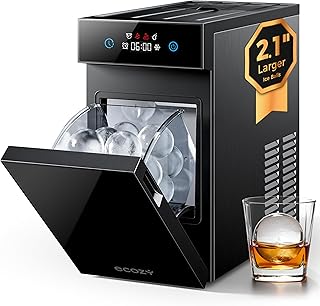
ecozy 2.4″ Clear Ice Ball Maker
The clarity here is the benchmark — CrystalFlux directional freezing produces spheres with no visible nucleation core, and the 8-hour timer means you can stage a batch before you leave for work. At 32 pieces a day it’s built for a household that drinks well rather than one that entertains constantly.
Silonn 2.4″ Sphere Ice Maker
Three spheres per 40-minute cycle and 100 a day makes this the practical choice if you host, and the dual Crystal Sphere and Rapid Sphere modes let you trade a little transparency for throughput when the party is already underway. Expect a slightly larger footprint than single-cavity rivals.
ecozy 2.1″ Clear Ice Ball Maker
A smart pick for standard rocks glasses, and the shorter 30-minute cycle plus 48-piece daily ceiling actually outpaces its bigger sibling. Same minimal footprint and self-cleaning function, so it’s the one I’d suggest for apartment bars with limited counter run.
2.5″ Stainless Large Round Ice Mold (2-Pack)
This is the maker’s answer: two heavy stainless press molds that sink through a frozen block overnight, plus a storage box and tongs. No power draw, no maintenance, and 2.5″ spheres larger than any countertop machine produces — you just need patience and freezer real estate.
Crystal Clear Ice Ball Maker, 4 Cavity
Four 2.5″ spheres per freeze at the lowest cost of anything here, using the same directional-freeze principle in a tray format. Clarity depends on filtered water and a full 12-hour cycle, but the results hold up next to machine ice for a fraction of the outlay.
Frequently Asked Questions
Why do these machines make clear ice when my freezer trays don’t?
They freeze in one direction only, insulating every surface except the chilled plate. Air and minerals get driven ahead of the ice front instead of being sealed inside, which is exactly what the cooler trick accomplishes — just faster and without the sawing.
Does clear ice actually melt slower?
Yes, though the shape matters more than the clarity. A sphere has the lowest surface-area-to-volume ratio of any ice form, so it sheds cold slowly; dense, void-free ice adds to that by eliminating the fracture points where melting accelerates.
How much maintenance do countertop units need?
Run the self-clean cycle every couple of weeks and descale monthly with a diluted citric acid solution if you’re on hard water. Empty and dry the reservoir when storing the machine for more than a few days to prevent biofilm.
Can I flavor the ice or freeze coffee and juice?
Skip it in powered machines — sugars and pulp foul the freeze plate and void most warranties. Press molds and trays handle diluted juice or cold brew fine, though anything but pure water will freeze cloudy.
Final Thoughts
For most buyers the ecozy 2.4″ delivers the cleanest spheres with the smallest footprint, while the Silonn 2.4″ earns its counter space if you regularly pour for a crowd. And if you’d rather spend on whiskey than appliances, the 2.5″ stainless press mold gets you 95% of the way there for the price of a decent bottle.