Key takeaways
- Know which type you’re buying: A refrigerant unit with an auto-evaporation system genuinely lowers room temperature and needs a window vent. An evaporative cooler adds humidity while it drops the air temp a few degrees, works best in dry climates or with a cracked window, and needs no venting at all.
- Match BTU to square footage honestly: Roughly 20 BTU per square foot is a workable baseline, then add capacity for sun-facing rooms, high ceilings, or a kitchen. Undersizing means the compressor never rests, which kills efficiency and your sleep.
- Check the window kit before you order: Most kits assume a standard double-hung sash. Casement, awning, and sliding windows often need an adapter or a plexiglass insert you cut yourself, so measure the opening and confirm the hose diameter first.
- Look at tank size against runtime: On swamp coolers, a small reservoir means frequent refills. A 6-plus gallon tank can run most of a day, while a 1,000 to 1,500 ml mist tank is really a desk or bedside solution rather than a whole-room fix.
- Read the noise spec, not the marketing: “Silent” usually describes the lowest fan setting. Anything under about 52 dB on sleep mode is genuinely livable in a bedroom; above that, plan on a fan or white noise to mask it.
What's inside
Anyone who has hauled a portable AC up a flight of stairs knows the real headache isn’t the cooling, it’s the water. Older units park a drain hose or a sloshing bucket in the middle of your floor plan, and if you forget to empty the reservoir on a humid August afternoon, the compressor shuts down and you’re back to sweating. Self-evaporative designs solve that by recycling condensate over the hot coil and pushing the moisture out through the exhaust, which means far less babysitting and no hose snaking across a rug you actually care about.
The catch is that “self evaporative” gets stamped on two very different machines: true refrigerant units that vent out a window, and swamp coolers that chill air by passing it over a wet pad. Both have a place, and neither is a scam, but buying the wrong one leads to disappointment. Below is a shortlist covering both categories, plus the specs worth checking before you commit, from tank capacity and exhaust kit fit to how much noise you’ll live with overnight.
As an Amazon Associate we earn from qualifying purchases.


How to Choose a Self Evaporative Portable Air Conditioner (2026)
- Know which type you’re buying: A refrigerant unit with an auto-evaporation system genuinely lowers room temperature and needs a window vent. An evaporative cooler adds humidity while it drops the air temp a few degrees, works best in dry climates or with a cracked window, and needs no venting at all.
- Match BTU to square footage honestly: Roughly 20 BTU per square foot is a workable baseline, then add capacity for sun-facing rooms, high ceilings, or a kitchen. Undersizing means the compressor never rests, which kills efficiency and your sleep.
- Check the window kit before you order: Most kits assume a standard double-hung sash. Casement, awning, and sliding windows often need an adapter or a plexiglass insert you cut yourself, so measure the opening and confirm the hose diameter first.
- Look at tank size against runtime: On swamp coolers, a small reservoir means frequent refills. A 6-plus gallon tank can run most of a day, while a 1,000 to 1,500 ml mist tank is really a desk or bedside solution rather than a whole-room fix.
- Read the noise spec, not the marketing: “Silent” usually describes the lowest fan setting. Anything under about 52 dB on sleep mode is genuinely livable in a bedroom; above that, plan on a fan or white noise to mask it.
The Best Self Evaporative Portable Air Conditioner (2026)s Reviewed
3000 CFM Swamp Cooler & Evaporative Air Cooler
With 3,000 CFM of airflow and a 6.87-gallon tank, this is the pick for garages, workshops, and open patios where venting a hose simply isn’t practical. The 120-degree oscillation and 15-hour timer make it easy to set and forget, though like all evaporative coolers it performs best when the air is dry and there’s some cross-ventilation.
Newair 8,000 BTU Portable AC
Newair’s compact 8,000 BTU unit is a smart choice for a bedroom or home office under roughly 200 square feet, combining real refrigerant cooling with dehumidification and self-evaporative condensate handling. The narrow footprint tucks beside a nightstand or desk without dominating the room, and the remote saves you getting up at 2 a.m.
10,000 BTU 3-in-1 Portable AC
Rated for medium rooms around 450 square feet, this three-mode unit handles cooling, dehumidification, and fan duty with an auto-evaporation system that keeps drain maintenance to a minimum. It hits a sensible middle ground on price and capacity, making it the default recommendation for a main living space.
12,000 BTU Smart Portable AC
For open-plan areas up to 600 square feet, the 12,000 BTU smart model brings app and remote control, an energy-saving mode, and a genuinely quiet sleep setting alongside auto evaporation. The included ventilation kit assembles in a few minutes, and the higher capacity means it cycles off instead of running flat out all evening.
4-in-1 Portable AC Fan with 1500 ML Tank
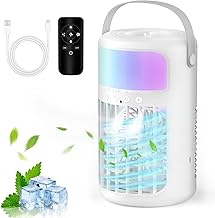
This USB-C powered cooler is built for personal comfort rather than whole rooms, with three speeds, two mist modes, and a 1,500 ml tank that suits a desk, a tent, or a workbench. Treat it as a highly portable spot cooler and it delivers real relief for very little money or power draw.
Frequently Asked Questions
Does a self-evaporative unit ever need draining?
Occasionally, yes. In very humid conditions the system can’t evaporate every drop, so most units include a small drain plug and a full-tank shutoff. Draining at the end of the season also prevents standing water and mildew.
Can I run a portable AC without venting it out a window?
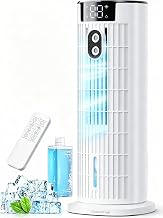
Not a refrigerant model. Without an exhaust route, the hot air it removes goes straight back into the room and you net a slight temperature increase. Evaporative coolers like the 3000 CFM swamp cooler and the CoamoTrail tower are the vent-free options.
Why does my unit ice up or lose power?
Icing usually points to a clogged filter or restricted airflow, so rinse the filter monthly. Always plug into a dedicated wall outlet rather than a power strip or thin extension cord, since the compressor draws hard on startup.
How much cooling can I expect from an evaporative model?
Typically a 5 to 15 degree drop in the airstream, with the bigger numbers in dry climates. In humid regions the effect narrows considerably, which is when a refrigerant unit becomes the better investment.
Final Thoughts
For most homes, the 10,000 BTU 3-in-1 hits the best balance of capacity, quiet operation, and hands-off evaporation, while the 12,000 BTU smart model is worth the step up if you’re cooling an open living area. If you need something for a garage or covered porch where a window vent is off the table, the 3000 CFM swamp cooler and its 6.87-gallon tank is the practical answer.