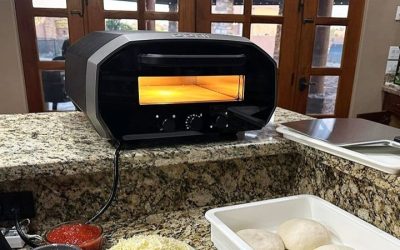
In the air fryer vs convection oven decision, the biggest difference is often the size and layout of the cooking space, not a completely different source of heat. Both circulate hot air. A compact air fryer suits quick, crispy portions, while a convection oven accommodates larger pans and broader baking or roasting tasks. An oven with a dedicated air-fry mode can blur the distinction further.
Quick Verdict: Choose a basket air fryer if you regularly crisp a small batch of fries, wings or reheated snacks and want compact cleanup. Choose a convection oven for sheet-pan meals, baked dishes and larger gatherings. If your current oven has an air-fry mode, try it with the recommended tray before purchasing a second appliance.
As an Amazon Associate we earn from qualifying purchases.
By DIY Ideas 4 Home Editorial Team
Air Fryer vs Convection Oven: Key Differences
Whirlpool’s air-fryer comparison explains that both appliances use fans, but their heating-element arrangements and chamber sizes can differ. Some air fryers direct heat mainly from the top; some ovens combine a convection fan with their bake, broil or third heating element. The cooking result depends on fan speed, rack design, ingredient load and recipe settings, so no single technology label guarantees crispness.
| Factor | Basket Air Fryer | Convection Oven | Better For |
|---|---|---|---|
| Cooking chamber | Compact basket or drawer | Larger racks or baking pans | Small snack vs family tray |
| Air circulation | Concentrated around small load | Distributed through wider cavity | Fast crisping vs even batch cooking |
| Preheating | Often quick; model dependent | Can take longer; some air-fry modes skip it | Check specific manual |
| Batch capacity | May require multiple batches | More room for pans and racks | Larger meals favor oven |
| Cleanup | Basket, insert and drip area | Pans, racks and larger cavity | Depends on meal and design |
| Counter or floor space | Separate countertop footprint | May already be installed | Existing oven can save counter space |
Heating method and cooking texture
An air fryer is essentially a specialized hot-air cooker with a relatively compact chamber. USDA’s Air Fryers and Food Safety page describes rapid circulation around food as the mechanism behind its browned, crisp exterior. Convection ovens also circulate air, but the air speed, food distance from the heating source and pan design may differ. A typical solid casserole dish blocks heat from reaching the underside of fries more than an open mesh basket does.
For frozen fries and breaded snacks, an approved perforated tray in a convection oven can improve exposure to moving air. Whirlpool suggests shallow pans or perforated baskets when trying to achieve a similar crisp exterior in a convection oven. Conversely, a small air fryer does not automatically cook everything better: large batches of vegetables may steam each other when piled up in a crowded basket.
Preheat, capacity and batch timing
Whirlpool notes that compact air fryers generally preheat faster than larger convection ovens because there is less interior space to heat. That is a tendency, not a universal timing rule. GE Appliances has a No Preheat Air Fry oven setting that expressly omits a preheat stage on compatible models. Therefore the right comparison is the full time from a cold appliance to a finished meal, including repeated batches.
Consider a dinner for two compared with six servings of roasted vegetables. A small air fryer may finish the smaller portion promptly, but preparing the larger meal in three consecutive batches adds loading and unloading time. A convection oven with a full-size sheet pan may finish all the food at once, depending on food thickness and rack placement. The room for airflow matters as much as the advertised quart rating.
Temperature, energy use and operating costs
Both appliances can reach temperatures suitable for browning. USDA describes common air-fryer cooking around 350 to 400 degrees F and times of about 5 to 25 minutes, while emphasizing that recipe and appliance requirements vary. Whirlpool explains that convection and air-fryer recipes may use cooking temperatures roughly 20 to 25 degrees F lower than conventional oven settings; that is a broad comparison, not a substitute for the manufacturer’s recipe.
It is tempting to declare an air fryer always cheaper to run, but cooking energy depends on power, run time, preheating and food quantity. An already installed convection oven may be practical for a single large batch; a countertop fryer can avoid heating a large cavity for a small snack. Without consistent measurements for the two particular models and recipes, a universal dollar saving would be misleading. Assess how you actually cook rather than relying on unsupported energy claims.
Which One to Choose by Cooking Situation
Instead of buying by appliance name, start with the meals you prepare at least weekly. Also account for where the appliance will sit, how often it needs cleaning and whether your existing oven already has air-fry capability.
Choose an air fryer for small crispy servings
If your routine is reheating fries, making a couple of portions of wings, or crisping frozen appetizers, a basket fryer is convenient because the food sits close to circulating hot air. A removable crisper plate can make it easier to shake or turn food without handling a large hot oven pan. You still need a stable counter and clearance around the vents.
Size for real portions, not just a quart number. The Ninja Crispi FN101 system, for example, is sold with both a 6-cup container and a 4-quart container according to Ninja’s product page, highlighting how container geometry affects what you can cook. Check the number of wings or food pieces that fit in a single layer rather than assuming every four-quart vessel behaves alike.
Choose a convection oven for baking and larger pans
If you bake cookies, roast vegetables for a household or cook a casserole in a rectangular dish, a convection oven is usually the more versatile format. A full-size oven can accept cookware that would not fit a countertop basket. Rack placement and pan height still matter: tall-sided pans reduce the air reaching the food surface, and stacking too many trays may require rotation.
For a concrete countertop example, Breville’s Smart Oven Pro BOV845BSSUSC offers 10 cooking functions with a convection setting, according to the manufacturer’s product page. It is a convection toaster oven rather than a dedicated basket fryer, so it fits someone who wants toast, baking and roasting functions in the same appliance. Verify its actual usable pan dimensions before substituting it for a full-size oven.
Use your oven’s air-fry setting before buying another
Some convection ovens include a mode specifically tuned to crisp foods. GE Appliances says its No Preheat Air Fry mode uses hot moving air from above and may cycle the fan rather than running it constantly. Whirlpool likewise describes integrated air-fry modes as a way to get crisp food from an oven you already own. A mesh tray and suitable rack position can matter as much as the name on the button.
Find the model’s cooking guide and test a food you already make, keeping batch size and spacing realistic. If the result meets your expectations, adding a countertop appliance may duplicate a function without saving meaningful time. If it consistently cooks only tiny portions well or leaves you washing a large oven for one snack, a separate small fryer may still earn its counter space.
Choose based on cleanup and available space
A small basket is easy to carry to the sink, but greasy food can leave residue under its insert and around the upper heater. A convection oven has a wider cavity and larger racks, which can be awkward to wash, yet a removable pan may catch most of the drippings. Neither is automatically lower maintenance. Check whether the parts you touch most often are removable and approved for dishwashing.
Measure cabinet height, counter depth and nearby wall clearance before shopping for a countertop unit. A toaster oven may occupy a larger permanent area than a drawer-style fryer and may need room for its front door to swing down. An existing built-in oven uses no new counter space, though it may require more bending and reaching for everyday snacks. Check the clearance rules in each owner’s manual, not a generic inch allowance.
Choose by food safety, not brown color
These appliances move heat differently, but safe internal temperatures do not depend on whether the button says Air Fry or Convection. USDA directs cooks to use a food thermometer and lists 165 degrees F for poultry, 160 degrees F for ground meats, and 145 degrees F with a 3-minute rest for whole cuts of beef, pork, veal and lamb. A dark exterior can develop before the center reaches those values.
USDA also warns that overfilling an air-fryer basket can create uneven cooking. Spread food out, turn or shake when indicated and check the thickest part of the piece. For a convection oven with multiple racks, use the maker’s rack positioning guide to avoid undercooked zones. The real advantage of either appliance is repeatable cooking when loaded within its design limits.
Products That Help
The Ninja Crispi FN101 Air Fryer Cooking System illustrates a compact, container-based approach to small batch air frying; Ninja publishes a 6-cup and 4-quart vessel pairing and a 1,500-watt rating. The Breville Smart Oven Pro BOV845BSSUSC is a countertop convection oven aimed at broader cooking jobs; Breville identifies 10 cooking functions, including conventional oven-style modes. Compare the physical footprint and your most common recipe before deciding between them.
For someone who wants both modes in one countertop appliance, Breville’s Smart Oven Air Fryer Pro BOV900BSSUSC combines oven functions with air fry. Breville lists 13 presets, a 1-cubic-foot interior and space for a 9-by-13-inch pan, so its appeal is larger batch flexibility rather than the smallest footprint. These examples represent different appliance designs, not tested winners. Check current availability and the manufacturer’s listed dimensions for the precise US model before purchase.
Frequently Asked Questions
These comparisons are easiest to answer when the oven design and serving size are specified rather than treating ‘convection’ as one identical feature across machines.
Is an air fryer just a small convection oven?
They use a similar fan-assisted heating principle, but not necessarily the same heating-element arrangement, chamber layout or airflow speed. USDA describes air fryers as essentially countertop convection ovens, while Whirlpool points out meaningful design differences. Those distinctions can change browning and batch size, even though the underlying method is similar.
Can a convection oven make food as crispy as an air fryer?
Sometimes, especially with a dedicated air-fry mode or an approved mesh or low-sided tray that exposes the food to circulating air. Whirlpool recommends better airflow around the food as a way to approach air-fried results. A deep baking dish and crowded racks usually work against that goal.
Does an air fryer always cook faster than convection?
No. A small air fryer may finish one portion faster because its chamber warms quickly, but repeated loads can take longer than one large oven batch. GE’s no-preheat oven mode further shows why blanket preheat assumptions fail. Compare total recipe time and actual serving capacity for the two appliances.
Which appliance is better for a small kitchen?
If you already have a convection oven with a suitable crisping mode, it may be the better space-saving choice because you add nothing to the counter. Without that oven, a compact basket fryer may take less room than a large toaster oven. Account for ventilation clearance, door swing, storage and whether you need to bake full pans.
Final Thoughts
A small fryer is a sensible convenience tool for frequently cooked snacks and modest portions; a convection oven is the stronger all-rounder for pans, baking and family-size roasting. The decision changes if your existing oven has a capable air-fry mode, so try that first. Compare one normal week’s meals, available countertop space and how often you would need extra batches, then select the appliance that solves an actual cooking bottleneck rather than buying a second fan-assisted oven by default.