Key takeaways
- 3.5-inch color display works without a smartphone screen.
- Innova documents selected all-system scans and bidirectional tests.
- Published coverage checker lets buyers assess vehicle-specific functions.
A check-engine warning does not tell you which part to replace, and an automotive diagnostic scanner is only as useful as the systems it can actually access on your vehicle. An inexpensive handheld device may read generic powertrain codes perfectly well while being unable to diagnose an airbag or command an ABS bleed. Bluetooth adapters move the screen to a phone, but app support and vehicle protocols then become part of the purchase. These five specific US-market tools span basic code reading, selected body systems and higher-level functions; none replaces a service manual or a qualified repair procedure.
Quick Verdict: Innova 5610 is our best overall choice for DIY owners maintaining several supported vehicles: its published feature matrix includes all-system scans and bidirectional functions on compatible cars. The $349.99 price and required vehicle coverage check are important limitations. Based on October 2026 published specifications, not hands-on tests. Check VIN-specific coverage first.
As an Amazon Associate we earn from qualifying purchases.
By DIY Ideas 4 Home Editorial Team
5 Best Automotive Diagnostic Scanner Models Reviewed
The decisive factor is supported functions for a specific model year, not the largest list of symbols on the box. We compared generic powertrain read/erase, live data, ABS/SRS/transmission capability where documented, physical interface and software conditions. Prices observed as of October 2026 range from $59.99 to $349.99 for these configurations. Innova publishes a model comparison matrix; Autel’s model pages identify system coverage; OBDLink documents protocol and app support. Model-specific coverage is qualified in each review, because an OBD-II connector does not guarantee every module is accessible.
| Product | Best For | Key Spec | Listed Price (as of October 2026) | Watch Out For |
|---|---|---|---|---|
| Innova 5610 | Best Overall | All-system scan; bidirectional by vehicle | $349.99 | Coverage differs by make, year and function |
| Autel AL519 | Best Budget | 10 OBD-II modes; 320 x 240 display | $59.99 | Generic OBD-II, not broad ABS or airbag work |
| Autel ML629 | Best for Four-System Codes | Engine, transmission, ABS, SRS | $114.00 | Reset and access vary by vehicle |
| OBDLink MX+ | Best for Phone-Based Data | Bluetooth; MS-CAN/SW-CAN; 3 oz | $139.95 | Enhanced functions depend on software and vehicle |
| Innova 5210 | Best for Entry-Level ABS | Check-engine and ABS; live data | $99.99 | ABS coverage varies with exact vehicle |
Innova 5610: Best Overall
Best For: Experienced DIYers needing deeper diagnostics across several confirmed compatible household vehicles.
For a hobbyist already competent at reading wiring diagrams, the 5610 gives more room to diagnose than a generic emissions code reader. Its broader system scan may help connect a charging issue with warnings from other modules, and certain vehicle-specific bidirectional controls can shorten diagnosis. That functionality is only worthwhile if the feature is supported on the actual car. Buying it without checking coverage can be worse value than selecting a simpler $100 scanner.
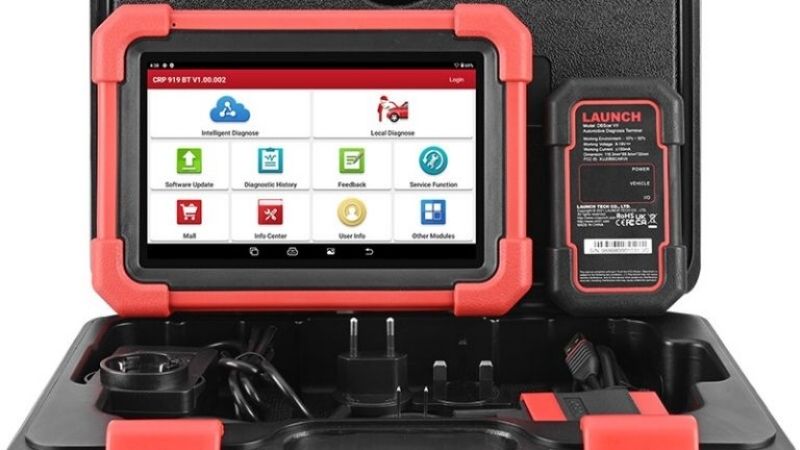
Innova’s 5000 Series master comparison chart lists the 5610 at $349.99 and identifies enhanced functions including OEM live data and bidirectional system tests subject to the coverage checker. The Innova 5610 specification page identifies a 3.5-inch color display and USB-C firmware updates. This is a diagnostic aid; actuator tests can move components or energize equipment, so read manufacturer service instructions first.
The unit body is described by Innova as roughly 7 inches long, 3.75 inches wide and 1 inch thick. The company lists vehicle power and a detachable connection cable, while optional RepairSolutions2 features require app consideration. It is bulkier to store than a tiny Bluetooth dongle, but it does not depend on a phone to display basic information. For safety, avoid clearing codes before documenting freeze-frame data and the original symptoms.
Pros:
- 3.5-inch color display works without a smartphone screen.
- Innova documents selected all-system scans and bidirectional tests.
- Published coverage checker lets buyers assess vehicle-specific functions.
Cons:
- $349.99 price is much higher than generic-code readers.
- Advanced functions may not exist for a particular vehicle.
Who Should Buy It: Choose the Innova 5610 only after checking supported tests; use Autel AL519 for basic emissions fault diagnosis without advanced-system expense.
Autel AL519: Best Budget
Best For: Drivers wanting an independent handheld to inspect check-engine codes and emissions readiness.
This is the efficient choice for checking a dashboard engine warning before deciding whether a professional diagnosis is needed. Its screen and dedicated readiness controls require no app account or phone Bluetooth connection, which is attractive when a device lives in a glovebox. It is not an alternative to a comprehensive scan platform for airbag controllers or automated brake-service procedures. That boundary should govern the purchase.
Autel’s official AL519 store page lists the scanner at $59.99 in October 2026 and documents all ten standard OBD-II test modes, live powertrain data, freeze-frame information and a one-click inspection/maintenance readiness interface. Autel’s AL519 technical page gives a 320-by-240 color display. Clearing trouble codes can reset emissions readiness monitors, so save information first and fix the cause rather than repeatedly erasing the light.
The handheld is approximately 6.91 inches long, 3.80 inches wide and 1.46 inches thick. The manufacturer puts its bare weight at about 0.8 pound without the cable. A cabled tool cannot be placed indefinitely in a pocket while plugged in, but it avoids reliance on a phone battery. The included carry case protects the screen during storage; use the vehicle OBD connector carefully rather than tugging the cord around the steering column.
Pros:
- $59.99 observed cost is low for a standalone screen.
- All ten standard OBD-II modes suit emissions troubleshooting.
- 0.8-pound bare unit fits a simple car-service kit.
Cons:
- No claim of all-system access across ABS and SRS.
- Cable and handheld require space around driver footwell.
Who Should Buy It: Buy AL519 for check-engine and readiness tasks; choose Autel ML629 if four-system access is supported for your vehicle.
Autel ML629: Best for Four-System Codes
Best For: DIY mechanics who need one handheld for engine, transmission, ABS and SRS code work.
The ML629 fills a useful middle ground: a scanner does not have to cost several hundred dollars simply to inspect more than the engine computer. Access to transmission, ABS and SRS faults can help document why multiple warning lights appeared together. However, reading a brake module fault does not itself authorize bleeding hydraulic systems, working around airbags or replacing safety-critical parts without the proper service procedure.
Autel’s MaxiLink ML629 product page lists $114.00 for the model and describes engine, transmission, ABS and SRS read/clear capability, ten standard OBD-II modes and live/freeze-frame functions. The store identifies AutoVIN and updates, although the practical scope of enhanced functions depends on supported vehicles. Compare coverage for your exact model and year before paying for any claim about all four systems.
The ML629 is a dedicated handheld rather than a mini Bluetooth adapter, so it can be used while a phone is occupied with a service manual. Confirm the size of the storage case and cable arrangement with the current package before buying, as some distributor pages describe bundled accessories differently. Avoid placing the device where it could snag the steering wheel or pedals while graphing data; have a passenger monitor readings during a road test.
Pros:
- Four named systems broaden fault discovery beyond engine data.
- $114 listed cost is below the higher-end Innova.
- Handheld use does not depend on phone pairing.
Cons:
- Four-system access is not full dealer-level functionality.
- Vehicle-specific maintenance routines still require coverage checks.
Who Should Buy It: Choose ML629 when ABS and transmission codes are a priority; choose Innova 5610 if supported bidirectional diagnostics are central to your work.
OBDLink MX+: Best for Phone-Based Data
Best For: Owners who prefer logging live vehicle parameters through an iOS, Android or Windows device.
Rather than pay for an onboard screen, this device puts the diagnostic interface into a small adapter that stays near the footwell. It particularly suits people who use graphs, trip recording or compatible third-party software. Its value rises for certain Ford and GM vehicle networks, but a phone app is part of the workflow, and available features differ dramatically by the software selected. This is not a universal bidirectional programming tool.
OBDLink’s MX+ product page posts $139.95 and lists standard US OBD-II support, plus MS-CAN and SW-CAN support for applicable vehicles. The company documents compatibility with iOS, Android and Windows, and its own included apps and firmware updates. A marketing claim of broad manufacturer support must be read with the published add-on and app compatibility documentation; safety-critical functions should never be presumed from a Bluetooth connection alone.
The adapter is 1.97 inches long, 1.77 inches wide and 0.91 inch thick, with a stated device weight of 3 ounces. Its small projection is valuable where a conventional scanner plug collides with the driver’s knee, but verify connector position in the particular car. The 3-year manufacturer warranty and documented low-power sleep behavior matter if you leave the device connected. Unplug it if the vehicle maker or your parking situation makes that impractical.
Pros:
- Small 3-ounce adapter reduces equipment carried between cars.
- MS-CAN and SW-CAN support helps some Ford and GM owners.
- iOS, Android and Windows support broadens data-display choices.
Cons:
- Requires compatible phone, computer and app workflow.
- Advanced access varies with chosen software and vehicle hardware.
Who Should Buy It: Buy MX+ for supported logging and network access; choose Innova 5610 if you need a self-contained display for vehicle-specific service tests.
Innova 5210: Best for Entry-Level ABS
Best For: Households wanting handheld engine and selected ABS codes without a professional-service budget.
The 5210 is a better match than the cheapest scanner when the household includes a car prone to occasional brake warning messages and a phone-based repair reference is acceptable. It remains a modest step up from basic emissions code reading, not a way to command every brake actuator. A buyer expecting full SRS, transmission and special function capability should avoid using the presence of an ABS icon as evidence of those functions.
Innova’s master comparison chart prices the 5210 at $99.99 and maps its standard check-engine, smog and ABS capabilities. The manufacturer directs buyers to the coverage checker because not all advertised functions are supported for every vehicle. Innova’s accompanying RepairSolutions2 app can assist with code explanations but should not be treated as proof that a suggested part is defective.
This wired handheld can stay in a home maintenance kit instead of permanently occupying the OBD port. Verify the exact physical display and cable included with the 5210 retail package, since Innova sells several nearby 5000-series variants with different interfaces. Keep a written code and symptom log before clearing anything, especially after a battery replacement or intermittent warning. For an unfamiliar airbag or brake hydraulic procedure, use a professional.
Pros:
- $99.99 sits below most enhanced handheld offerings.
- Checks selected ABS faults alongside standard engine codes.
- Coverage-checker support reduces unsupported-function assumptions.
Cons:
- Not a substitute for the 5610 advanced test features.
- ABS results depend heavily on make and model year.
Who Should Buy It: Choose Innova 5210 for modest expanded codes; pick Autel AL519 if only generic emissions diagnostics are needed.
How to Choose a Automotive Diagnostic Scanner
Before comparing scanners, identify the vehicle year, make, model, engine and exact module you need. Generic OBD-II emissions support on US vehicles from model year 1996 onward is not the same as enhanced proprietary access, and electric and hybrid cars may need separate tools or different coverage. A trouble code points toward a circuit, condition or monitoring failure, not automatically a defective component. Keep the vehicle stationary while reading any screen and record freeze-frame conditions before erasing the codes.
Generic OBD-II Versus Full-System
Autel AL519 provides the ten standard OBD-II modes for powertrain and emissions tasks. Innova 5610 and Autel ML629 advertise additional systems, but their useful scope must be checked by vehicle. A module may expose stored fault codes while withholding calibration or actuation commands.
If the airbag indicator is illuminated, a cheap scanner that clears engine codes will not necessarily communicate with the restraint computer. Even when codes are displayed, restraint systems can contain explosive devices and stored energy. Do not probe SRS connectors or perform unapproved airbag repairs. For this category, prioritize named supported modules over a generic claim of complete diagnostics.
Check the Exact Vehicle Coverage
The 1996-and-newer US OBD-II baseline establishes broad emissions access for compliant cars and light trucks, but model-specific networks evolve. Innova’s comparison chart specifically warns that features may be absent on particular vehicles. Autel and OBDLink also publish compatibility information.
A useful shopping test is to write down the exact procedure, such as reading an ABS sensor fault on a 2017 sedan, and search the maker’s compatibility tool for that result. Do not infer support from another car made by the same brand. New security gateways can restrict access even when a scanner communicates with several older model years.
Decide on Handheld or Bluetooth
A handheld such as Autel AL519 has its own screen and dedicated keys. OBDLink MX+ requires a separate phone, tablet or computer but can support richer data graphs and compatible software. The better option depends on whether you want a quick glovebox diagnostic or repeatable data capture while comparing vehicle behavior.
Think about battery life, app permissions, subscriptions, offline use and whether the diagnostic connector blocks a pedal. The physical size of a Bluetooth adapter may improve clearance, but never operate phone controls while driving. A passenger should supervise recording during any road test. Before paying for an add-on, make sure it explicitly supports the selected adapter and vehicle.
Evaluate Repair Features and Cost
The price gap is sizable: Innova 5610 was listed at $349.99 compared with $59.99 for Autel AL519. That difference can be appropriate for frequent diagnostics across supported vehicles, but rarely pays for itself when all you need is to check emissions readiness before inspection.
Bidirectional tests command an actuator or request a module response. Some procedures can activate pumps, fans or moving components. Only perform these steps with service information, protective equipment and a clear understanding of what might move. Software update promises also vary: check whether future functions, paid app modules and replacement cables add costs after purchase.
Frequently Asked Questions
Owners often ask these questions after the scanner has already been connected to a car.
Will an OBD-II scanner work on every US car after 1996?
Standard emissions-related OBD-II functions generally apply to compliant 1996-and-newer US passenger vehicles, but enhanced modules are not universal. Hybrid, EV, heavy-duty and manufacturer-specific systems may have different requirements. Use the tool vendor’s coverage lookup with exact vehicle details. The connector alone does not tell you what a scanner can do.
Can a scanner tell me which part to replace?
No. It reports symptoms and monitored faults, which may be caused by wiring, low voltage, leaks, software behavior or a component. A code involving an oxygen sensor, for example, does not prove the sensor itself is bad. Diagnose the complete circuit and operating conditions before buying replacement parts. Retain freeze-frame evidence because clearing codes often deletes useful context.
Does clearing a check-engine light repair the fault?
No. Clearing stored codes does not correct the mechanical or electrical cause, and many monitors need another drive cycle before reporting ready. That can affect an emissions inspection appointment. After repairs, follow the vehicle manufacturer’s drive-cycle guidance and confirm that readiness monitors complete without the warning returning.
Can I use a scanner while driving alone?
No; do not divert attention to a handheld or mobile screen while driving. Set up logging before moving and review results when parked, or ask another person to operate the equipment. A cable must not interfere with pedals, steering movement or airbag zones. Any advanced command that can operate a vehicle actuator should be performed in the safe conditions specified in the service manual.
Final Thoughts
Make a list of actual vehicles and the one or two functions you cannot currently perform, then check each function in the vendor’s supported-vehicle database before spending more. In a mixed-car DIY garage, Innova 5610 remains our best overall recommendation when its bidirectional features match those cars. For a single engine-light question, Autel AL519 may be all that is justified. Keep the scanner purchase separate from a decision to conduct hazardous brake or airbag repairs yourself.