Key takeaways
- 5.1.4: Five bed-layer speakers, one subwoofer, and four overhead or height speakers. Uses nine channels, leaving room for a second zone or future expansion on some models.
- 7.1.4: Adds two surround-back speakers to a 5.1.4 system. This is a common use for all 11 amplified channels and works best when there is space behind the seating.
- 9.1.2: Uses nine bed-layer speakers and two height speakers. It may suit a wide room where additional front or surround coverage is more useful than four overhead speakers.
The Best 11-Channel AV Receivers: Quick Picks by Theater Size
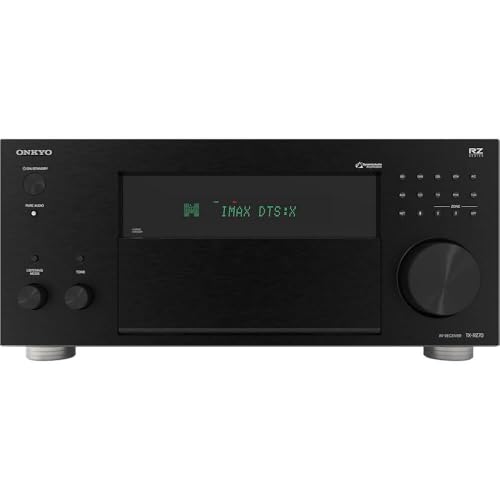
The best 11 channel AV receiver for most dedicated home theaters is the Denon AVR-X6800H: it has 11 powered channels, supports current HDMI 2.1 gaming features, and offers Audyssey room correction with an optional Dirac upgrade. Choose the Marantz Cinema 30 for more extensive calibration options and a more feature-rich installation, or the Onkyo TX-RZ70 when Dirac Live is a priority. The right pick depends on how many speakers you plan to power, the size of the room, and whether you need all 11 channels driven at once.
“11-channel” can mean 11 built-in amplifier channels, not necessarily 11.2-channel processing or support for every speaker layout. Check both the receiver’s powered-channel count and its processing limits before buying.
Our top picks


As an Amazon Associate we earn from qualifying purchases at no extra cost to you. Ratings are shown as listed on Amazon.
Compare the Leading 11-Channel Receivers
| Receiver | Built-in amplification | HDMI and room correction | Best fit |
|---|---|---|---|
| Denon AVR-X6800H | 11 channels; rated 140 W per channel under specified two-channel conditions | 8K/4K HDMI inputs; Audyssey MultEQ XT32, with optional Dirac Live | Medium or large rooms needing flexible layouts |
| Marantz Cinema 30 | 11 channels; rated 140 W per channel under specified two-channel conditions | 8K/4K HDMI inputs; Audyssey MultEQ XT32, with optional Dirac Live and ART availability depending on licensing and software | Premium installations and extensive calibration needs |
| Onkyo TX-RZ70 | 11 channels; rated 140 W per channel under specified two-channel conditions | 8K/4K HDMI inputs; Dirac Live, with Dirac Bass Control available as an option | Listeners prioritizing Dirac-based room correction |
| Yamaha RX-A8A | 11 channels; rated 150 W per channel under specified two-channel conditions | 8K/4K HDMI inputs; YPAO R.S.C. with multipoint measurement | Buyers who prefer Yamaha’s setup and sound-field features |
Power figures are manufacturer ratings and are not directly comparable unless test conditions match. Receivers typically deliver less power when many channels play simultaneously; speaker sensitivity, listening distance, and room acoustics also affect usable output. For demanding speakers or very high playback levels, a receiver with pre-outs can feed an external power amplifier.
Which Receiver Fits Your Room?
| Room and layout | Practical setup | What to prioritize |
|---|---|---|
| Small room, about 10 × 12 ft | 5.1.4 or 7.1.2 | Good calibration, quiet operation, and compact speaker placement; 11 powered channels may be more than you need |
| Medium room, about 14 × 18 ft | 7.1.4 | 11 powered channels, reliable HDMI switching, and room correction that can integrate subwoofers |
| Large room, about 20 × 25 ft or larger | 7.1.4 or 9.1.2, with external amplification if needed | Pre-outs, sufficient amplifier headroom, multiple subwoofer outputs, and careful speaker placement |
These are planning examples, not strict room-size limits. In a 10 × 12 ft room, an 11-channel receiver will not make a poorly placed 7.1.4 layout sound larger; it may be wiser to buy fewer speakers and spend the difference on placement or a subwoofer. In a larger space, consider listening distance and speaker sensitivity before treating a wattage rating as a guarantee of cinema-level output.
Head-to-Head: What Separates the Top Picks?
Denon AVR-X6800H: The flexible all-rounder
The X6800H suits buyers who want 11 internal amplifier channels and a broad choice of Dolby Atmos and DTS:X layouts. Its Audyssey MultEQ XT32 setup is accessible for many first-time calibrations, while optional Dirac Live can appeal to users who want another approach to room correction. It is a strong middle ground for a medium-sized theater, especially when you may expand the system later.
Marantz Cinema 30: The premium calibration choice
The Cinema 30 is a high-end alternative with 11 amplified channels and extensive configuration options. It makes sense when installation flexibility, processing features, and calibration choices matter more than minimizing cost. Confirm which Dirac features and licenses are currently included or available for your region before treating a specific feature as standard.
Onkyo TX-RZ70: Dirac-focused setup
The TX-RZ70 is worth comparing if you specifically want Dirac Live room correction and the option to add Dirac Bass Control. Calibration can help address room-related bass problems, but it cannot fix a subwoofer placed in a severe null or compensate for speakers aimed away from the listening area. Plan on experimenting with placement before relying on software alone.
Yamaha RX-A8A: Yamaha’s YPAO approach
The RX-A8A offers 11 amplifier channels and YPAO R.S.C. calibration. It is a sensible shortlist option for buyers already comfortable with Yamaha’s interface or interested in its sound-field processing. Compare its exact HDMI feature set and supported gaming modes with your console, television, and source devices before purchase.
HDMI 2.1: Check the Features You’ll Actually Use
For a 4K/120 Hz console or gaming PC, look beyond the “HDMI 2.1” label. Verify support for 4K/120 Hz pass-through, variable refresh rate (VRR), and auto low latency mode (ALLM), along with the number of inputs that can handle the formats you need. Enhanced Audio Return Channel (eARC) is useful for sending audio from a compatible TV back to the receiver. If a particular device chain is troublesome, connecting the console directly to the TV and using eARC may be a practical workaround.
Also check whether your sources and display support the same video formats. An AV receiver cannot create 4K/120 Hz from a source that outputs only 4K/60 Hz, and cables must be certified for the bandwidth of the connection.
Plan the Speaker Layout Before You Buy
- 5.1.4: Five bed-layer speakers, one subwoofer, and four overhead or height speakers. Uses nine channels, leaving room for a second zone or future expansion on some models.
- 7.1.4: Adds two surround-back speakers to a 5.1.4 system. This is a common use for all 11 amplified channels and works best when there is space behind the seating.
- 9.1.2: Uses nine bed-layer speakers and two height speakers. It may suit a wide room where additional front or surround coverage is more useful than four overhead speakers.
Check the receiver’s manual for the exact supported combinations: two layouts with the same channel count are not automatically interchangeable. For in-ceiling speakers, follow the Dolby placement guidance and account for joists, lighting, and wiring access before cutting. If the room has no suitable overhead locations, compatible height speakers mounted high on the front or side walls may be easier to install.
Installation Details That Affect the Decision
These receivers are substantial components. Depending on the model, expect roughly 30–45 lb of receiver weight, before accounting for packaging. Check the manufacturer’s dimensions and leave several inches of open space above the chassis for ventilation; do not stack devices on top or shut the receiver inside a tight cabinet without active airflow. Measure the shelf opening, doorway, and stair turns before delivery, and lift with two people if the receiver must be carried upstairs.
Before setup, label speaker wires by position, confirm that their gauge and length suit the run, and avoid strands of bare wire touching neighboring terminals. Run the room-correction microphone from the main listening seat and several nearby seats, not across the entire room. If bass sounds uneven, try moving the subwoofer before rerunning calibration; placement often matters more than a small change in receiver settings.
Bottom Line
For a medium-sized 7.1.4 theater, start with the Denon AVR-X6800H as the balanced pick. Choose the Marantz Cinema 30 if its premium feature set and calibration flexibility justify the extra investment, or the Onkyo TX-RZ70 if Dirac Live is central to your decision. In a small room, first ask whether you will use 11 powered channels at all; in a large room, prioritize pre-outs, speaker efficiency, and amplifier headroom alongside HDMI and room correction.