Key takeaways
- Pro: Metal drawer slides smoothly and holds tools without sagging, unlike fabric-drawer competitors.
- Pro: Three tiers fit a printer, a spool, and a tool tray on a single desk footprint.
- Con: Assembly requires an Allen wrench not included in the box, adding friction on day one.
Most makers hit a wall when their 3D printer sits on a cluttered desk next to a half-used filament spool and a pile of calibration tools. The printer works fine; the workspace does not. A dedicated 3D printer table solves this by giving the machine a stable, vibration-resistant platform while keeping spools, tools, and finished prints organized on the same footprint. The problem is that not every stand labeled “3D printer table” delivers that stability or storage layout.
After comparing published specs and cross-referencing owner feedback across the current market, the dividing lines become clear. The best 3D printer table options share rigid metal construction, a tier layout that separates the print bed from spool storage, and drawer or rack systems that actually hold the accessories you use daily. Weak entries wobble under printer weight, use thin MDF panels that sag over time, or offer storage that fits neither standard spool diameters nor common tool sizes. The eight picks below represent the standouts for 2026, selected on those concrete criteria.
Our top picks




As an Amazon Associate we earn from qualifying purchases at no extra cost to you.
Quick Picks
| Product | Best for | Price |
|---|---|---|
| ENOXEN 3D Printer Stand (Black) | Overall value with a metal drawer | $109.98 |
| Anrigeail 3D Printer Stand | Workshops needing a built-in power hub | $119.99 |
| AHOWPD 3D Printer Table | Compact setups that prioritize organization | $109.89 |
| Heavy Duty 3D Printer Table (Spool Rack) | Multi-spool makers running long prints | $109.99 |
| Bliesosfud 3D Printer Stand | Highest value for the price | $79.99 |
| ENOXEN 3D Printer Stand (Fabric Drawers) | Quiet offices where metal rattle is a concern | $89.99 |
| ENOXEN 3D Printer Stand (Brown) | Home offices with warm-toned furniture | $109.98 |
| Dual-Zoned 3D Printer Table | AMS-compatible multi-color setups | $104.99 |
How We Picked
Three criteria separate a worthwhile stand from a disappointing one. First, structural rigidity: a table that flexes under a 20-kilogram printer introduces ringing artifacts on finished parts, so we prioritized frames with welded or bolted metal legs and cross-bracing. Second, storage architecture: the tier layout must place filament spools at a height where they unwind without dragging on the desk surface, and drawers need to be deep enough for calipers, spatulas, and nozzle sets. Third, footprint efficiency: many buyers have a fixed corner width in mind, so a table that packs three storage zones into a sub-36-inch width scores higher than one that demands extra floor space for marginal convenience.
The 8 Best 3D Printer Table in 2026
1. ENOXEN 3D Printer Stand with Filament Storage (Black)
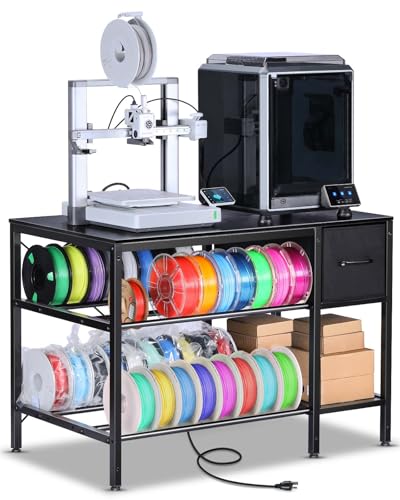
This is the balanced pick for anyone who wants a metal drawer without paying a premium. The 36-inch, three-tier frame holds mid-range FDM printers comfortably, and the bottom shelf doubles as a spool rack. Owners consistently note the powder-coated finish resists fingerprints better than the cheaper alternatives on this list.
- Pro: Metal drawer slides smoothly and holds tools without sagging, unlike fabric-drawer competitors.
- Pro: Three tiers fit a printer, a spool, and a tool tray on a single desk footprint.
- Con: Assembly requires an Allen wrench not included in the box, adding friction on day one.
Skip this if you need dual-printer capacity; the top tier fits only one machine.
2. Anrigeail 3D Printer Stand with Filament Storage
The power hub is the standout feature here. Instead of trailing a surge strip across the floor, you plug the printer and any peripherals directly into the built-in outlets on the frame. For workshop environments where multiple machines run simultaneously, this eliminates cable clutter at the source.
- Pro: Integrated power hub keeps cords off the floor and within arm’s reach.
- Pro: Heavy-duty frame rated well above what a typical resin or FDM printer weighs.
- Con: At $119.99, it carries a modest premium over equally rigid competitors.
Skip this if your printer sits in a corner with a wall outlet within reach; the hub adds cost you might not need.
3. AHOWPD 3D Printer Table with Filament Storage Rack & Drawer Organizer
Designed for smaller rooms where every inch counts, this table uses a vertical rack alongside the drawer to stack spools without consuming floor width. The organizer layout inside the drawer keeps nozzles, build plates, and calibration cards in labeled compartments rather than a jumbled mess.
- Pro: Internal drawer organizer saves time otherwise spent searching for small accessories.
- Pro: Slim profile fits behind doors or in narrow corners other stands cannot enter.
- Con: The vertical spool rack has a limited number of pegs; multi-material setups may need a separate holder.
Skip this if you run four or more filaments on rotation; the rack capacity is modest.
4. Heavy Duty 3D Printer Table with Spool Rack
The dedicated spool rack on this unit is its strongest selling point. Rather than laying filament on a shelf where it can roll, the rack suspends each spool on a horizontal axis, allowing clean unwinding with minimal friction drag on extrusion.
- Pro: Suspended spool rack reduces drag that can cause under-extrusion on long prints.
- Pro: Three-tier design gives clear separation between the printer, filament zone, and tool storage.
- Con: The black finish shows dust more readily than textured or brown alternatives.
Skip this if you print infrequently; the spool rack earns its keep mainly for high-volume users.
5. Bliesosfud 3D Printer Stand with Filament Storage
At $79.99, this is the lowest-priced entry that still offers a genuine spool holder and a workstation layout sized for two printers. Owners report that the frame handles dual FDM machines without noticeable flex, making it a practical choice for farms on a budget.
- Pro: Accommodates two printers side by side on a single stand, uncommon at this price point.
- Pro: Spool holder integrates into the frame rather than relying on add-on brackets.
- Con: Drawer depth is shallower than the ENOXEN models; taller tool boxes may not fit.
Skip this if you need a deep drawer for resin tanks or large spatulas; the storage volume is adequate but not generous.
6. ENOXEN 3D Printer Stand with 2 Fabric Drawers (Black)
The fabric drawers on this model make it the quietest option in the lineup. In shared offices or bedrooms, metal-on-metal rattle from sliding drawers is a genuine annoyance; cloth bins eliminate that noise entirely while still providing accessible storage for small parts and failed prints.
- Pro: Fabric drawers open silently, suitable for quiet workspaces or night-time printing.
- Pro: Lowest price among all ENOXEN variants, making it the entry point to that frame design.
- Con: Fabric bins cannot be locked or fully enclosed, so dust settles inside over long idle periods.
Skip this if you store loose powders, pigments, or small hardware that needs containment; metal drawers are safer for those items.
7. ENOXEN Heavy Duty 3D Printer Stand (Brown)
Functionally identical to the black variant at the same price, the brown finish exists for buyers whose home office furniture uses warm wood tones. The metal drawer, three-tier layout, and 36-inch width remain unchanged. Owner feedback confirms the coating matches its black sibling in durability.
- Pro: Brown finish blends with wooden desks and bookshelves, reducing visual clutter in a shared room.
- Pro: Same rigid metal-frame construction and metal drawer as the top pick, with no structural compromise.
- Con: No functional advantage over the black version; you are paying the same price for aesthetics alone.
Skip this if your workspace already mixes metals and dark tones; the black variant offers identical utility without the color risk.
8. Dual-Zoned 3D Printer Table with AMS System Storage Panel
This table is purpose-built for multi-color workflows. The dedicated AMS storage panel keeps filament hub modules organized and accessible, while the dual-zone layout separates the printer platform from the material-loading station. For users who run color-mixing setups, this eliminates the improvisational cable and tube routing other stands require.
- Pro: AMS panel provides labeled slots that keep filament tubes untangled during color switches.
- Pro: Dual-zone separation prevents the printer from being jostled when loading or unloading spools.
- Con: The specialized panel adds wasted surface area if you never use an AMS or similar multi-material system.
Skip this entirely if you run single-filament prints; the panel consumes space you could use for a wider tool drawer.
Buying Guide
Frame Material and Load Rating
Metal frames dominate this category for good reason. Resin printers weigh 15-25 pounds dry, and FDM machines with heated beds push the same range. A metal leg assembly with cross-bracing distributes that load without the long-term sag that MDF or particleboard exhibits after months of thermal cycling from the printer’s electronics. When comparing stands, look for welded joints rather than bolted corners, as fasteners loosen with vibration over time even with thread-locker applied.
Tier Height and Spool Ergonomics
The distance between the top tier (printer surface) and the middle tier (spool storage) determines whether filament unwinds cleanly or drags across the shelf edge. An ideal gap places the spool center at or slightly above the printer’s filament input port. If the spool sits too low, extrusion friction increases and you may see grinding on direct-drive machines. Three-tier layouts that separate printer, filament, and tools solve this naturally by giving each element its own level.
Drawer Type: Metal versus Fabric
Metal drawers lock out dust and protect sharp tools, but they produce noise on every pull and add cost. Fabric drawers are silent and cheaper but cannot be sealed against airborne particulates. If your workspace is a garage with dust or you store abrasive materials, metal wins. If the stand sits in a bedroom or shared office where quiet matters more, fabric is a reasonable trade-off.
Our Verdict
The top pick is the ENOXEN 3D Printer Stand with Filament Storage (Black) at $109.98. It balances metal construction, a sliding metal drawer, three-tier storage, and a 36-inch footprint that fits most rooms without compromise. The budget pick is the Bliesosfud at $79.99, which covers two printers and a spool holder at a price that undercuts every competitor by at least ten dollars. However, if you run a multi-color AMS setup, the Dual-Zoned table at $104.99 wins outright; no other option on this list provides dedicated hub storage, and the time saved in tube management outweighs the slightly smaller general-purpose drawer.
FAQ
How much weight should a 3D printer table hold?
Look for a frame rated well above your printer’s static weight to account for dynamic loads during high-speed printing. Most FDM and resin machines fall between 15 and 30 pounds, so a stand that does not flex under that load is sufficient for the majority of home setups.
Can I use a regular desk as a 3D printer stand?
A regular desk works mechanically but fails organizationally. Without integrated spool holders and tool drawers, filament rolls across the surface and accessories scatter, which creates a tripping hazard with bowden tubes and increases the chance of knocking the printer out of alignment.
Do I need a stand with a power hub?
Only if your outlet is not within a short cable reach. A built-in hub reduces extension cords and trip hazards in workshop settings but adds cost that is unnecessary in rooms where a wall socket sits directly behind the printer.
How do I stop a metal stand from rattling during printing?
Place self-adhesive foam pads under each printer foot where it contacts the table surface, and tighten all frame bolts with a torque driver rather than hand-tightening. The pads absorb vibration, while properly torqued fasteners prevent the frame joints from developing play over time.