Key takeaways
- Match sweep to square footage: A 52-inch fan handles most rooms up to roughly 400 sq ft. Above that — vaulted living rooms, open-plan spaces — step up to 65 inches. Undersizing is the single most common mistake, and no speed setting fixes it.
- Chase CFM, not blade count: Eight blades look impressive but only help if pitch and motor torque back them up. Look for CFM figures in the listing; anything under 4,000 in a large room will disappoint you regardless of how many blades it has.
- DC motors earn their premium: They pull roughly 60–70% less power than AC equivalents, run noticeably quieter, and give you six speeds instead of three. For a bedroom fan you’ll run all night, that’s the difference between white noise and an annoyance.
- Measure before you pick a downrod: Blades need at least 7 feet of floor clearance and 8–10 inches from the ceiling to breathe. On a standard 8-foot ceiling, use the shortest rod included. On 9 feet or higher, go longer — a fan hugging the ceiling recirculates air instead of pushing it down.
- Verify your junction box is fan-rated: A standard lighting box is not built for a rotating 20-pound load. If you see a plastic box or one that isn’t stamped for fan support, swap it for a braced metal box before you hang anything. Ten dollars now beats drywall repair later.
What's inside
Most ceiling fan shopping goes sideways for the same reason: people buy for looks and hope the airflow sorts itself out. Then the fan goes up, the room still feels stagnant on the third speed, and you’re stuck on a ladder with a box you can’t easily return. Airflow is a measurable thing — CFM, blade pitch, sweep, motor torque — and the fans that actually move air tend to advertise those numbers rather than bury them.
I’ve hung enough of these to know what separates a fan that stirs a room from one that just spins. This guide walks through the specs that predict real air movement, the install details that trip people up (downrod length, box rating, blade clearance), and six fans worth considering in 2026 — from 65-inch eight-blade units for open living rooms to compact 52-inch models that fit a standard bedroom without eating the ceiling.
As an Amazon Associate we earn from qualifying purchases.


How to Choose a/an Air Movement Ceiling Fan (2026)
- Match sweep to square footage: A 52-inch fan handles most rooms up to roughly 400 sq ft. Above that — vaulted living rooms, open-plan spaces — step up to 65 inches. Undersizing is the single most common mistake, and no speed setting fixes it.
- Chase CFM, not blade count: Eight blades look impressive but only help if pitch and motor torque back them up. Look for CFM figures in the listing; anything under 4,000 in a large room will disappoint you regardless of how many blades it has.
- DC motors earn their premium: They pull roughly 60–70% less power than AC equivalents, run noticeably quieter, and give you six speeds instead of three. For a bedroom fan you’ll run all night, that’s the difference between white noise and an annoyance.
- Measure before you pick a downrod: Blades need at least 7 feet of floor clearance and 8–10 inches from the ceiling to breathe. On a standard 8-foot ceiling, use the shortest rod included. On 9 feet or higher, go longer — a fan hugging the ceiling recirculates air instead of pushing it down.
- Verify your junction box is fan-rated: A standard lighting box is not built for a rotating 20-pound load. If you see a plastic box or one that isn’t stamped for fan support, swap it for a braced metal box before you hang anything. Ten dollars now beats drywall repair later.
The Best Air Movement Ceiling Fan (2026)s Reviewed
65″ Farmhouse Ceiling Fan with Dual-Finish Blades
Eight blades on a 65-inch sweep with a quiet DC motor makes this the strongest air mover here for large rooms, and the six-speed range means you can actually use the low settings. The dual-finish blades and textured glass shade read farmhouse without being precious, and both a 6″ and 12″ downrod ship in the box — a nice touch that saves a second order.
Fanbulous 65 Inch Black Ceiling Fan
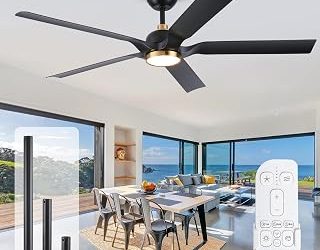
Same 65-inch, eight-blade formula in a cleaner matte black package, with 3CCT lighting and a damp-rated build that works on a covered patio. The 24W LED is bright enough to serve as a room’s primary fixture, which matters if you’re replacing a flush mount rather than adding to existing lighting.
Madera 52in Smart Indoor/Outdoor Ceiling Fan
The distressed koa solid wood blades are the real draw — genuine wood rather than printed MDF, and it shows from the floor. Full 2700K–6000K tuning plus iOS and Android app control puts it ahead on features, though app-controlled fans mean one more thing on your network to troubleshoot.
OPONL 52 Inch Reversible Ceiling Fan
A dependable mid-size pick with six color temperatures, smooth dimming, and reverse for winter downdraft circulation. Genuinely quiet at low speed, which makes it my default recommendation for bedrooms where the fan runs every night.
52 Inch Modern DC Reversible Ceiling Fan
Strong value for the spec sheet: DC motor, 3CCT lighting, reversible rotation, and indoor/outdoor rating at a lower tier than the smart models. If you want efficient airflow without app integration, this covers it.
Frequently Asked Questions
How much airflow do I actually need?
Roughly 4,000–5,000 CFM suits a standard bedroom or office, while open living areas want 6,000 or more. Ceiling height factors in too — taller rooms need more push to move air where people sit.
Are more blades better for air movement?
Not inherently. Blade pitch and motor torque matter more; a well-pitched three-blade fan often outmoves a flat-bladed eight-blade unit. Extra blades mainly reduce noise and wobble, which is why premium quiet fans tend to have them.
Can I install one myself?
If you’re comfortable working at the panel and your box is fan-rated, yes — plan on 60–90 minutes. Kill the breaker, test with a non-contact voltage tester, and have someone steady the motor housing while you wire. Aluminum wiring or no ground means call an electrician.
Which direction should the blades spin?
Counterclockwise in summer to push air down, clockwise on low in winter to pull warm air off the ceiling and circulate it. Every fan here reverses, usually via remote.
Final Thoughts
For large or open rooms, the 65″ Farmhouse Ceiling Fan moves the most air of the group and includes both downrods you might need. The Fanbulous 65 Inch is the pick if you want that same airflow in a modern black finish, and the Madera 52in is worth the premium for its real wood blades and full CCT tuning in mid-size rooms.