Key takeaways
- Match coverage to your real layout: Manufacturer square-footage claims usually assume one air change per hour. For pet dander you want four or five, so divide the advertised coverage by four when you shop. A unit rated for 2,200 sq ft is a genuinely good match for a 500 sq ft living room.
- Insist on a washable pre-filter: Cat hair clogs the outer layer first. A rinseable mesh screen means you’re replacing HEPA cartridges on a normal schedule instead of every eight weeks, which is where the real cost of ownership hides.
- Check the sound floor, not the peak: A 22–27 dB sleep mode is what determines whether the thing stays plugged in. Anything louder than a refrigerator hum gets switched off, and a switched-off purifier filters nothing.
- Look at the cabinet like a woodworker: Weighted bases, tip-over cutoffs, and bite-resistant cord sleeving matter more than app features. Cats knock things over and chew cords; assume yours will.
- Get a real PM2.5 readout: A numeric display tells you whether litter changes, brushing sessions, or the vacuum are your actual dust events. That data changes your cleaning routine more than any filter spec.
What's inside
Anyone who has pulled a felt-like mat of cat fur off a return-air grille knows the problem isn’t just shedding. Cat dander is a protein called Fel d 1, it rides on flakes small enough to stay airborne for hours, and it settles into upholstery, curtains, and the underside of every wood surface in the room. If you build or refinish your own furniture, you already know how much finer dust sticks to a fresh oil finish. Dander behaves the same way, except it never stops being generated.
This guide is written from the workbench-and-tape-measure perspective: what filtration actually does in a real room, how to size a unit for the space you’ve got, and which models earn their spot next to a sofa or under a console table. I’ve focused on machines with washable pre-filters, honest coverage ratings, and cabinets that survive life with an animal that treats every vertical surface as a suggestion.
As an Amazon Associate we earn from qualifying purchases.


How to Choose a/an Air Purifier Cats (2026)
- Match coverage to your real layout: Manufacturer square-footage claims usually assume one air change per hour. For pet dander you want four or five, so divide the advertised coverage by four when you shop. A unit rated for 2,200 sq ft is a genuinely good match for a 500 sq ft living room.
- Insist on a washable pre-filter: Cat hair clogs the outer layer first. A rinseable mesh screen means you’re replacing HEPA cartridges on a normal schedule instead of every eight weeks, which is where the real cost of ownership hides.
- Check the sound floor, not the peak: A 22–27 dB sleep mode is what determines whether the thing stays plugged in. Anything louder than a refrigerator hum gets switched off, and a switched-off purifier filters nothing.
- Look at the cabinet like a woodworker: Weighted bases, tip-over cutoffs, and bite-resistant cord sleeving matter more than app features. Cats knock things over and chew cords; assume yours will.
- Get a real PM2.5 readout: A numeric display tells you whether litter changes, brushing sessions, or the vacuum are your actual dust events. That data changes your cleaning routine more than any filter spec.
The Best Air Purifier Cats (2026)s Reviewed
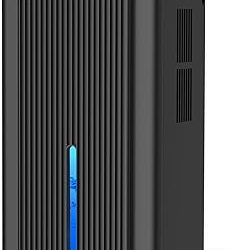
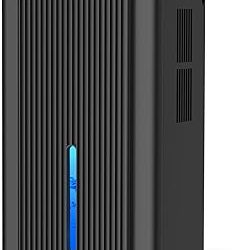
MOOKA PR1 Large Room Purifier
The 2,200 sq ft rating gives you enough headroom to run this on a low, quiet setting in a mid-sized room and still hit multiple air changes per hour. The washable filter and onboard PM2.5 sensor make it a sensible workhorse for open-plan spaces where the cats roam freely.
WISESKY 5-Stage Cat Air Purifier
This is the one built with cats specifically in mind: 360-degree intake pulls dander from every direction rather than a single face, and the bite-resistant cord plus tip-over cutoff address the two failure modes pet owners actually experience. The five-stage stack handles litter odor better than most single-carbon designs.
LEVOIT Vital 100S-P
My default recommendation for bedrooms and dorm rooms. AHAM-verified coverage up to 1,073 sq ft means the rating is independently tested rather than marketing math, and the washable pre-filter keeps long-term filter costs reasonable.
LEVOIT Vital 200S-P
The bigger sibling, rated to 1,875 sq ft and running at 27 dB in sleep mode, which is quiet enough to sit beside a nightstand. The air quality monitor and auto mode mean it throttles up during peak shedding and settles down overnight without intervention.
P358 Double-Sided H13 HEPA Purifier
Two filter faces roughly double the media surface area, which slows clogging in heavy-shed households and lets the fan work less hard for the same output. At 2,500 sq ft of rated coverage it’s a strong pick for connected living and dining spaces.
Frequently Asked Questions
Will an air purifier actually reduce cat allergies?
It reduces airborne Fel d 1, which helps meaningfully, but dander also settles onto fabric and reintroduces itself when disturbed. Pair filtration with washable slipcovers and regular vacuuming for the real improvement.
Where should I place the unit?
Keep at least a foot of clearance on the intake side and avoid tucking it behind a sofa arm or into a cabinet nook. Near a favorite napping spot or the litter area gives you the fastest capture.
How often do filters need replacing?
Rinse the pre-filter monthly and expect six to twelve months from the HEPA layer depending on shedding load. A visible grey cast across the pleats is your cue.
Do I need carbon filtration for litter odor?
Yes. HEPA media captures particles, not gases, so odor control comes entirely from the activated carbon stage. Multi-stage designs like the WISESKY handle this better than basic two-layer units.
Final Thoughts
For most households the LEVOIT Vital 200S-P hits the best balance of verified coverage, genuine quiet operation, and sane filter costs. If your cats are hard on furniture and cords, the WISESKY earns the premium for its 360-degree intake and protective build, while the MOOKA PR1 is the value choice for large open rooms where you just want maximum airflow over square footage.