Key takeaways
- Carbon mass over carbon coating: Odor molecules are gases, and HEPA media does not trap gases. Look for a genuine granular or pelletized carbon layer with some depth to it. A thin carbon-sprayed mesh will fade within weeks in a litter room.
- Match CADR to your actual room, then oversize: A unit rated for 1,000+ sq ft running on low in a 150 sq ft space beats a small unit screaming on high. You get more air changes per hour, less noise, and longer filter life.
- Washable pre-filter: Litter dust and fur will clog the first stage fast. A rinsable mesh you can knock out over a trash can every couple of weeks keeps static pressure low and protects the carbon behind it.
- Skip continuous ozone: Ozone reacts with odors, but it also irritates feline airways, which are far more sensitive than ours. If you buy an ozone-capable unit, run it only in an empty, closed room and air the space out before cats return.
- Placement and intake geometry: A 360-degree intake works best in open floor space; a rear-intake unit belongs against a wall near the box. Keep 12 inches of clearance and put the machine on the downwind side of your doorway airflow.
What's inside
Cat litter smell is a ventilation problem disguised as a cleaning problem. You can scoop twice a day, swap to a clumping crystal blend, even build a plywood cabinet enclosure with a cutout door, and that ammonia edge still finds its way into the hallway. The reason is simple: ammonia and mercaptans off-gas the moment urine hits substrate, and they diffuse faster than most rooms can flush themselves. A purifier that pulls air across activated carbon before it drifts into the rest of the house is the actual fix, and where you place it matters as much as what you buy.
I’ve run purifiers next to a top-entry box in a 140 sq ft laundry room and beside an open pan in a 300 sq ft den, and the difference between “works” and “expensive white noise” came down to carbon volume, real airflow, and whether the pre-filter can be rinsed instead of replaced. Below are the units worth your money in 2026, plus the specs I check before anything gets a spot on my shelf and the tweaks that squeeze more out of whatever you already own.
As an Amazon Associate we earn from qualifying purchases.


🛒 Best Price Today on Amazon
Prime members get fast, free shipping on everything above, plus member-only deals. New members get a 30-day free trial — cancel anytime.
How to Choose a Air Purifier For Cat Litter Smell (2026)
- Carbon mass over carbon coating: Odor molecules are gases, and HEPA media does not trap gases. Look for a genuine granular or pelletized carbon layer with some depth to it. A thin carbon-sprayed mesh will fade within weeks in a litter room.
- Match CADR to your actual room, then oversize: A unit rated for 1,000+ sq ft running on low in a 150 sq ft space beats a small unit screaming on high. You get more air changes per hour, less noise, and longer filter life.
- Washable pre-filter: Litter dust and fur will clog the first stage fast. A rinsable mesh you can knock out over a trash can every couple of weeks keeps static pressure low and protects the carbon behind it.
- Skip continuous ozone: Ozone reacts with odors, but it also irritates feline airways, which are far more sensitive than ours. If you buy an ozone-capable unit, run it only in an empty, closed room and air the space out before cats return.
- Placement and intake geometry: A 360-degree intake works best in open floor space; a rear-intake unit belongs against a wall near the box. Keep 12 inches of clearance and put the machine on the downwind side of your doorway airflow.
The Best Air Purifier For Cat Litter Smell (2026)s Reviewed
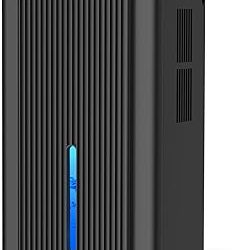
LEVOIT Vital 100S-P
The most reliable all-rounder here, with a genuinely useful washable pre-filter and a wide, low-mounted intake that suits floor-level litter areas. Coverage up to 1,073 sq ft means it loafs along on low in a bathroom or utility room, which is exactly how you want it running 24/7.
KNKA APH4000
Strongest airflow of the group at up to 1,695 sq ft per hour, with an AQI readout that makes it easy to confirm your enclosure mods are actually working. Pet mode plus the rinsable pre-filter make this the one I’d pick for a multi-cat room or an open-plan basement.
AIRROMI A2005
The 360-degree intake is the real advantage: drop it in the middle of a small room and it pulls from every direction rather than fighting a wall. Aimed squarely at litter and pet odor, though I’d leave the scent pad empty since masking fragrance just layers on top of ammonia.
Ozone & Negative Ion Deodorizer with Sensor Monitor
A targeted tool rather than a whole-room purifier, useful for shocking a closed litter closet between deep cleans. The sensor monitoring is a genuine safety feature, but treat it as a periodic reset and keep pets out while it cycles.
Plug-In Negative Ion Deodorizers (3-Pack)
Filterless ionizers that sit in the outlet behind the box and cost almost nothing to run. They won’t replace a HEPA-and-carbon machine, but as satellites in a hall closet or under a cabinet enclosure they take the sharp edge off between scoops.
Frequently Asked Questions
Does HEPA filtration remove litter box odor?
Not on its own. HEPA captures dander and litter dust down to 0.3 microns, but ammonia is a gas that passes straight through. Odor control comes from the activated carbon stage, so verify the unit has one before you buy.
How close to the litter box should it sit?
Two to four feet away, positioned between the box and the doorway. Any closer and you’ll pull litter dust straight into the pre-filter; any farther and odors escape the room before capture.
Are ionizers safe around cats?
Low-output negative ion generators are generally fine in ventilated spaces. Ozone-producing modes are not, since cats have proportionally larger lung surface area relative to body mass and no way to leave the room.
How often do carbon filters need replacing?
In a litter room, expect three to six months rather than the twelve months on the box. When you stop noticing a difference within an hour of scooping, the carbon is saturated.
Final Thoughts
For most homes, the LEVOIT Vital 100S-P is the smart default: quiet, rinsable pre-filter, and enough coverage to run gently instead of loudly. Step up to the KNKA APH4000 if you have multiple cats, a large open room, or want the AQI display to validate your setup, and consider the AIRROMI A2005 when you can place a 360-degree intake in open floor space near the box. Pair any of them with a sealed enclosure and a rinse-every-two-weeks habit, and litter smell stops being something you manage and starts being something you forget about.